And Things Continue to Go Boom!

“Listen up – there’s no war that will end all wars.”
― Haruki Murakami, Kafka on the Shore

The first war in recorded history took place in Fertile Crescent in c. 2700 BCE between Sumer and Elam, two city-states in what was known as Mesopotamia. There is prehistoric evidence of earlier wars, but writing had not been invented prior to the invention of cuneiform so there is no record.  For five thousand years of recorded history, humans have been consistently good at killing each other and creating better ways of killing each other. Earlier wars were fought over resources, goods, or land. Throw in religion and ideology and one sees little has changed.
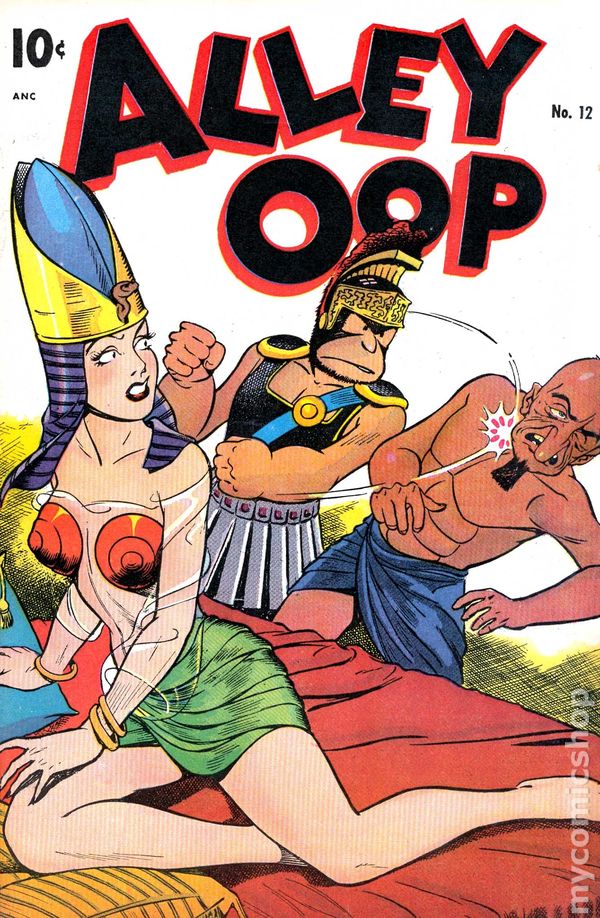
Somehow a cave man battles an Egyptian priest for the hand of a fair maiden. Alley Oop, the comic strip was founded in 1932.

From sticks and stones, to spears and swords, to sling shots to the invention of gunpowder, muskets, and cannon, galore. To Minié balls and rifled single shot rifles, to rapid fire weapons beginning with the Gatling gun and ending with…it hasn’t.

Flying machines dropping hellfire and brimstone on innocents, to the latest ultimate weapon, nuclear bombs delivered by ICBMs or cruise missiles. Every generation has its ultimate weapon. I am sure there is a new one just beyond the horizon. Setting our phasers to stun is not an option.

“I know not with what weapons World War III will be fought, but World War IV will be fought with sticks and stones.”
― Albert Einstein

Einstein’s quote recalled the movie “On the Beach” and the novel it was based upon, Nevil Shute’s Cold War, end of the world drama published in 1957. It had it all. Love, hate, stalwart heroes, brave and beautiful heroines, gallows humor, and the death of all mankind. There was no one left to use the sticks and stones. Only the cockroaches armed themselves.

Cover of the Shute novel

I believe a better quote might be, if in fact, there is anyone left….

“War does not determine who is right — only who is left.”
― Anonymous

Gahan Wilson ~ artist | Playboy ~ publisher

The Fifties and Sixties were rife with fear of instant incineration or an agonizing death from radiation sickness. To say the Cold War influenced my outlook on life would be like saying that the Grand Canyon was a hole of middlin’ size.

1950s/60s Bomb Shelter

Duck and cover drills, “In case of nuclear attack” alerts, nuclear escape routes, advertisements for fallout shelters, movies like “Fall-Safe” or the later, “The Day After”, and books like “On the Beach” had profound effects. And who could forget the ’62 Cuban Missile Crisis and a glut of “brush fire” wars or policing actions. I worried about “mutually assured destruction” and searched for a red star every time a large aircraft flew over my head.
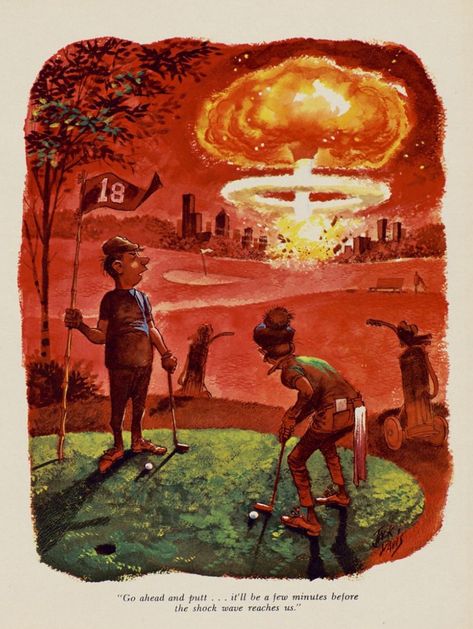
Jim Davis Art. Also, published in Playboy The caption reads, “Go ahead and putt…it will be a few minutes before the shockwave gets here.” Golfers….

I was a part of a generation of school-aged kids who were sold the bill of goods that sitting under our desks with a book over our heads would somehow save us from a nuclear fireball and that it was “better to be dead than red.” Our parents and teachers swallowed the lies too.  Civics was more propaganda than learning how our government was supposed to work. Despite the movie “Dr. Strangelove” I never learned to stop worrying and love the bomb and found other reasons to distrust world leaders.

Peter Sellers as Stanley Kubrick’s Dr. Strangelove

As I read the latest news from the Ukraine, watched all the pundits telling me what we should do with Russia, especially those on social media who traded their “contagious disease” credentials for “international relations” ones. Fielding nuclear threats from Russia and threats de jour from Communist China, North Korea, or Iran, I realize that history is not only repeating itself we also maybe writing its final chapters.

Rodney King’s lament rings in my head, “Can’t we all just get along?” We haven’t for any length of time in our recorded history. Why would you think we would suddenly change?

I don’t believe that the world is anymore broken than it once was. It became broken when the first tribe picked up sticks and stones and rushed to war against another tribe. The only change is our weapons are no longer sticks and stones. Lest I forget, as I listen to the Trumps, Putins, Xi Jinpings, The Ayatollah, Jong-uns, and others, it is our voices that might be the most dangerous. Words matter despite what the old saying might tell us.

The motivations are the same. Land, safety, ideology, and religion. Water will soon be a motivation if it is not already. With the world’s vast natural resources, people starve, die of thirst, die of disease because we believe it is more important to possess than to share. We would rather allow food to rot than give it away. We would rather go to war than be benefactors. Too many national leaders have the attitude of a cuckolded lover, “If I can’t have it, no one else will.”

To the politicians of the world, beware of what you wish for. We are in dangerous times, and I don’t believe duck and cover drills, or a turtle named Bert can save us.

Source: http://www.flickr.com / x-ray_delta_one

I guess I would be remiss if I didn’t add one YouTube Video. It is from another era but quite real for millions of us.

Edwin Starr’s War.

***

Don Miller normally writes on more uplifting subjects. His author’s page may be found at https://www.amazon.com/Don-Miller/e/B018IT38GM?fbclid=IwAR1U1r59lqC_LpyqJ_duYRx-g4WH71O3bSLVbF9ql_4MFz_Pq-oy13IWkuc

His latest is “Pig Trails and Rabbit Holes”, more musings from a slightly insane Southerner.

Spinnin’ Plates…?

“Metaphors have a way of holding the most truth in the least space.
― Orson Scott Card, Alvin Journeyman

I have a memory of speeding us home from MYF to claim my front row seat. The seat was in our living room, in front of a black and white RCA TV. Ed Sullivan was coming on and could not be missed. Every Sunday evening at eight we expected, “A really big shew!” The night of my remembrance was The Beatles, but I remember many other acts with dimming clarity. Some more than others and some that have become metaphors in my dimming brain.

Ed Sullivan

My memory was triggered by another memory, which was triggered by a conversation. A simple comment I made about the complexities of life. A comparison to an incomplete story, incomplete because the story had too many moving parts. Too many spinning plates wobbling as I try to bring my story to its conclusion.

From the conversation a rabbit hole opened, beckoning me to fall in and I obliged it. Slide on over Alice, I’ve come to join you. Set a place for me at your tea party preferably next to the Mad Hatter. We have much in common, especially our insanity.

The memory of Ed Sullivan led me to the memory of a tuxedo clad man with a bad haircut running hither and yon attempting to keep bowls spinning on dowls and plates spinning on the table the dowls sat on. As their spin began to slow, the plates or bowls would begin to wobble. The tuxedo clad man would run first to one and then to another while carrying a tray with glasses, eggs, and cutlery that he would perform ‘amazing’ tricks with while keeping the bowls from crashing to the floor.

The tuxedo clad man was Erich Brenn. His act was pure circus, but it reminded me of the circus that life has become for so many. Spinning plates have become a metaphor for life.

I’m retired. Life doesn’t get much simpler. Life is so simple my biggest struggle is to remember what day of the week it is or what time of day it might be. As simple as it is, I still remember and long for simpler times. What about those who now find themselves spinning plates in the Twenty-First Century?

Both my parents worked in the Twentieth Century. Shift work in a cotton mill weave room. Sometimes my dad would ‘work over’. An extra four hours here and there. Even working over he was always home in time for supper, the evening meal in the South. They owned their home, made payments on a new car every four or five years, and there was always food on the table. I never wanted for anything that was needed. Admittedly there were disagreements over what was ‘needed’.

They had time to have a life outside of the heat, humidity, and lint of a weave room. The job ended with the closing of the huge, sliding doors that separated ‘in there’ from the ‘out there’. They didn’t carry the job home with them…at least in their heads. They might have been bone weary, but they weren’t mind numbed. They didn’t have to work two or three jobs to make ends meet. They had money to put away for a ‘rainy’ day.

They had time, an irreplaceable commodity, to smell the roses. Time to do chores, work a crossword puzzle, paint by numbers, go to choir practice, or host the Canasta Club or just watch TV. Time to be parents. Time to do nothing if they wanted. What happened?

The modern world happened. Life morphed into something that would not be recognized in the Fifties, Sixties, or Seventies. Life has reverted to the early days of the Industrial Revolution…to the Great Depression, long hours as pay hasn’t kept up with cost. The Greatest Generation should be shaking their heads in disbelief. Life now resembles Erich Brenn’s spinning plate novelty act.

Today, many families of four can’t survive on one salary, are stretched to survive on two, can’t own a home, are forced to keep a ten-year-old vehicle running for five more years. In many cases, they are working multiple jobs and still making decisions on which bills to pay, which meds to take, living from paycheck to paycheck, one calamity away from being thrown to the curb. One disaster from living in their car or a cardboard box. Spinning plates.

This was before Covid, before runaway inflation, before soaring gas prices, before more rumors of war in the Ukraine turned out not to be rumors. Life is hard for this newest generation and looks worse for the next. Forget saving for a better life, saving for a house or college for their kids. It’s hard to save when catsup soup is the soup de jure.

I wonder how many more plates are being spun…or shattering as they fall to the floor.

I worry about my daughter, son-in-law, and grandbabies. They are lucky and I hope they realize it. I’m sure some days they wonder too. I’m sure they must make tough decisions. They both work, have good jobs, and both are home for supper. Sometimes my electrician son-in-law works side jobs but most days he’s doing taxi service to one practice or another. They sound much like my parents.

They are great parents. They amaze me. They put their children first…sometimes to their own detriment. I worry they are wearing themselves out sprinting in the rat race of life. No chance to slow down and smell the roses. Spinning those plates. They can call on family members when the schedule spins out of control, or when life adds a plate to the table. So far, no plates or bowls have come crashing down. Still, I worry.

Many young parents don’t have the support to soften the blow of falling bowls and I am sorrowful. Many grandparents who were once the support system still must work, still spinning plates themselves.

Spinning plates shouldn’t be a metaphor for life…yet it is. It is a metaphor for the fear many experience. One broken plate from going bust.

My parents had a dream their ‘baby boys’ would have a better life than they did. A better life was the same dream their parents had and a dream I had for mine. For some that dream was realized. For others, the deck was stacked against them from the beginning and has become dog-eared over time.

We keep being told that the American Dream is still alive. All you must do is work hard. I think that is a lie and for the coming generations that dream may be a nightmare.

***

As madly as we spin plates, I can’t help but point out that at least I’m not having to manufacture and use Molatov cocktails, and my grandchildren are not having their blood type sewn onto their clothing by their parents. I’m not living in a makeshift bomb shelter with a pet in my lap. To my Ukrainian friends, known and unknown, Любов і удача. Love and good luck.

Image is from https://wordwranglers.blogspot.com/2016/02/spinning-plates-and-shiny-objects.html

Don Miller’s author’s page may be found at https://www.amazon.com/Don-Miller/e/B018IT38GM?fbclid=IwAR03_CNDnl9zP1PUcuPq3gRcw2MxMBnxKv6-Xb07S_k4BEx3dP81Yk912HY

Don Miller’s newest offering is “Pig Trails and Rabbit Holes”

Why?

“War isn’t Hell. War is war, and Hell is Hell. And of the two, war is a lot worse…There are no innocent bystanders in Hell. War is chock full of them – little kids, cripples, old ladies. In fact, except for some of the brass, almost everybody involved is an innocent bystander”.  – Hawkeye from the TV program MASH

I’m having a challenging time letting God off the hook. I know according to the Bible the root cause of war and suffering is the “man’s inhumanity to man” thing but according to the Bible, God created “the heavens and the earth” along with puppy dogs and pink flamingos. He also gave us the free will to eviscerate and dismember our enemies and in the Old Testament seems content to do it himself. Doesn’t he have to take some credit for the pain and suffering?

Despite the “Dude” whispering for me to “abide” I asked my deity that very question this morning. I was greeted as always with silence.

I have this thing I do. Wake up, pee, breakfast, and then head outside and focus on some heavenly body. It was foggy so I looked in the general direction of Venus and prayed.  I gave thanks for my many blessings, enumerating some. I asked for blessings for family and friends, and asked forgiveness for “sins real and imagined, past and future”. It is much easier than enumerating them all.  

From there I have a one-sided conversation about whatever is bothering me. This morning, war was bothering me along with its dose of pain and suffering. I couldn’t help but ask, “Why?”

Silence. Neither beast nor fowl interrupted my train of thought. Even the calliope of swamp frogs from the night before had fallen silent. I paused to give thanks the silence wasn’t being interrupted by bombs, artillery shells, cruise missiles, and nuclear weapons. I was thankful the silence had not been interrupted by pain and suffering.

I know “the wages of sin” and all. According to a video game, Diablo, “the wage of sin is war.” It seems men like Vladimir, or Adolf, or Joseph, or Pol can escape their wars and must wait for eternal damnation to reap their just wages.  Even little Adolf sent himself to his just rewards. Little Suzy Q on the other hand gets her fingernails pulled out or incinerated from hell fire reigned from above by human demons in flying machines.

Did we learn from you, God? I’m thinking the Sodom and Gomorrah thing and the number of battles waged in your name and by your command.

I do know it is a human failing but again I ask “Why?” Is this just because Adan accepted the apple from Eve? Does this have to do with our original sin…” St. Augustine where are you when I need you?” You are as silent as God but then you are dead.

While I’m rambling, how many wars have been fought over “my god is better than your god” and how many have died thinking that “God is on my side?”  God, it seems like you attract war and suffering, and my grandmother told me that “you will be judged by the company you keep”. An argument might be waged that you could be a warmonger by the company you keep. Even in Exodus it says, “The LORD is a man of war: the LORD is his name.”

More whys? Why does the Old Testament God seem so hateful compared to the New Testament God? Why does he annihilate rather than use diplomacy? I’m certainly not a theologian so I consulted Google and picked several well-known theologians. I read your words Billy Graham. Well, that wasn’t productive. Context? Wrath and vengeance taken out of context. I don’t know. If it looks like a duck….

Anyway, I’m not going to bore you with anymore whys. I’ll leave that with you and your God, god, or gods. Maybe they will answer your “Whys”. Questions but no answers and the silence is deafening.

Don Miller’s latest literary masterpiece, “Pig Trails and Rabbit Holes”, may be purchased in paperback or downloaded at https://www.amazon.com/gp/product/B09GNZFXFT/ref=dbs_a_def_rwt_bibl_vppi_i1

RADIOACTIVE DUST

I published this in 2017 but except for some leadership changes it is still, unfortunately, timely. Words like mutually assured destruction are ringing in my head.

cigarman501's avatarRavings of a Mad Southerner

It was October 21, 1962. I’m quite sure of the date. The twelve-year-old me listened intently to the adults gathered around my mother’s formal dining room table awaiting Sunday dinner. That would-be lunch in more civilized circles. Twelve-year-old Donnie was doing as I had been told repeatedly, “children are to be seen, not heard.” Despite being a pre-teen, I was unsure of my standing and decided not to chance a thrashing with a “keen hickory” at the hands of my grandmother.

The news around the table was terrifying to the pre-teen me. Nuclear weapons right down the road in Cuba. Just ninety miles from the good old US of A. An uncle, a member of the Navy reserves, was afraid he was going to be called up to help blockade the island that had become a bristling launching pad of fire and radioactive ruin. A cousin, an army reservist and…

View original post 492 more words

Valentine’s Day Grinch

“On Valentine’s Day, the Spirit Club plastered the school with red streamers and pink balloons and red and pink hearts. It looked like Clifford the Big Red Dog ate a flock of flamingoes and then barfed his guts up.” ― Carolyn Mackler, Vegan, Virgin, Valentine

It seems, every Valentine’s Day is my own version of The St. Valentine’s Day Massacre. Once again, I have shot myself in the foot but at least my bride hasn’t beheaded me like the original St. Valentine. I’m sure she has considered it.

When it comes to Valentine’s Day, I have the Midas touch in reverse. Everything I touch turns to poop.

My first memory of a Valentine’s Day celebration was a preteen party in the early 1960s. The Church sponsored affair was supposed to be a dress up, Sunday best kind of gala. We were Methodist so dancing would be allowed, and I prayed my two left feet would somehow transform themselves.

The day before, the world’s largest zit appeared in the middle of my forehead.  It didn’t matter. I’m sure the dance was great, but I have no memories because I didn’t get to go. My anxiety over my “first date” was so great I threw up and was kept home. It might have been something else but Valentine’s Day has been a downhill drag since.

The dance worked out well for my date. A friend took advantage of the situation, and they became a couple. This weird Cupid moment might have been the high point of my attempts at being a romantic Valentine.

Can you imagine, on the average, fifty-eight billion pounds or two point two billion dollars’ worth of chocolate will be sold the week leading up to Valentine’s Day. Over two-hundred and fifty million roses are produced just for Valentine’s Day. That is two point three billion in flower sales. A whopping six point two billion dollars are spent on jewelry.

Love-struck Americans dole out almost twenty-four billion dollars on Valentine’s Day with men spending twice the average. Men will spend on average, one-hundred and seventy dollars to prove their undying love. Women? Half of that.

I’ve all but given up on making Valentine’s Day a special event. Attempts at romantic dinners have ended with food poisoning. I’ve tried poetry, “Roses are red, violets are blue, pizza is hot, and so are you.” I’ve tried to create artistic and rustic birdhouses with tin hearts or a couple holding hands. Most fell apart as quickly as my other attempts at romantic expression. I’m waiting for a masked psychopath to show up to carve out my heart in a real-life Valentine’s slasher movie. Blood splatter replacing rose petals scattered on the bedroom floor.

Speaking of bloody, how did the violent death of a Catholic saint become a celebration of love anyway? There are three suggested stories about three different Saint Valentines. What do they have in common? Martyrdom. Violent death. Two of the accounts involve beheading. Somehow beheading seems apropos. How many of us have lost our heads over someone we shouldn’t have?  

The seeds of the holiday we know as Valentine’s Day were planted in Lupercalia, an ancient Roman festival honoring the Roman goddess of marriage some twenty-six hundred years ago. It was a pagan festival and involved excesses we have come to expect from such a ritual.

Lupercalia was a sexually charged and violent rite, involving the sacrifice of dogs and male goats as a sign of virility. Priests would cover themselves in milk and the blood of their sacrifices and run naked through the streets whipping women with strips of goat hide cut from the bodies of their sacrifices. Sounds like fun. Getting whipped would allow the barren to become pregnant and women lined up for the opportunity.

Later in the day, men would pick women’s names from a jar in hopes that they would form a romantic bond. In my mind I read that differently than it was written. I mentally visualize a Seventies wife swapping party with car keys drawn from a candy dish. I have no firsthand knowledge, I read a lot.

All this changes around 500 A.D. with the rise of Christianity. Pope Gelasius replaced the pagan rite by instituting the Feast of Saint Valentine on February 14. Christians feeling the need to end all the fun of naked men running around whipping women.

There are several stories involving Christians named Valentine who were executed by the Roman Emperor Claudius II about two hundred years previous, but the most famous was a third-century martyr imprisoned for secretly marrying Christian couples and helping persecuted believers. This Valentine was reportedly executed on Feb. 14, 289 A.D.

As fiction became more interesting than fact, the future saint supposedly restored sight to his jailer’s blind daughter. Later, the legend grew even more to include a letter he gave the girl before his execution, reportedly signed “Your Valentine.”

That still doesn’t explain cards, candy, flowers, and jewelry but a historical change in Nineteenth Century America does. Prior to this time most marriages were economic rather than romantic despite what romantic writers would have us believe. Even the poor founded their marriages more as economic alliances than romantic love. “Two can live as cheaply as one,” I was told once. Someone lied to me.

This changed in the mid-1800s from economics to romance, or at least combined the two. It also triggered an increase in the giving of tokens of love and it has snowballed from there.

I thought I had nailed it this year but once again reality has reared its ugly head. A sweet token of my love involving puppy dogs I saw online. I immediately knew it would be perfect and I ordered it a month ago. Something cute to let her know of my undying love. It won’t be here until the end of February. Typical. Why would I expect any difference? The supply chain issues have bit me upon my chubby, pink, cherubic butt. “Cupid, draw back your bow….”

Don Miller’s author page may be accessed at https://www.amazon.com/Don-Miller/e/B018IT38GM?fbclid=IwAR3yEfoldEBWs3ZbA6bCCQc13npcCrXWdZl0pVYvdbsRMQ86SppPZQVl3SE

In Praise of Mediocrity

“Some men are born mediocre, some men achieve mediocrity, and some men have mediocrity trust upon them.” ― Joseph Heller, Catch-22

“And sometimes you have to work really hard just to be mediocre.” -Don Miller

I was reading an article about specialization in sports and the arts…wait, not “and the arts.” I believe a well-turned 4-6-3 or a 3-6-1 double play is just as artistic as Anna Pavlova performing “The Dying Swan”. I don’t think Ottis Anderson’s MVP performance in Super Bowl XXV was any less artful than Whitney Houston’s rendition of the National Anthem before it. Is Yo-Yo Ma playing his cello more of an artist than Ozzie Smith vacuuming ground balls around second base? There is art in most athletic endeavors and many long, hard hours of preparation in the ‘finer’ arts.

Okay, back on point. I was reading an article about a school district in Oklahoma that forbade coaches from limiting their athletes in artistic activities and vice versa.  I’m sorry that a school district must put a rule like that into place, but the fact is, many parents, coaches, band, and chorus directors want specialization. They see specialization as a path to excellence…and lucrative scholarships or professional careers.

The article also took me down one of my rabbit holes as I thought of my own challenges as a child and teenager. I was a “want-to-be” great. A combination of Mickey Mantle, Bart Starr, Otis Redding, and Cannonball Adderley with a bit of Ginger Baker thrown in for good measure. A power hitting quarterback who could sing and play the saxophone and drums “just like ringin’ a bell.” That’s what I wanted to be.

The fact? I was the GOAT of mediocrity. I might have been the world’s worst athlete, singer, drummer, and saxophonist. But I got to do them all, along with being a part of the soil and cattle judging teams and a myriad of other endeavors I fell short of. There was little excellence in my endeavors, and some might say that I tried to do too much. Maybe. But with all the specialization in the world, no matter how hard I worked, no matter how many singing lessons or drumming I might have taken, I was never going to be Pavarotti or Buddy Rich.

I was terrible and I’m not being hard on myself. I may have gone to the only school in the state that would allow me on a football or a baseball field as a player. The same goes for the other endeavors. I CAN carry a tune…albeit it is over a limited range, and most of my tones come through my nose.

I went to a small school. For most of my “skoolin’”, twelve grades were housed in one, small building. There were twenty-one in my graduating class. Ten males and eleven females. I got to try anything I wanted just by walking through a door. “Hey, there is a body. Can he catch? Put him at first base. Can’t hit his way out of a paper bag? Doesn’t matter, he can catch a thrown ball.”

I was one of those kids who strove for greatness but only achieved lower levels of mediocrity. A kid of many suspect talents who couldn’t come close to mastering any. But I so wanted to. How many hours did I waste bouncing the ball off the barn wall attempting to become a better fielder? How many hours did I waste running through arpeggios sounding like I was strangling a duck? Not one. It took those hours just to become mediocre. I worked hard just to be bad and enjoyed every minute.

My own childhood experiences gave me a soft place in my heart for little Johnny or Jill who couldn’t play dead in a graveyard but wanted too so badly. I felt much joy in my heart when the little kid who was as short as he was wide came back out a year after being cut to make the team and went on to a college career. He had also gained about a foot and a half in height. I always had a hole in my heart for the kid I had to cut who I never saw again.

When I first began my coaching career I remember a little boy, thin shouldered with a long pencil neck. Black hornrims perched on his nose, a prominent Adam’s apple bobbing as he nervously tried to explain he wanted to come out for the JV baseball team, but that he had violin lessons on Mondays.

My response was, “You need to make a choice.” I never saw him again. Fifty years later I wonder why I didn’t make the allowances I made in later years. He might have been an all-star second baseman. I can still see the dejection on his face and I’m ashamed of myself.

I know, there is an age you must make a choice and certain sports one might want to stay away from if you are a child prodigy or artistic pursuits if an outstanding athlete. A trumpet player might not want to continue with a boxing hobby. A fat lip might limit his ability to hit high notes. A violin virtuoso might want to stay away from full contact karate. An elite dancer might want to avoid soccer…or not. Do you enjoy boxing, karate, or soccer? Do what you enjoy! Even if you are bad at it.

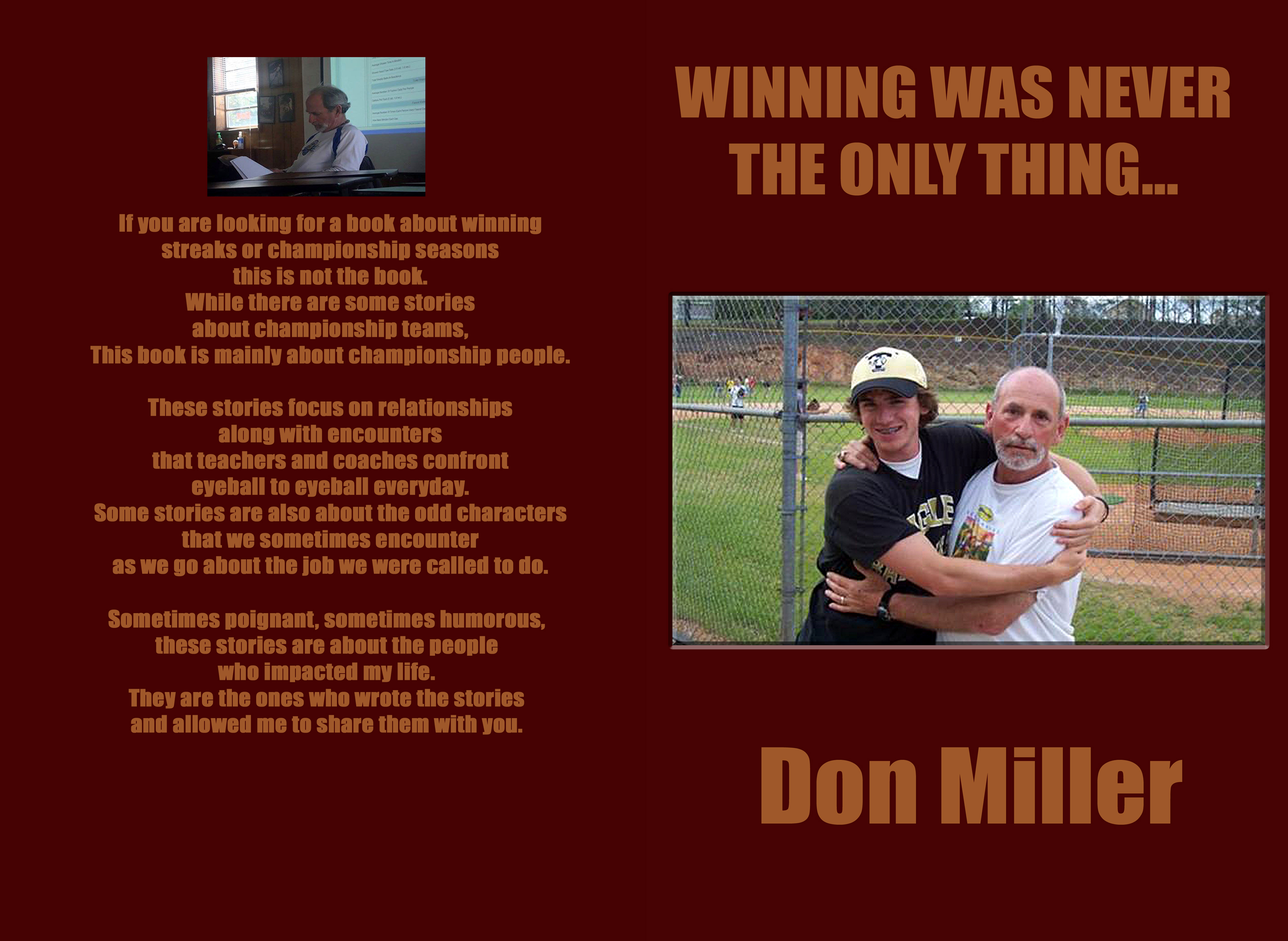
I did make allowances later in my coaching career. Sometimes those allowances came at a cost but not for the player…and eventually not for me.  I authored a book entitled “Winning Was Never the Only Thing….” for a reason. At some point, skillful players or artists will have to make a choice but why not put it off as long as possible?

Let them play their sports, sing, dance, or play the flute. The worst thing that can happen is they might be mediocre at something or at everything. The worst thing is they might enjoy it. It isn’t a fate worse than death if the best you can be is bad. It is about effort. Many of us will chase excellence all our lives and never catch it. Enjoy the chase, enjoy the effort.

Don Miller is a retired teacher and coach of more than forty years. “Winning Was Never the Only Thing…” was his first attempt at writing and reflects on those forty plus years. The book, along with other offerings, may be purchased or downloaded at https://www.amazon.com/Don-Miller/e/B018IT38GM?fbclid=IwAR0x-AF-AmUA2Q5PdIf_ZihApxSfVRNWFadCJw__8hTmz03dxr9nPL6W2WE

Sittin’ and Smilin’, Thinkin’ ’bout That Dock on the Bay.

I ran across a version of Otis Redding’s “Dock of the Bay” at a time when I needed it the most. I didn’t realize I needed it but sometimes life gives you little gifts to smile about.

On a site, Playing for Change, musicians from all over the world came together to lend their voices and musical talents just to help my spirits rise and give me a chance to have a productive day even if it is just sittin’ and smilin’.

Roger Ridley and Grampa Elliott Playing For Change

This is my dark time of the year and not because it is still the predawn hours of the day. Depression and anxiety cloud my thoughts despite the clear morning, stars twinkling over my head. The days are lengthening but it will take time for the early morning sunlight to wash my depression away. I’m struggling for motivation to write, motivation to get out of my chair, and I can’t keep my train of thought on its tracks. My mind is like Ricochet Rabbit, bouncing from place to place without settling.

I am downright morose until I find joy in a simple song.  A song about sitting in the sunlight…an ode to sunlight. I can hear the Redding’s whistle in my head, and it makes me smile, whistling away my dark clouds. Music does that sometimes…most times.

Redding was dead by the time “Sittin’ on the Dock of the Bay” hit number one. He recorded it just three days before a plane crash took his life on December 10, 1967. He was twenty-six and left behind a wife and four children. I remember lying in my twin bed, the transistor radio struggling to pick up late night WLS in distant Chicago when the news came through. Otis Redding killed in a plane crash along with four members of the group The Bar Kays. My own “day the music died.”

The song itself is melancholy but contains hope for me. “Sittin’ in the morning sun, I’ll be sittin’ when the evening comes.” I can almost feel the sun on my face, the light shimmering across an emerald bay, a blue sky, and a sea breeze blowing in my face. Sea gulls mew and pirouette in my mind. Hopeful that I’ll get a chance to be “sittin’ when the evening comes” when the days of Summer lengthen. Sometimes there is productivity in “just wastin’ time.”

This 2011 version features Roger Ridley, a street singer and guitar player from Las Vegas, and New Orleans’ Street icon, Grampa Elliott Small. They are backed by musicians from across the world and I genuinely believe Otis Redding would be proud.

According to Wikipedia and the Playing for Change website, “Playing For Change (PFC) was founded in 2002 by Mark Johnson and Whitney Kroenke. Mark Johnson was walking in Santa Monica, California, when he heard the voice of Roger Ridley, who joined Redding in “Rock ‘n Roll Heaven” in 2005, singing “Stand by Me”; it was this experience that sent Playing For Change on its mission to connect the world through music.”

Travelling the world with a small film and recording team, producers Johnson and Enzo Buono developed a mobile recording studio (originally powered by golf cart batteries) for recording and filming musicians live outdoors, and progressively editing all the separate artists, blending all into one performance. Epic performances and epic editing.

I see the sun is out and calling me. Actually, a water leak is calling me, but it is outside, and a plumber is to join me after it warms up. It is bright but cold in the foothills of the Blue Ridge…but it is not a bad leak.

The sunlight is golden, and it is time for me to go out and bask in it, whistling as I go, a song looping in my head, a smile on my face. Thanks Otis, thanks Playing For Change.

The Original Version of (Sittin’ On) The Dock Of The Bay by Otis Redding

Don Miller’s latest offering is “Pig Trails and Rabbit Holes”, available for download or in paperback at https://www.amazon.com/Pig-Trails-Rabbit-Holes-Southerner/dp/B09GQSNYL2/ref=sr_1_1?crid=FXC3AISNRIU7&keywords=pig+trails+and+rabbit+holes&qid=1640701551&s=books&sprefix=Pig+trails+an%2Cstripbooks%2C299&sr=1-1

Collards and Black-Eyed Peas, the Witches Brew

I asked. “What do witches eat?” “Witches loves pork meat,” she said. “They loves rice and potatoes. They loves black-eyed peas and cornbread. Lima beans, too, and collard greens and cabbage, all cooked in pork fat. Witches is old folks, most of them. They don’t care none for low-cal. You pile that food on a paper plate, stick a plastic fork in it, and set it down by the side of a tree. And that feeds the witches.”

Midnight in the Garden of Good and Evil— John Berendt

It is a witches brew that feeds Southerners who aren’t witches, especially on New Year’s Day. Gather ‘round children, your social studies lesson is about to begin.

Southern culture is steeped with superstition, from painting our porch ceilings “haint blue” (Gulla/Geechie) to protect against evil spirits, to hanging a mirror beside our front door (Appalachian) to occupy the devil. Another superstition involves the love for black-eyed peas and collard greens and their relationship to luck and prosperity.

Eating collard greens and black-eyed peas on New Year’s Day are a Southern tradition that has spread to other parts of the land, south to north and south to west and the historian in me loves to ask the question, “Where did the tradition of eating collard greens and black-eyed peas on New Year’s Day originate and why?”

As with most “ancient” history, there is “gracious plenty” speculation and like all histories, are written by the victors or at least by those people who remained in power.

We Southerners can all agree that peas are the embodiment of blessings or luck and collard greens, prosperity but how did it get to be that way? Why did it spread so widely?

Peas are the oldest of the New Year’s traditions, used by Jewish folk to celebrate the New Year as far back as 500 AD. The Jewish tradition of eating black-eyed peas for fertility and luck continues today during the Jewish New Year some 2500 years later. Our Southern tradition doesn’t date that far back but is just as strongly embedded.

The origin is not as clear-cut in the Southern United States. According to “some” White Southerners, peas became a New Year’s staple because of that dastardly General William T. Sherman and his infamous “March to the Sea” during the Civil War. According to “some” historians, Sherman deemed salt pork and dried peas to be unfit for human consumption and left them behind, giving starving Southerners and Confederate soldiers a “blessing” as they were “lucky” enough to have it to stave off starvation.

In another tradition, Black Southerners, read slaves, made black-eyed peas a staple for New Year’s celebrations because the Emancipation Proclamation went into effect on January 1, 1863, and black-eyed peas were their only abundant food source.

Once considered a crop fit only for livestock, starving Southerners of both races consumed black-eyed peas out of necessity and transformed them into a symbolic and well-loved tradition.

I’m sure there is truth in both stories but what I know as truth, black-eyed peas in the United States date from the time slaves brought them from Africa. Black-eyed peas became so pervasive throughout the old slave states that black-eyed peas appear in recipes as varied as Cowboy Caviar down in Texas to Hoppin’ John in South Carolina to Peas with Ham up in North Carolina.

Dried beans of all varieties have been a staple, certainly a staple in my childhood, of Southern cooking especially during the dismal, gray days of winter and have a quality of taste that far surpasses those canned today. They were never used as livestock food during my lifetime unless the cow got loose in the pea patch. In my grandmother’s kitchen, dried peas were sorted through, washed, and then allowed to soak in water overnight before being rinsed again and put on to cook with salt, onions, garlic, and, of course, pork fat.

Collard greens are a bit more straight forward. Collard greens, along with their cousin turnip greens, are typically one of the only fresh vegetables that you can find in January in the South, so their place in the New Year’s food bill of fare is quite practical. They are also inexpensive and nutritious. More importantly, they are quite tasty when cooked in bacon grease, salt pork, or with ham hocks and seasoned with red pepper flakes and vinegar to add a little heat and tartness.

How collards came to be regarded as a precursor to prosperity is unknown, except that collard greens are green like paper money. I have been told “every mouthful of collard greens is worth a thousand dollars in your pocket.” For this reason, greens have replaced cabbage or sauerkraut in most Southern New Year’s celebrations.

With all that pot liquor created from cooking you must have something to sop it up with and that leads us to cornbread, corn being a staple in the South, both for animal and human consumption. Over time I have come to believe that cornbread makes us stop and remember what we have and where we came from. It harkens to our “roots.” Pones of cornbread prepared in cast iron pans passed down from the generations before us and seasoned by the hands of angels no longer with us. Rich in flavor, yellow in color, this bread has been compared to the color of gold and thought to bring good fortune and wealth.

Every Southern supper (dinner to you Yanks) involves a protein and hogs were the cheap staple even if you ate “high on the hog.” Slaves, later freemen, and poor white farmers alike found ways to prepare lesser cuts, making them palatable to the point of being preferred.  Hog jowls or ham hocks are slowly cooked, the meat picked out before being added to collards and peas already cooked with salt pork. Spareribs slowly cooked over a barbacoa, I’m salivating a bit.  One tradition says that a pig cannot turn its head, which means it’s always looking forward as we should be looking to the future.

How peas and collards culturally diffused to parts north and west is easy to understand and troubling for a progressive Southerner. The Great Migration was one of the largest movements of people in United States history. Six million Black people moved from the American South to Northern, Midwestern, and Western states from the 1910s until the 1970s.

The driving force behind the mass movement was to escape racial violence, pursue economic and educational opportunities, and obtain freedom from the oppression of Jim Crow in my beloved South. With their migration they took their culture and their traditions and passed them on to other folks. Traditions that included black eye-peas and collards. Traditions that added vivid colors to the canvas of life in the United States.

I have been lucky, and blessed, if not rich…rich monetarily that is. My life has been filled with richness attributed to family and friends, acquaintances, and students I taught and coached. The people I have been lucky enough to run across in my seven decades on earth. I don’t know how much to attribute to eating black-eyed peas and collards, dumb luck, or a benevolent Supreme Being. What I most appreciate are the diverse traditions and the diverse people who make me smile and add richness to my own off-white canvas.

My hope for the New Year is that we all will celebrate a newfound prosperity, monetary or otherwise, good luck, good health, and peace. Peace from Covid, war, and peace in our own lives. I hope the New Year brings people together with understanding rather than forcing them apart with disinformation.

Happy New Years from the Foothills of the Blue Ridge. Enjoy your peas and collards.

Sources:

https://www.southernliving.com/holidays-occasions/new-years/new-years-traditions-black-eyed-peas

https://www.gastonoutside.com/post/collards-and-black-eyed-peas-the-history-of-new-year-s-day-food-and-where-to-find-it-in-gaston

https://www.archives.gov/research/african-americans/migrations/great-migration

https://www.allrecipes.com/article/how-to-cook-dried-beans/

And a lifetime living in the South.

Don Miller’s latest nonfiction release is “Pig Trails and Rabbit Holes,” a collection of short stories and essays on life in the foothills of the Blue Ridge. It can be purchased in paperback or downloaded at https://www.amazon.com/Pig-Trails-Rabbit-Holes-Southerner/dp/B09GQSNYL2/ref=sr_1_1?crid=FXC3AISNRIU7&keywords=pig+trails+and+rabbit+holes&qid=1640701551&s=books&sprefix=Pig+trails+an%2Cstripbooks%2C299&sr=1-1

Of Bubble Lights, Pointy Plastic Icicles, and Ghost Stories-A Christmas Memory

If you are lucky enough to have had a “normal” childhood, I’m sure you have warm memories of Christmas, Hanukkah, or any of the other dozen or so celebrations that occur this time of the year. I’m not sure what normal means, I just know the Christmas of my childhood was wonderous. I’ve decided to list some of my memories and hope they might trigger some for you. Most are from the Fifties and Sixties before I realized Peter Pan was a myth and I was forced to grow up.

Trapsing through the fields with my father looking for the perfect wild growing cedar tree to chop down and then dragging it home. I remember asking why there were so many cedar trees growing along the fence line and being told birds eat cedar berries and sit on barbed wire fences and poop. The seed that made it through their digestive system germinates and a tree grows. Science and Christmas memories.

Bubble lights strung on a cedar tree that had to warm up before they bubbled.  I remember waiting for them to bubble with anxious anticipation and I can still hear their gurgle in my head. Later they were strung on a fake ‘metal’ Christmas tree waiting to electrocute us all.

Pointy plastic icicles hanging from a tree so sharp they could have stood in for a dagger during a home invasion and silver tinsel hung “oh so” precisely and used Christmas after Christmas…even on the silver, metal Christmas tree.

Helping, you should read, “being in the way.” Helping to hang ornaments and dropping one of my mother’s oldest and most favorite. Seeing the pain in her eyes despite assurances it was okay.

The year Santa brought a full-sized bicycle and a three-day rainstorm that kept me wondering if I would ever get to ride it. It didn’t stop me from riding it back and forth in our small living room until strong orders to do otherwise.

Strange one: Sitting in a dark closet telling ghost stories to my brother and cousins on Christmas Eve as we waited for the family festivities to begin. That may explain a great deal of adult dysfunction on their part…and mine. They always requested my renditions of Thriller’s “Pigeons from Hell.” As our family grew, so did my audience and suddenly a Christmas tradition was born.

A windup metal robot gifted by my Uncle Olin, that walked, sparked, flashed, and smoked. It also reversed when it ran into something. Not very impressive by today’s standards but innovative in 1957 and a glorious gift for a seven-year-old boy.

Billy Vaughn, Andy Williams, and Perry Como singing from the huge cabinet stereo…ad nauseum. How many versions of “Silent Night” are too many versions? Where my mother was concerned, you cannot have too many versions of “Silent Night.”

It wasn’t Christmas until I heard Nat King Cole singing The Christmas Song, “Chestnuts roasting on an open fire….”

My church’s Christmas play with shepherds dressed in plaid bathrobes with towels wrapped around their heads tied with bailing twine. Shepherd’s hooks wired to make the hook.

An angel dressed in cheese cloth with wings made with coat hangers for structure and wrapped in tinsel presided over a ‘Betsy Wetsy” doll standing in for Baby Jesus.

Being “promoted” from shepherd to one of the Three Kings. I used the same bathrobe but had a gold scarf wrapped around my head like a turban and carried a foil wrapped cigar box to present to the “Betsy Wetsy’ baby Jesus instead of a shepherd’s hook.

The cookies and mulled cider after the play as we sat around the Christmas tree decorated with construction paper in Sunday school, waiting for Santa to make an appearance to give every child in the church a gift. We were a small church, the gifts inexpensive, and Santa looked and sounded like my Uncle James.  Fun was had by all and appreciated.

My first “date”, an early teen Christmas affair. A “goob” the size of Mt. Everest appeared in the middle of my forehead, but it didn’t matter. I was so nervous with anticipation I threw up and wasn’t allowed to go. Later I was so embarrassed I tried to hide every time I saw the young lady.

Playing my drum solo when the school choir sang “Little Drummer Boy” on the last day of school before Christmas break. I was scared to the point of nausea…a recurring theme? It was the last offering, and I had the entire Christmas concert to think about it. I survived it but have always wondered why Mary allowed the Little Drummer Boy to wake up Baby Jesus by pounding on a drum.

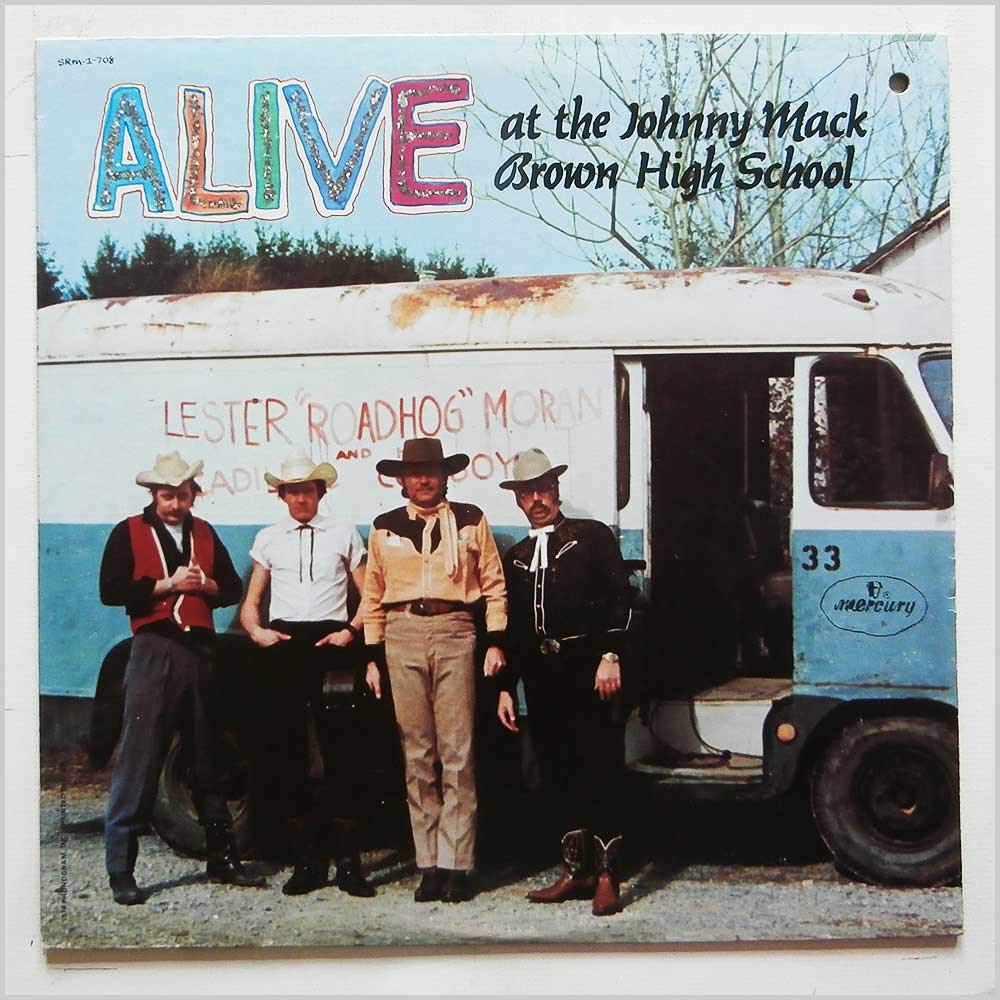
Loading up in cars and traveling over our rural area singing Christmas Carols to the “sick and shet in” and shedding tears because we stopped at my home to sing to my mother. “Shet” is how the minister said shut…or it was Lester “Roadhog” Moran.1

Pink coconut caused by my fathers “barked up”, bloody knuckles from grating fresh coconut for Mother’s ambrosia or coconut cake.

Going to the Belk Brothers and Woolworth in Monroe, NC with my father early on Christmas Eve. I remember the press of people and the Christmas scenes in the Belk Brothers’ windows.

The man with no legs sitting in front of Belk’s selling pencils and my father’s tears as he dropped money in the man’s tin cup.

Eating Woolworth’s warm cashew nuts as we drove home, the bags of fruit and nuts he always bought to fill our Christmas stockings lining the backseat. The aroma of tangerines still takes me to Christmas.

The Christmas Eve reading of “Twas the Night Before Christmas.” My vision was not of “sugar plums” but included a Sgt. Sauders “Combat” Thompson machine gun or a “Rifleman” Winchester and a lifetime’s supply of caps to shoot in them.

The annual drive through the community looking at everyone’s Christmas decorations.

Photographs from Christmases past. The family, still intact, sitting around a dining table in my grandmother’s small dining room. A faded one of my grandmother standing behind my seated grandfather. A picture of my brother, little “Stevie Reno”, opening a gift and presenting it to the camera lens along with a broad smile.  

“Little” Donnie dressed like Fred Kirby, a local TV cowboy and Roy Rogers want-to-be. My cowboy hat at a jaunty angle, a western vest over my pajamas, and two silver cap pistols “tied down”, gunslinger style. “Take that Black Bart! Bam, bam, bam.”

I find as I get older my memories have become snatches of events and I hate to admit it, some of those memories are dimming. I’m sure this is a normal occurrence. I hope it is a normal occurrence. I’m writing memories for that reason.

Merry Christmas and Happy Holidays to all. I hope your Christmas memories are, well, memorable.

1Lester “Roadhog” Moran and the Cadillac Cowboys’ “Alive at the Johnny Mack Brown High School” was a comedic LP by the Statler Brothers that made fun of early country music and radio. It has nothing to do with Christmas except that I was introduced to it and a comely young brunette during a Christmas break somewhere in the dimness of my past. Christmas “spirits” may have been involved and would account for the dimness.

The Old Roadhog and his Cowboys

Don Miller’s newest release is “Pig Trails and Rabbit Holes” and may be downloaded or purchased in paperback at https://www.amazon.com/Pig-Trails-Rabbit-Holes-Southerner/dp/B09GQSNYL2/ref=sr_1_1?crid=1NL4KPTB0R4EY&keywords=pig+trails+and+rabbit+holes&qid=1639579530&sprefix=pig+trails+and+rabbit+holes%2Caps%2C224&sr=8-1

Memories Revisited…

“One minute, you’re young and fun. And the next, you’re turning down the stereo in your car to see better” –Unknown

Who were these guys? I arrived late to the table and questioned, “How did you guys get so old?” I had made the hour drive to the restaurant thinking of those thrilling days of yesteryear, seeing them as the young men from forty years ago. Young men, full of piss and vinegar, with all their hair in my mind’s eye. Except Stan, Stan never had hair. Obviously, my mind’s eye needs some corrective lenses.

There were nine of us, eight retired coaches and one of our former players.  It had been the player’s idea. An impromptu reunion. I don’t know how many great ideas John has had during his life, but this was assuredly one of the better ones.

We had lived life like dysfunctional brothers for most of a decade and stayed connected for the three decades since. Clay, the head coach and athletic director. Carroll, the secondary coach, and basketball coach. Stan, the offensive line coach, wrestling coach, and later head coach and athletic director after my time. Max, a former player who could coach anything and helped me with the defense when he wasn’t calling plays for the offense. Cooper, the defensive line coach, resident comedian, and Precious Pup. Larry, our JV coach who would become a successful head coach in his own right. Mike, the trainer, and highly successful wrestling coach. John the wide receiver, punter, and wrestler we coached so long ago who went on to a college career before a continuing career as a successful human. Oh, I forgot. There was Don, the linebacker and defensive end coach.

Around the table there were jokes and laughter, stories that had been told before, with embellishment, I’m sure. There was catching up and a bit of talk about those we have lost over the years. Most of our conversations wound from our own craziness to the kids we coached or taught and their craziness. “Do you remember” began many of our conversations.

We were young coaches and teachers in the middle Seventies, in our mid-twenties to early thirties. Some of us fresh out of college were closer in age to our kids than our peers. We became seasoned quickly and somehow never quite gave up our youthful exuberance even as our hair fell out and turned gray. Testosterone ruled the day and sometimes youth is wasted on the young. Many mistakes, many humorous, were made but somehow, we survived and grew into responsible human beings.

There was nothing more important than Friday nights…or preparing for Friday nights and the parties afterward. It was war and losing was an affront to our manhood. One coach described winning as “better than sex.” Sex lasts minutes, winning lasts all week long.

We were a brash, egotistical about our abilities, hardworking, hard partying group. We were the Ivanhoe, King Arthur, and Knights of the Round Table of the football fields. We were Sirs Percival and Galahad seeking our own version of the Holy Grail and fighting opposing knights from the opposite sidelines. Like Percival and Galahad, we never found our Holy Grail, but it didn’t stop us from competing.

There might have been a bit of the wooing of the lovely Rowena or Rebecca but most of us ended up like Brian de Bois-Guilbert, dead on a sword…usually our own sword. It didn’t stop us from trying until marriage and family responsibilities reared their head. I promised not to tell those stories until we were all dead.

As I have become seasoned, or just old, I have come to realize there was much more to those years than the rush of winning football games. There is the rush, but eventually I learned it is about the people. The memories of wins and losses have dimmed over the years but the people…the people in those memories are crystal clear.

It has been almost twenty years since I stood girded for battle on the sidelines of a football field, a whistle or play sheet instead of a sword. I coached the game for thirty years. One might think I would have more ties but in all honestly, I haven’t watched a high school football game live in a decade or more. I’m not motivated. I don’t know the people. I don’t know the players, the coaches, the teachers, and the fans. There are no ties. There is nothing to bind me to the game except my memories.

I am often asked, “What did you do before you retired?” My answer is usually followed by another question, “A teacher and coach?  What did you teach and coach?” Once, I went into a litany of sports and subjects, now I simply say, “Kids, I coached kids.”

It is the memories that bind me to people…to my former students and players like John. It is the memories that bind me to seven balding coaches telling jokes and reminiscing. It is the memories that made it seem like just yesterday I walked off the football field and out of the locker room we once shared.

“The past beats inside me like a second heart.” ― John Banville, The Sea

“Kids don’t remember what you try to teach them. They remember what you are.” —Jim Henson

From left to right, from the floor and around the table: Hank the wonder dog, John Black, Stan Hopkins, Clay Bradburn, Larry Frost, Dennis “Max” Massingille, Don Miller, Cooper Gunby, Mike Frye, Carroll Long

Blog image of Mauldin Football from Gwinn Davis.

Don Miller’s author’s page https://www.amazon.com/Don-Miller/e/B018IT38GM?fbclid=IwAR2n75Gfrb8wkA0AlIhcygC4VnZMTaNWVqzVDEqEKQRuMGy9oc8kN4B5l8I