Historia Arcana

“The deeper you penetrated into the true South, a Protestant land of moral absolutes, Baptist blue laws, tent revivals, fire and brimstone, heaven and hell, good and evil, black and white, and damn little room between.”  Greg Iles, The Bone Tree

And bitter hypocrisy thrown in for good measure.

According to a “too large” number of my Southern brethren, racism hasn’t existed in a while…and if it does it is reverse racism.  All groups supporting social justice and the removal of monuments and flags are Marxist and radical, and the worst danger facing our country has nothing to do with the reactionary right.  Our President has even given us a new group to hate, the “radical fascist” which sets my teeth on edge just thinking about it.

Histories are written by the victors…or are they?

In the middle of the Sixth Century, the last great ancient Western historian, Procopius of Caesarea, wrote Historia Arcana which translates to The Secret History.  He hoped it would never be published, and it was not until well after his death.  It was to be his if needed, ‘get out of jail’ card.

The history chronicled the seedier sides of Byzantine Emperor Justinian, and his wife, Empress Theodora.  It is not a glowing history and shows the author’s disillusionment with the Byzantine Empire.  Justinian is portrayed as cruel and incompetent, Theodora, vulgar, and lustfully insatiable.  I feel some of Procopius’ disillusionment today.

No, it is not the history Theodora and Justinian would want to be published and it was not published until nearly a thousand years later.  The sixth-century power couple would go on to be sainted by the Greek Orthodox Church.  Their hidden history remained hidden until it no longer mattered.

I have seen the same with some of our own “sainted” folk.  The heroes of Southern culture and heritage.  In the South, we guard our “historia arcana” with a tenacity unmatched by the rest of our nation.  Families of now-departed men and women hope their histories remain secret.

I’m reading Greg Iles’ Natchez Is Burning trilogy and stumbled upon the above quote on the first page of the second novel, The Bone Tree.  The original book, Natchez is Burning, while fictional, is based on a period in our history that anyone south of the Ohio River would like to forget.

The novel is fictional but based upon historical facts…the treatment of African-Americans during the Fifties and Sixties and how white men got away with the murder of black men and women simply because they could.  A period we are being asked to move on from without recognizing how evil it was or how events from forty or fifty years ago…or one hundred and sixty years ago…or four hundred years ago could actually affect the time we live in now.  Just move on…there is nothing here.

Any Southern town, large or small, has its share of “secret” histories…histories that display our dirty unmentionables, the soiled petticoats displayed as we try to navigate the deep mud puddles of Southern history before quickly dropping our antebellum gown to cover our ankles and muddy shoes.  Like Justinian and Theodora, it is a history we would prefer not to read in print and only speak to in whispered tones if we speak of them at all.

The mud stains are still on our shoes but we do our best to make sure they are out of sight.  Historical accounts we have purged from our memories it seems…or at least the “dark” part of our histories.  Histories so well hidden, a Southern, seventy-year-old retired history teacher didn’t know they existed.

Accounts we claim never existed at worse or were not as bad as were made out at best.  “Why can’t we just move on?” is a question reserved for the propagator, not the victims.  Maybe I should again pick up Faulkner, O’Conner, Williams, Yerby, or Gaines again.  Even in their fiction are large kernels of truth.

Men and women are human, with human failings.  Men and women can be both good and bad at the same time.  Bad…good old Baptist guilt or Calvinist repression, not necessarily the point.  This is more collective guilt…a collective guilt we refuse to accept or acknowledge.  The guilt we have turned into a “Lost Cause” and “Forget Hell” is only reserved for one side of the argument.

As we debate the removal of statues and memorials, the elimination of one hundred and sixty-year-old eulogies made of cloth, disclaimers added to eighty-one-year-old motion pictures, and the changing of aging athletic nicknames and mascots, we pontificate about what seems to be different histories from the same place and from the same time.  Some pray to the gods of the status quo, the good old days, while others are breaking under the burdens we refuse to remove.

Good men doing bad things or is it bad men doing good things…or is it just human nature to cover or change what is unpalatable for us?  Is it human nature to resist change or just a Southern cultural trait?

There is the fear factor too.  Fear that somehow we will lose control of what we have controlled for so long.  Similar to the old question asked by good Protestant ministers so long ago, “What will we do when they run off with our wives and daughters?”  We still look for boogie men under our beds and label them as Marxist or radically “fascist” whatever that is.

I do not know where to stand on statues and memorials.  I know, despite my deep Southern roots, I will not stand next to them in defense.  My great, great and great, great, great grandfathers may be rolling in their graves.

Our statues and memorials are tributes to men and to histories most unsavory but they themselves are not history.  They should not be celebratory, should they? They are reminders of not only heritage but the hate some of that heritage rests upon.

Having taught history, I never used a statue or memorial as a teaching tool but that doesn’t mean they can’t be used as teaching implements…provided those monuments are teaching the “real” histories which are found not on lists of gallant Confederate dead etched in stone or on mountains, but in the pages of primary documents and historical works.

We must focus less on gallant propaganda and more on the facts.  We need to recognize that our history didn’t end with the beginning of the Civil War.  We need to question why some men died to “make men free” and why others resisted…no matter how bitter the taste of the fruit of that resistance might be.

All countries have shame.  We are not unique.  Many countries have tread on the weak for national and economic gain.  We are no different.  We are not even the only country that has not come to grips with the travesties we have committed.  We are not the only country to ignore our travesties and attempt to squash the message of those tread upon.  Unfortunately, as a child in the Fifties, I bought the propaganda of American Exceptionalism.  I really believed we were supposed to be better than other nations.

I  admit to ignoring problems in hopes they might go away.  They do not.  They only grow worse and ours has festered for over one hundred and fifty years.  I have also learned when faced with an issue, the most unappealing and unappetizing option is probably the correct one.

Here in the Bible Belt, we are filled with religious indignation and justification toward anyone who questions authority…unless it is a fellow Christian of a certain race.  It is as if by conforming to a God’s will we give up the right to think on our own.

Here in the Bible Belt, we have tied our Christianity to our politics, and any afront to our politics is perceived as an affront to our religion.  I am seeing this more and more concerning “peaceful” protesters and reactions to “other” religions.  Too many “good” Christians wrapping their Bible in a flag and calling their racism and bigotry patriotism.

As I read Iles’ quote I thought back to my youth and own privilege.  I grew up a Methodist Protestant, graduated from a Lutheran institution of higher learning, and committed the mortal sin of marrying three Baptist women.  If at first, you fail….  I once considered taking up the mantle of religion…God does work in mysterious ways.  It is my historia arcana.

Moral absolutes were something I obviously had a problem with as did others.  I have just now learned others did a better job of covering theirs up and have throughout history.  In towns large and small, men and women have been willing to hide their moral absolutes away when it suited.  Good men and women doing bad things and praying for absolution on Sunday morning? Justinian and Theodora?  Or was I just cursed with the ability to see grays in among the blacks and whites?

I remember the revivals and the Blue Laws, the hellfire and brimstone sermons conjuring the smell of sulfur.  Hot and sticky Southern Sunday morning humidity with funeral fans working against the oppressive heat.  The preacher pounding his Bible before issuing his alter call, a closing hymn…benediction, please.

There was no gray, only heaven or hell, no in-between.  I remember the Wednesday night and Sunday morning Christians, the amen corners, the tv evangelist, and faith healers.  Billy Graham’s piety on display in black and white while George Beverly Shea sang “How Great Thou Art.”

I remember being taught from the pulpit, white was good and black was bad.  When white was virtuous and black was evil.  I remember when we used the same arguments a lifetime ago that we recycle now.  I remember our historia arcana and feel the shame that we can’t seem to overcome it or even admit it.

***

Iles, Greg The Bone Tree: A Novel (Penn Cage Book 5) (p. 1). William Morrow. Kindle Edition

The image is from The Smithsonian’s National Museum of African American History and Culture’s online portal.  https://nmaahc.si.edu/

Don Miller writes on various subjects that bother him so and in various genres.  His author’s page is https://www.amazon.com/Don-Miller/e/B018IT38GM?fbclid=IwAR2syCHGI2Eb96lK63frT528V_cBY995j2m_hd_LOLFPdV4KqqoZQn1J7Fs

Shut up and Listen

It’s time for white folk to just shut up.  We are not listening.  We are shouting down the message.

Four years ago, Colin Kaepernick peacefully took a knee, and we (White Folk) shouted him down.  Athletes who joined him were called sons of bitches and threatened with firings.  A blonde-haired news pundit told an athlete to “shut up and dribble.” Conservative radio wrapped their racism and white nationalism with the US Flag and made it about disrespect instead of listening.  Award winners who dared to use their medium as a platform were told to just accept their award and shut up.  Be quiet so we don’t have to listen.

Why? It’s easier to be tone-deaf if you don’t have to listen.  You can be happy and secure with your head stuck where the sun never shines.

Four years later, what has changed?  I’m being kind, I could have asked twenty years later? Or thirty….  Nothing.  Systemic and institutional racism is still in place along with the double standard that is our justice system…and white people are still attempting to shout down those who are affected the most.

You dare to question this great country?  Just shut up and sit down, or move.  “Don’t like it here, go back to your shithole country.”  If we shout long enough maybe a bigger story will come along during the next news cycle to make people forget.  People do forget…white people.

White folk needs to shut up and listen.  Violent protest is not constructive…you are preaching to the choir if preaching to me.  It ain’t about me.  The white folks who have the most to lose are using it to drown out the message.

Our forefathers put the system into place, and we have guarded the fire of discrimination as if our lives depended upon it.  Not all, I believe the loudest shouters are in the minority and are the ones guarding and fanning the flame of racism and intolerance.

It is time for the silent majority to shut out the shouts of the minority haters and decide what we believe in.  We can’t afford to sit on a fence that may burn down from under us.  Shit or get off the pot because it is not the responsibility of people of color to destroy an oppressive system.  A system, we, as in whites, put into being…and have maintained since the end of the Civil War.  We must be the ones who dismantle discrimination and we can’t do that without listening.  We have to make dialog possible…by shutting up and listening.

“But things are better aren’t they?”  I don’t know.  I’m an old white guy.  Maybe you should go ask a friend of color…and listen quietly and intently.

I don’t believe white people get to make up the rules for acceptable protest.  We don’t get to share cute memes of MLK’s nonviolence without also sharing his quote “Riot is the language of the unheard.”  To do so is as hypocritical as “We hold these truths to be self-evident that all men are created equal” when we have a system that openly disparages, marginalizes, and discriminates.  

Before we shout about violence, we need to accept our own.  My lifetime memories are full of scenes I’d like to forget.  As a student of history, I am aware our history books are full of glossed over white initiated violence in the name of expansion, manifest destiny, imperialism, and racism.  Glossed to the point it doesn’t exist.

King’s peaceful protests were met with burning buses, police dogs, and water hoses. King’s belief in non-violence got him killed.  Murdered by a white man with a gun, trying to maintain the flame of white supremacy.

“Oh, but that was long ago, people just need to get over it.”  People can begin to get over “it” when we admit and accept our sins and the sins of our forefathers.  I don’t believe we’ve done that.  I think we have done nothing but shout our excuses and what-about- isms.

The riots from the Nineties disappeared from our rose-colored sight and out of mind…and little was accomplished. The same with protests from more recent history.

I’m an old white guy who doesn’t understand how burning down your neighbor’s house because you are pissed is positive.  I won’t ever understand it.   My time and energy, and yours, would be better spent listening with an open mind and attempting to understand why there is so much anger and frustration.

If you find it easier to believe in leftwing plots, led by George Soros or Bill Gates, the Democratic Party, Antifa or the Illuminati…if you believe it is a rightwing plot, led by Donald Trump, the KKK, The Church of QAnon or other far-right groups, you are part of the problem because you would rather face made up problems than real ones.  The real one is too painful.

Are they organized, certainly but I don’t believe it is a Dark State plot.  Activism is not a dirty word and it is not anarchy.  Are there bad players at work  Sure, but you are allowing them to shout over the message.  You are not listening.

You are the ostrich with your head in the sand or worse if you don’t believe people of color have a reason to be mad.  You are shouting instead of listening because you don’t want to hear the truth.  You are afraid to listen to the pain, anger, and frustration of your neighbors because you might have to acknowledge we live in a racist system.  You are helping to fan the flame whether you want to or not.

In 1968, King died from an assassin’s bullet. The white shouts were almost the same as today.  The streets were burning and National Guard troops patrolled American cities. The cries were of anger, sadness, and frustration.  We didn’t listen.  We were too busy shouting about radical agitators as we watched the newsreels loop.  We wouldn’t shut up long enough to listen.  It was 1968 or is it right now?

In 1992, LA burned after four LA policemen were acquitted of the beating of Rodney King.  They were caught on camera for the nation to see.  The National Guard was on patrol again and there were the same shouts, the same excuses.  We didn’t listen.  It couldn’t be about a racist system.  It was 1992 or is it right now?

Do we repeat the same sins by drowning out people in pain or do we shut up and listen?  Are we willing to push for meaningful change or wait for the next tragedy to drown it out and return to the status quo?  Are we willing to change?

George Floyd’s death was awful, but it only cast a light on one symptom of the disease.  The disease isn’t terminal yet but it is moving swiftly in that direction.  Shut up and listen before our racism kills us.

***

Featured Image:  https://steemit.com/life/@domioanna/just-shut-up-and-listen

Don Miller’s author’s page https://www.amazon.com/Don-Miller/e/B018IT38GM?fbclid=IwAR1IWVKrQFOwlgUOn0jXI0N85XUF4AFM-IgNPqW7PE1GGK23l7PJUvho9Fs

Remembering Kent State

For those of us who were young adults or near adults, it should be a bit of a somber day. Fifty years ago, today, four Kent State students were shot, nine others wounded, one paralyzed.  Twenty-eight Ohio National Guardsmen fired approximately seventy rounds in less than fifteen seconds into students, some protesting President Nixon’s “Cambodian Incursion” by the US military, others who were simply watching from a distance, one was walking from one class to another.  Nixon had promised the day before to get us out of the war.

It had been a contentious period in our history, “The Kent State Massacre” was neither the beginning of the violence nor would it be the concluding chapter.  Three protesting students were killed and some thirty injured during a protest at South Carolina State in Orangeburg, SC in February.  Several days after Kent State, two students were killed, and a dozen injured at Jackson State.  Both were confrontations with the police and on a small scale exemplified the student unrest over the Vietnam War and Civil Rights.

Kent State had been a hot spot for student protest beginning in the middle Sixties.  Students For a Democratic Society (SDS), the Black Student Organization and the Youth International Party, (Yippies) all staged sit-ins, marches and other protests, including an attempted take over of the Administrative Offices by the SDS that led to fifty-eight students being arrested by the Ohio Highway Patrol.  There had been scattered violence, including the burning of the ROTC building, but no deaths until May 4, 1970.

Monday, May Fourth. was the culmination of four days of unrest that began the previous Friday after President Nixon announced the Cambodian Incursion on the previous Thursday.  From the aforementioned fire, a protest march, beer bottles and rocks being thrown at police, bonfires in the street, and numerous arrests, violence reared its ugly head, violence from the students, and from groups sworn to protect them.

Unconfirmed rumors of students with caches of arms, spiking the local water supply with LSD, and of students building tunnels for the purpose of blowing up the town’s main buildings added gasoline to an already volatile cocktail.  The city mayor requested National Guard Troops from the governor and the request was granted.  They came armed with loaded M-1 Garands, bayonets, tear gas, and smoke grenades.

The National Guard first became entangled on the Third, breaking up a rally and a sit-in, using tear gas and even bayoneting students.  A noon rally of some 2000 students on the Fourth became the catalyst for the shooting.  Again, rocks and tear gas were involved until the shots rang out.  It became a they said-they said situation after the gunpowder had cleared.

I was a struggling sophomore in college, less than a month past my twentieth birthday when news of the massacre flashed across the community tv screen in the basement of Brokaw Hall.  I remember the silence that followed and the debate that issued later.  Despite being a Southern liberal arts college, Newberry was not a fertile ground for liberal thoughts.

Near the end of the semester, I was more concerned about the effect exams might have on my grades than what had taken place in faraway Ohio or nearby Orangeburg.  I was also mourning the end of my first serious relationship, one I characterized as a hurricane waiting to happen.  You knew you were in for a big storm you just didn’t know when or where it would happen.  It had happened.  A hurricane that had turned my grades into a shambles.

It wasn’t that I wasn’t aware, I was.  A male, I had just participated in the first draft lottery and hadn’t won but I hadn’t lost either…April 9th came up 219…kinda in the middle.  My awareness was focused on my poor but improving grades and fear.

I had no desire to die in a rice paddy in a Southeast Asian country but like many of the young men surrounding me, I would have gone to my death rather than disappointing my family and friends.  I would do what was expected.

As I look back, I am both proud and ashamed.  Happy I wasn’t called while feeling I missed something by not being called to serve.  Ashamed for not taking a more active interest in protesting the war.  Confliction but I am a conflicted person.

There were several veterans on third floor Brokaw my freshman year taking advantage of the GI Bill.  They were good guys, damaged good guys.  Few returned for our sophomore year, fewer still graduated.   They were just too damaged.

I wondered which was worse, dying in a jungle or leaving a part of your soul there.  They all participated in the activities of college life, but it seemed they only participated from the periphery.  All still had the “Thousand Yard Stare.”

One vet, of Marine Force Recon, had been our protector during our freshman year.  I didn’t know what Force Recon was, I just knew from the whispers he was a badass dude.  He was much older and became a buffer against Rat Week and later the fraternity bull pledges whose grades were so low they had been moved out of fraternity housing and onto the freshman halls.  They weren’t happy and wanted to take it out on the ‘rats’.  Force Recon would have none of it and the bull pledges left us alone.

He sat next to me as Walter told us about Kent State.  A man of few words, he leaned over and asked, “Who gives fucking National Guardsmen live ammo against students?”  I wondered myself.  Several friends were National Guardsmen and I wouldn’t have trusted them with a pea shooter.  Thankfully, they were members of the SC National Guard Band.  They blew into their instruments instead of blowing things up.

Later, Force Recon would suggest in a bit of a drunken stupor, “If you get drafted, run to Canada.  It ain’t worth dying for.”  This from the same man who ‘liberated’ a Christmas tree from the Winn Dixie parking lot late one night so we could decorate with toilet paper and beer cans in our community restroom…good times.  Coming from a veteran I began to rethink the war.

Violence begets violence and the violence didn’t end in May of 1970.  Many more Americans, Vietnamese, Cambodians, and Laotians would die before that little policing action was over.

The shootings at Kent State would trigger more protests, one in Washington estimated at a hundred thousand that caused President Nixon to be whisked away to Camp David.  Hundreds of college campuses would close involving over four million students due to student protest.  Eleven students were bayoneted at the University of New Mexico during a peace rally and peace protesters battled pro-Nixon construction workers in what became known as the Hard Hat Riots.

1968 was bad, ‘69 was a bit of reprieve if you didn’t look past the moon landing to the Manson Murders and Mai Lai.  ‘70 was a return to the bad but as some smart someone said, “it gets darkest just before the dawn.”  It would be five long years before dawn and the Vietnam War ended but the US had been out of the warzone for the last two.  I must believe Kent State and the protests that followed helped get us out of a war we should never have been involved in.  Helped to stop the killing.

***

I drew from a lot of sources but since I am not selling this I’m not going to footnote.   If you question something other than my sanity I will go back and do so.

The featured image is the iconic photograph of Mary Ann Vecchio kneeling over the body of student Jeffrey Miller, who was killed by Ohio National Guard troops during an antiwar demonstration at Kent State University on May 4, 1970.

Don Miller writes on various subjects and various genres.  His authors page is at https://www.amazon.com/Don-Miller/e/B018IT38GM?fbclid=IwAR2Iyegsi5CjQ4ZNPU2nA9C1e3q7jekDZ6e3T8qw5QUgwNhM9Yj_-dKOag4


For What It’s Worth


The song has been running in my head since I heard it early this morning as I tromped up and down the hills around my foothills home. The pain of the steep hills has been replaced by the pain of my broken mind. I’m not depressed, am I? “Children what’s that sound, everybody look what’s going down” reminds me of a flushed toilet with its contents circling before disappearing. Maybe I am depressed.  Thank you, Buffalo Springfield and my playlist.

The song became an anthem for the anti-war crowd in the late Sixties and early Seventies but was not written as such. It was written to protest a curfew put into place around the famed Whiskey a Go-Go, a West Hollywood music venue. The status quo (read conservative adults) had become upset about the noise, loitering and traffic congestion caused by crazy kids high on life, “Young people speakin’ their minds, are getting so much resistance far behind.” The culture clash became known as the Sunset Strip curfew riots and featured counterculture clashes with the Los Angeles Police.

My thoughts, my thoughts…. In the late Sixties, I was not a member of the counterculture. I was still the proud, flat-top sporting, John Wayne adoring, “my country right or wrong” conservative.  I’m still proud just not as conservative as I once was.  My country can be and has been wrong.

I grew out of my flat-top during my high school and college years but no one would have confused me with a long-haired hippie freak.  I ignored protest music for the soulful sounds of rhythm and blues and Beach Music, and bells and Jesus sandles for Weegins and stifly starched khakis.  Afterall if it didn’t effect me why should I worry…well, I’m worried.

Because of my worry I have become the aging, white-bearded, balding hippie, embracing those things I should have embraced fifty years ago, although I still toke on cigars rather than weed and find the conservative drug of choice, beer, and Jack Daniels, more palatable…beer and Jack Daniels separately, not mixed. Certain libations transcend social and political orientations.

I had flirted with the left but hadn’t gone ape-shit liberal until my Autumn years when I found Jimi Hendrix and Janice Joplin more in line with my musical and political taste than Florida-Georgia Line. Country?  That ain’t country.

It always begins with the devil’s music…even if it was from the Sixties.  Having ignored it in my youth it was as if I had discovered Coronado’s Seven Cities of Gold.  First, it’s Rock-n-Roll and before you know it, sex and drugs along with a good dose of liberalism are rearing their radical heads.

I’m a little long of tooth for “free love” and “psychedelics” but my middle of the road liberalism seemed to fit better with what I believe are the ills facing our world; global climate change, hunger, lack of clean water, wage inequality, unchecked capitalism, and a government that reminds me more of a Russian oligarchy.  Funny…my change coincided with the birth of grand children.

My thoughts ramble, I am astounded.  “Something’s happin’ here, what it is ain’t exactly clear.” Those people I considered liberal in my childhood and my early adulthood have become the status quo of today, the conservative adults wondering what has happened to the youth of today…or their aging hippie teacher.

This from the former blue jean, mini-skirted, halter topped or John Travolta “catch me, f@#$ me” leisure suited crowd, now nattily dressed in their dark blue suits and red ties. They are now the conservatives resisting social and political change, many to the point of embracing any conspiracy related to the evils hiding under their beds.

My “outlaw”, dope-smoking brother even became the paragon of the conservative status quo, forgoing Seventies drug use and briefly flirting with Tea Party politics.  Well, he is still a tee shirt, cargo pants kind of guy.  At least he wears his UNC cap “fore and aft.”  I believe it might have something to do with marriage and business ownership.  Settling down?

My characterization is unfair, my brother is the epitome of the too-often quoted, “social liberal, fiscal conservative.” He helped start and continues to support a food kitchen and other social programs.

The give away is his musical tastes.  They are “neo-hippie” and “Americana”…kind of like mine. He doesn’t think modern country is country either.  It seems his square pegs won’t fit in my round holes…maybe I should take a look at my own square pegs.

Truth?  We don’t stray far from each other’s political or social beliefs. We enjoy many of the same things, and share a live and let live attitude.  I just find it necessary to give grief to my younger brother.

What amazes…and concerns me are the protests popping up.  I should say the types of protests.  Stanchly conservative, dare I say right-wing reactionaries…protestors dressed in camo and battle gear, sporting assault-style weapons have replaced hippies putting flowers down the barrel of rifles.  What?

Make Love, not War does not seem to be their mantra. I think the lyrics from Dylan’s All Along the Watchtower, might fit them better.“All along the watchtower, princes kept the view.  While all the women came and went, barefoot servants, too.”  It seems they want to keep the masses in view…and under their thumb.Based on Isaiah, I like the Hendrix version the best.

It was just a few years, months ago, the same folk were shaming “liberal” teachers for walking out of their classes for more pay and smaller class sizes, global climate change idiots led by a sixteen year old, railing against Black Lives Matter, and cheering when Native Americans were arrested or water blasted for protesting an oil pipeline through their native lands. Oil pipe…peace pipe…hum…water pipe.

The hippie legions from fifty years ago are either rolling in their graves or wondering what kind of bad shit was in those edibles or ‘srooms.

“What a field day for the heat.  A thousand people in the street.  Singing songs and a carryin’ signs.  Mostly say, “hooray for our side.” 

It’s time we stopped.  Hey, what’s that sound? Everybody look what’s going down.”

Stephen Stills was quoted saying, “It (For What it’s Worth) turned out to be indicative of what was about to happen.” And I would add, “Continues to happen.” The only changes are the participants and the battlefields they argue over.

“There’s battle lines being drawn and nobody’s right if everybody’s wrong”

***

Added note:  I don’t want to be  accused of viewing history through rose colored granny glasses.  Not all left led protest were peaceful and the violence was not necessarily prompted by the minions of the status quo.  At least the police didn’t face protestors with AR-15s.

I decided to include All Along the Watchtower….

YouTube.  Jimi Hendrix live in Munster, 1/14/69

Buffalo Springfield, YouTube Vid of them at the Hollywood Palace in 1967.

The Flower Power photograph is by Bernie Boston, taken during “March on The Pentagon”, 21 October 1967.

Featured image is of protesters of the Michagin shelter in place order.


Textile Strikes, Labor Unions, and Ella May Wiggins-History Repeated


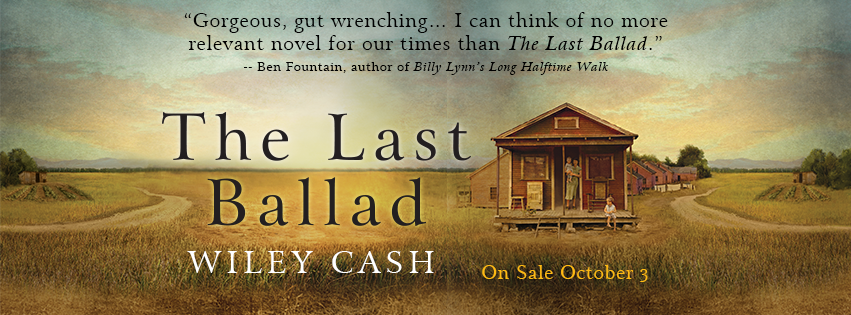
During research for a novel I hope to write, I ran across the novel, The Last Ballad, written by Wiley Cash.  Cash’s novel is a fictionalized glimpse into the life and final months of union organizer and balladeer, Ella May Wiggins.  The story was inspired by actual events that hit a little too close to home.  Cash paints a historical picture that is both historically accurate and vivid, yet is as dark as the interiors of the textile mills he writes about and the lives of the people forced to work in them.  It’s a novel I wish I could have written.

Image result for ella may wiggins

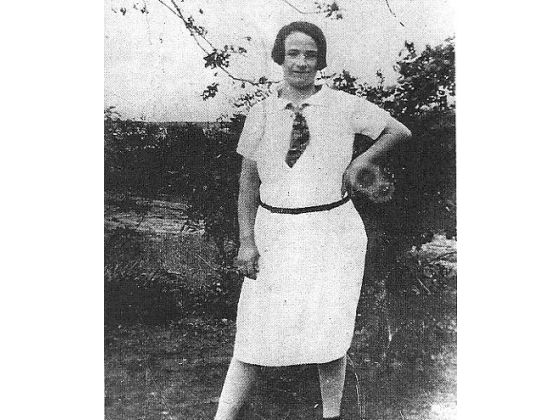
Wiggins, a spinner at Bessemer City’s American Textile Mill #2 with a history of bad choices for many right reasons and some not so right, was shot and killed in 1929 during labor unrest leading up to the Loray Mill Strike in Gastonia, North Carolina, April 1,1929 and ending in the collapse of the strike after Wiggins’s death in September of the same year.

It was the end of the period called “The Roaring Twenties” which for the textile workers and farmers of the South, were anything but roaring.  While Wiggins did not live to see the great Wall Street crash, times were already hard for those who toiled in textiles, many who had just earlier been left destitute from falling farm prices.  As my grandmother often stated, “We lived so hard we didn’t notice the Great Depression.”

For anyone with empathy, the book is a tough read.  It is painful on many levels, not just Wiggins’s death.  It is disturbing because I see a certain parallel with “history repeating itself.”

I grew up a “hill milly”.  My youth was tied both to the fields of corn and beans of my grandparents and to the textile mills of my parents. By the time I cleaned the cow manure off my boots and traded square bales of hay for the lint, heat, and noise of the Springs Mills’ White Plant in Fort Mill, South Carolina, conditions, pay, and hours had markedly improved from Ella May’s day.  Improved, but still some of the hardest physical labor I ever did under some of the most taxing physical conditions.

On my first day, I was two months past my fourteenth birthday.  I was summer labor, a spare hand, working a six until two shift at whatever hell my second hand decided.   Doffing cloth, filling batteries, taking up quill and skinning them were my primary chores.  I must have done okay, I was invited to continue, working weekends during the school year.

The early shift allowed enough daylight in the evening to pull four additional hours hoeing corn, picking beans or tossing square bales onto the bed of an old flatbed for two dollars a day.  I was bone-weary at the end of the day and slept the sleep of the exhaustedly pure of heart, but in my immature brain, I was rich.

A dollar sixty-five an hour, time and a half for overtime over forty hours, plus the six dollars a week I got for tossing hay.  $93.80 a week before taxes for seventy-two hours counting four overtime hours…all hard work.  That was in 1964 and I wasn’t as rich as I thought.  My parents took half my take-home pay for room and board and I was forced to save half of my half for the college days looming in the near future.

My week’s take came out to about fifteen dollars a week in my pocket…more than what Ella May made for seventy-two hours in 1929.  Six days a week, twelve hours a day for $9.00 a week in conditions you can’t believe unless you lived it. $9.00 to house, feed and clothe herself and her five living children.  She had lost two children in early childhood who developed rickets due to malnutrition.  She was pregnant at the time of her death.

Image result for springs cotton mills fort mill sc

South Carolina has never been receptive to unions…the South has never been receptive to unions.  As of 2017, only 2.6 percent of the Southern workforce was unionized. During Ella May Wiggins’s day, unions had only just begun to move south and were met with a solid, often violent, effort to keep them out.

On my first day at Springs, a cousin, Charlie Wilson, took me aside and yelled his whisper above the din of eleven hundred looms, “Never mention the word union if you want to keep your job.”  I’m not sure I had heard of the word at the time but never mentioned it even though many days I doubted I really “wanted to keep my job.”

Despite the mind-numbing sound and physical labor, I was spoiled and didn’t know it until I went to work for another cotton mill during my college days.  Springs Mills was a Cadillac of cotton mills.  Well lit, it was reasonably modern and technologically advanced, cleaner than most, with a family atmosphere.

The two mills I worked at in Newberry, SC, during my college years were everything Springs wasn’t including an “every man for himself” atmosphere.  Dimly lit, the old Draper looms were contrary and dangerous, the closed painted over windows a reminder of what was just on the other side…bright sunshine and clean air as opposed to the oppressive, lint filled atmosphere and heat inside.

As I lived through a week that saw a major drop in the stock market and a toilet paper panic, I am somberly amused at some of the similarities that exist today as in those thrilling days of yesteryear.  Conservatives attempting to hold the line, liberals clamoring for change.  Name-calling, finger-pointing and unfortunately threats to our democratic system if not our very person.

I hope most threats are coming from internet trolls with nothing to do as we “hunker down”, self-isolating ourselves from the coronavirus, worrying about where our next toilet paper score might occur.  We can’t even agree if this disease is a health threat or simply the flu blown up by a liberal media controlled by communists and George Soros.  I digress with tongue in cheek.

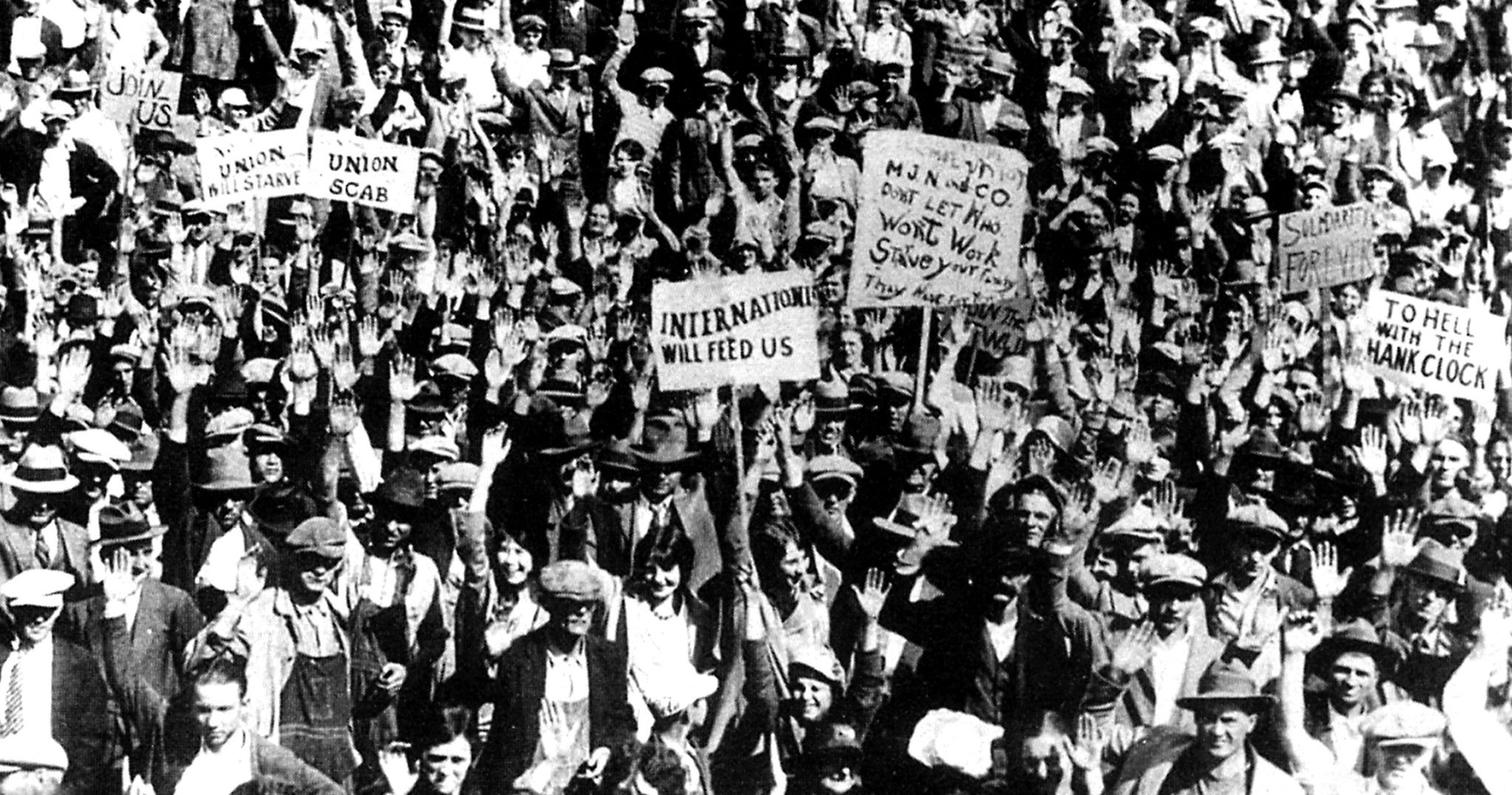
The reason for the Loray strike were workers protesting for better working conditions, a forty-hour workweek, a minimum $20 weekly wage, union recognition, and the abolition of the stretch-out system, a system that doubled worker’s labor but reduced their wages as textiles fell on hard times after The Great War and the drying up of government contracts.

An estimated 1,000 strikers at Loray Mills, Gastonia, 1929. -- Millican Pictorial History Museum

The numbers and issues may be different, our responses have been eerily similar.  It would be during the middle of the Great Depression before minimum wage, the forty-hour workweek and child labor, along with the Social Security safety net, would finally be addressed…all maligned at the time as at best socialism, at worse communism, both a threat to American capitalism and the owners it made rich.

In 1929, company men labeled any check to unlimited capitalism as Marxist, socialist or communist, and yes there were more than a few of them around. Ella May’s National Textile Workers Union certainly had communist ties, not that Ella May and her fellow workers knew what a communist was.  She was simply seeking a better life for her children and herself.

I see the same labels raised when we debate increasing the minimum wage, health care, safety nets or educational opportunities.  Labeling has become quite acute with both our political parties battling to pass a coronavirus relief bill.

Union enrollment is on the decline while finger-pointing increases.  There is no middle ground.  Signs of the time…or as my Evangelical friends shout, “Signs of the Apocalypse.  The time is nigh.”

I wonder if we are nearing a tipping point when the national guard, new wave strikebreakers, and the police force will be employed to evict and expel people whose opinions simply differ.  Couldn’t happen, could it?  Yet in 1929 it did, and the violence would continue well into the Thirties.

Violence spurred by unchecked capitalism, fears of communism and being forced to work side by side with those of a different race.  All supported by a sympathetic conservative media, and government “for and by” the “Captains of Industries.”

On April 1, 1929, eighteen hundred workers walked off the job at Loray in Gastonia, mostly women, some marching with babes in arms.  Management evicted them from company housing, throwing their meager possessions into the street.  One striker was killed, many beaten.

The North Carolina National Guard was called out on the third of April, violence erupted sporadically over the next several months.  The police chief was killed, strikers and company men shot or beaten, and in September, a truck carrying twenty-two strikers was chased down and shot up.  The pregnant organizer and singer of ballads, Ella May Wiggins, was killed, shot through her chest.  Her children sent to an orphanage until their eighteenth birthdays.

Image result for ella may wiggins

A general wave of vigilantism washed across the countryside, company men arriving in the middle of the night, forcing strike participants out of the county in exile.  These were their neighbors, people they knew by name, people they might have worked with just a few weeks before.  People threatened with bodily harm if they returned.

The struggle continues today just not in US textiles.  Textiles left the South for climates more receptive to low pay and long hours.  There are a few specialty mills around but we simply can’t compete.   Our standard of living requires we have a higher level of poverty than places like China, India, and Pakistan.   Hopefully a higher level of empathy for our workers…but I am unsure.

***

I recommend The Last Ballad.  Again, I warn you, it is a painful history brought to life by Wiley Cash.  It is a history I was unfamiliar with even though I possess a history degree and lived within an hour of Gastonia and the Loray Mill site.  We Southerners have a tendency to overlook or twist some of our more unsavory histories.  This one seems to have been ignored.

The book may be purchased on Amazon or if you have a library card, downloaded to a Kindle or computer with a Kindle App for free.  Yes, I’m cheap.  https://www.amazon.com/Last-Ballad-Novel-Wiley-Cash/dp/0062313118

Image result for The Last Ballad

Don Miller is a retired educator and coach.  He writes on various topics and his author’s page may be accessed at https://www.amazon.com/Don-Miller/e/B018IT38GM

Images

Featured Image:  A member of the NC National Guard forcing two female strikers back. https://wilsoncountylocalhistorylibrary.wordpress.com/tag/ella-may-wiggins/

The first image is of Ella May (spelled Mae on her grave marker) Wiggins just before her death, https://www.charlotteobserver.com/entertainment/arts-culture/article175129556.html

The second image is of a young girl tending spinning frames in the early 1900s  https://www.pinterest.com/pin/83457399315355531/

The third image is of Loray Mill strikers who walked out on April 1, 1929.

The fourth image is of the truck that carried Ella May Wiggins to her death.  https://www.shelbystar.com/news/20190405/1929-loray-mill-strike-gastonia-violence-makes-waves


Fifty Years Ago…


Section 5377 of the Code of Laws of South Carolina of 1942: “It shall be unlawful for pupils of one race to attend the schools provided by boards of trustees for persons of another race.”

Fifty years ago, yesterday, The School District of Greenville County became one of the last school districts in one of the last states to comply with the “spirit” of the Supreme Court Case Brown v Board of Education, Topeka, Kansas.  It had only taken sixteen years to accomplish this compliance.

1954’s Brown v Board included a South Carolina case filed by then Civil Rights lawyer, future Supreme Court Justice Thurgood Marshall on behalf of Harry and Eliza Briggs and 20 other families living in Summerton, SC, a small town in Clarendon County.  Filed in 1947, Briggs v Elliott challenged school segregation in Clarendon County, South Carolina.  It was the first case filed of five cases combined under the Brown umbrella

Unanimously, the Justices found that separate was inherently unequal and that “public school segregation was unconstitutional.” They also found segregation “fostered feelings of inferiority among black children that could harm their educational futures.”

Brown overthrew Plessy v Ferguson’s “Separate but Equal”, a railroad case from the 1890s that had been applied to education.  Mandated segregation in South Carolina was over…defacto segregation wasn’t.

I used the word “spirit” earlier because for sixteen years South Carolina lawmakers systematically attempted to put off the inevitable by increasing spending on black schools, implementing “pseudo” freedom of choice, and an end-run with what became known as “token” integration.

State Senator Strom Thurmond of Dixiecrat fame helped to pen what became known as the Southern Manifesto, pledging, along with one hundred other federal lawmakers, the intent to resist integration as far as the law would allow.

It seemed South Carolina and other states, mostly Southern, were intent on being deliberate rather than speedy when instructed by the Supreme Court to integrate their schools “with all deliberate speed” in 1954.

With a Mississippi Federal Court ruling, segregation ended over a long weekend in Greenville County on February 17, 1970, with the busing of sixty percent of the black school populations to various schools distant from their own neighborhoods.  Only ten percent of white children were bused.  Five hundred educators found themselves cleaning out their desks and moving to different desks in different schools as well.  This was done to reflect the racial makeup of the county, 80% white, 20% black.

What had been black high schools, some quite new became middle schools or closed that weekend.  These centers of pride for many communities, like Sterling High or Lincoln High, were now empty; only living on in the memories of many people of color.

I was a second semester junior in college at the time and not very concerned about the politics of my state.  The next year, my senior year, I would find myself an unpaid assistant baseball coach while doing my student teaching at a local high school.  It would be my first-time interacting with black students and athletes.  It would probably be some of their first interactions with white teachers and coaches.  Somehow we survived.

From all I can glean from friends and fellow educators who taught during the period, the change was relatively peaceful.  I imagine there was some selective memory loss but unlike other states, few buses, if any, were pelted with rocks. There were no rabid white crowds shouting expletives to little schoolgirls. The governor did not stand on the schoolhouse steps shouting, “segregation now, segregation tomorrow, segregation forever.”

Still…I can’t imagine what those thousands of students were thinking at the time as they rode school buses to new locations.  I’m unable to fathom the fear of the unknown that prevailed, both black and white.  I can only imagine what might have gone on in restrooms, locker rooms, in the parking lot, on buses…out of range of teacher’s and administrator’s ears.

By the time I became a full-time teacher and coach in 1973, I found race relations still raw and contentious.  Generally, the question of race relations simmered just beneath the surface on briefly exposing itself.  There were just enough brief flareups to remind us.  Beliefs don’t go gently into the night just because judges tell them to.

For years we had been indoctrinated to believe races should be kept separate as a benefit to both, and then in the blink of an eye it was over…or was it?

There were still arguments made and old white men continued to try and find ways around the law.  Court cases would still be heard, especially over busing.  Isolated areas would still attempt to hang on to the old ways.  Affluent white folk found another way to be separate.

One hundred and thirty-four private schools and academies opened in South Carolina during the period, one hundred and thirty-one were opened to whites only.  Many still exist today, many still are all white with names featuring Lee, Davis or Calhoun.

Over fifty thousand white students fled to private schools and today one in seven public schools in South Carolina are considered “highly segregated” still.  “Separate but equal” seems to have a firm foothold all over the South and it appears the Secretary of Education is intent on strengthening its foothold nationwide while weakening an already weakened public school system.

I often hear or read, “We need to move on.  That was so long ago.  I don’t understand why it is always about race.”  I find it is often people of my race who make these comments.  The same people who insist their heritage is under attack when certain flags are removed from federal buildings.

I point out that Jim Crow was still entrenched during the years of my youth well into my college days.  As I reach a major birthday in a month and a half, I find that 1970 doesn’t seem that long ago.  If it is during my lifetime it can’t be that long ago.

I remember the signs stating, “White’s Only.”  I remember fire hoses, German Shepards and burning buses.  I didn’t fight for my Civil Rights, I didn’t have to.  I’m sure for those who fought for their Civil Rights…continue to fight for their Civil Rights, it seems like only yesterday.

Addendum 

According to various accounts, although Brown resulted in a legal victory against segregation, it was a costly victory for those associated with the Briggs case.

Reverend Joseph De Laine, the generally acknowledged leader of Summerton’s African-American community at the time, was fired from his post as principal at a local school in Silver. His wife Mattie was also fired from her position as a teacher at Scott’s Branch school, as were all the other signers of the original petition.

De Laine’s church was also burned and he moved to Buffalo, New York in 1955 after surviving an attempted drive-by shooting.  He never returned to South Carolina.

Harry and Eliza Briggs, on behalf of whose children the suit was filed, both lost their jobs in what was called “economic retribution.”  They both left South Carolina.

After death threats and by a joint resolution of the South Carolina House of Representatives, Federal Judge Walter Waring was forced to leave South Carolina for good.  He had sided with the petitioners.

An interesting article I just read, https://www.greenvilleonline.com/get-access/?return=https%3A%2F%2Fwww.greenvilleonline.com%2Fstory%2Fnews%2F2020%2F02%2F17%2Fdesegregation-1-out-of-7-south-carolina-schools-highly-segregated%2F2843394001%2F

***

Don Miller is a retired educator and athletic coach.  He writes on various subjects using various genres.  His author’s page can be accessed at https://www.amazon.com/Don-Miller/e/B018IT38GM

The image is from “A New Wave of School Integration”, The Century Foundation, https://tcf.org/content/report/a-new-wave-of-school-integration/?session=1

***

Sources

https://brownvboard.org/content/brown-case-briggs-v-elliott

http://www.scequalizationschools.org/briggs-v-elliott.html

https://en.wikipedia.org/wiki/Briggs_v._Elliott


Like A Bowl of Gumbo….


I was triggered but I was proud of myself.  I said my peace and disengaged.  I recognized that anything I might say would make no difference.  I think most arguments these days are best left…unargued.  There was an upside, my “triggering” sent me down a pig trail to Alice’s rabbit hole.  I found the Mad Hatter, but he wasn’t drinking tea, he was offering me a bowl of gumbo and an Abita instead.

The tiff was over a “Fun Fact” I had posted about Black History Month.  I share “Daily Doses” of witticisms or “Fun Facts” about the world we live in.  Anything to cut the greasy derision abounding today.  Since we celebrate Black History Month in February, I decided to avail myself of the subject although I am sure there will be fun facts about Valentine’s Day and Mardi Gras thrown in for good measure.

A comment made about my “Fun Fact” ruffled my feathers.  I felt the response was inappropriate and told the responder so.  He didn’t take it well…or maybe I didn’t take it well.  I opted to say my peace and disengage.  Instead, I punched up a playlist that included Jimmy Buffett’s “I Will Play for Gumbo.”  One of the choruses goes….

“A piece of French bread

With which to wipe my bowl,

Good for the body.

Good for the soul.

It’s a little like religion

And a lot like sex.

You should never know

When you’re gonna get it next.

At midnight in the quarter or noon in Thibodeaux

I will play for gumbo

Yes, I will play for gumbo.”


It’s a fun song and it had me seat dancing in my recliner, forgetting about my triggered self.  I might have had a Pavlovian response to boot.  The ditty made me think about diversity…also a good subject for Black History Month.  I know of no other bowls of goodness that are more diverse in ingredients, origin…and full of tasty joy.  If I had to come up with the last meal it would probably include gumbo with a side of shrimp and grits.

The word gumbo derives from West Africa, ki ngombo or quingombo, from the Niger-Congo language spoken by many of the West African slaves who survived the Middle Passage and were forced to settle and perform back-breaking labor.  The words mean okra, a plant the slaves brought with them.

Gumbo can be served without okra but why would one want it without okra?  It was also Africans who introduced serving okra with rice, and rice is generally served with gumbo.

Sometime later, it was the Louisiana French, some who came by way of Canada, who probably shortened the African words to gumbo.

The Choctaw, who gave the dish filé, ground sassafras leaves, called the tasty dish, kombo.

The dish is most closely associated with Nawlins, Loo-see-Anna but can be found in bowls across the United States.

Like gumbo, New Orleans is about as diverse as one place can be.  The Spanish conquistadores wrestled the area from the Natives in the middle 1760s while fighting off the French before secretly giving it to Napoleon’s France in 1800.  The area was heavily explored and settled by both the French and Spanish lending to the diversity.  Napoleon, feeling a money pinch from his many wars, sold New Orleans and a bunch more to the United States in 1803.  All the while, African slaves and Native Americans added to the diversity whether they wanted to or not.

Gumbo varies according to the Cajun style or Creole style…or your style.  All make use of a dark roux (French, although darker than most French styles), some use okra (African) to thicken, others use filé powder, (Choctaw).  Still, others use both.  Seafood or chicken, both or none, can be combined with Andouille sausage (French but with a heavy German influence).  Gumbo’s first cousins, Jambalaya and red beans and rice, are probably Spanish introductions and akin to the Spanish rice dish, paella, so I must believe there are Spanish influences in gumbo too.

What I like about gumbo, besides its taste, is its diversity.  It is made with diverse ingredients that vary, of course, depending on who’s making it.  It can be made with table scraps, shrimp, sausage, chicken or alligator, I guess.

Gumbo in a wide mouth bowl crosses lines of class, rich or poor.  It crosses race and ethnicity and probably religion too.  Louisiana cooks call the combination of celery, bell pepper and onion the “Holy Trinity” after all.  As tasty as it is, I’m sure there might be a bit of West African Voodoo involved.  Gumbo is truly a melding of ingredients, tastes, and people.

Gumbo is both labor and love intensive.  You just can’t put it all together and then walk away.  There is much stirring before you can cut the temperature down to low and let those flavors get to know each other.  People should cut the temperature down and get to know each other too.

Sometimes I wonder if it is the sweat off the chief’s brow that adds to the spice as much as that “Loo-see-Anna” hot sauce…Its gotta be love that makes it so tasty.

“Maybe it’s the sausage or those pretty pink shrimp

Or that popcorn rice that makes me blow up like a blimp.

Maybe it’s that voodoo from Marie Leveaux,

But I will play for gumbo

Yeah, I will play for gumbo

The sauce boss does his cookin’ on the stage,

Stirrin’ and a singing for his nightly wage.

Sweating and frettin’ from his head to his toe,

Playin’ and swayin’ with the gumbo

Prayin’ and buffetin’ with the gumbo.”


Lyrics courtesy of AZlyrics.com, Jimmy Buffett, I Will Play For Gumbo, written and performed by Jimmy Buffett.  From the 1999 album Beach House on the Moon.  Video courtesy of YouTube

Featured Image of New Orleans Creole Gumbo from Big Oven https://www.bigoven.com/recipe/new-orleans-creole-gumbo/170608

My favorite Gumbo Recipe from Emeril Lagasse, Gumbo Ya-Ya https://parade.com/27003/emerillagasse/gumbo-ya-ya/

Don Miller’s author’s page can be found at https://www.amazon.com/Don-Miller/e/B018IT38GM

Viennas, Nabs, and Cherry-Lemon Sundrops

Or as is said ’round heah, Vienners…a somewhat heavy accent mark on the “ners”.  “Vi-en-NERS”.  Some of us end words with “er” that don’t require it, like yeller instead of yellow.

If you are North American and happen to find yourself in Germany with an intense hankering for a Vienna sausage…and, if you can actually get a vendor to understand your Southern accent, you’re probably not going to get what you are expecting; a “baker’s” half dozen of two-inch or so sausages in a jelly-like substance, all contained in a small can with a pull tab.  I remember when you had to us a “key“ to open the top of the can by inserting it into a metal band you twisted off.  Lawd have mercy if the little band twisted or broke, you might starve to death.

Image result for sardine can key"

Image result for vienna sausages in jelly"

What you’re going to get in Germany is a long, slender sausage that we Nordamerikanisch would call a skinny hot dog wiener.  They are called Wiener Würstchen in the Germanic states.

Image result for vienna sausages pinterst"

I’m sure, by now many who haven’t clicked to a more interesting post are wondering, “What the hell is he babblin’ about.“  A better question might be “Why is he talkin’ about whatever the hell he is babblin’ bout?“  I’m getting there.

Recently, I handed a new friend twenty dollars to tide him over until his “gubmint” check arrived.  We had become friends that very day but that’s another story.  After thanking me he pointed out, “This’ll buy a lot of  Vienners at the Dollar Store.”

I commented, “And some soda crackers, too.”

As I drove home, I thought, “or buy a lot of Spam…or Potted Meat…or Deviled Ham…which might just be disguised potted meat.”  Nope, I just researched potted meat and wish I hadn’t.  Potted meat is not Deviled Ham.

While I haven’t eaten any of the above in decades, they do hold a warm spot in my heart and as my new friend pointed out, “They’ll hep keep the wolves away.”  I’m also sure they contributed to my 2006 heart attack because as a child I ate a great deal of the highly salted and fatted proteins, what I call “mystery meat”  as in it is a mystery as to what meat parts were used to make it.  I suggest you not read the ingredients if you actually like them.  Ignorance is bliss.

During the summer of my twelfth (12) year, I went to work in the fields alongside my cousins and an uncle.  It’s not like I hadn’t been working in the fields before, this work paid money…mullah…greenbacks…two dollars a day, ten dollars for five early thirty to dark thirty days per week.  Cash money every Friday evening.  Ten brand new Silver Certificates.  There was a caveat.  Two bucks a day plus midday meal.

Two bucks a day plus midday meal to load and haul hay, hoe and pull corn, clean out animal stalls and load their leavings into a manure spreader to…what else…spread manure.  Saturdays, I worked alongside another set of cousins on another uncle’s chicken farm.  The two farms were nothing alike except shoveling poop stinks no matter what animal it comes from and two dollars a day ain’t enough even with the midday meal.   Especially when the midday meal usually consisted of Vienna Sausage or Deviled Ham, soda crackers and a MoonPie or pack of nabs…all washed down from a jug of warm water.  Yummy.

Nabs?  For the uninitiated, nabs is Southern lingo for the National Biscuit Company (Nabisco) which first produced small sandwich crackers usually filled with cheese or peanut butter.  Here in the South, we ate Lance’s, based in Charlotte, North Carolina, or Tom’s from Columbus, Georgia, but we still called them nabs.

Tom’s was eventually absorbed by Lance’s but still retains its name and is better known for its peanuts, while Lance is better known for its nabs.  Walk into any Southern mercantile and ask for a pack of nabs and a dope, they know exactly what you want.  You do have to provide which one of the gazillion choices you desire.1

Image result for nabs crackers"

That leads me down another rabbit trail.  Tom’s peanuts and Pepsi Cola.  In the afternoons my uncle would head out to the closest mercantile and bring back a Pepsi Cola, still called a “dope” in my neck of the woods, and a pack of Tom’s peanuts.   Any soft drink was called dope because the original Coca-Cola formula contained cocaine.  Back in the day, Southern soda shops were referred to as “hop joints” and Coke delivery trucks as “dope wagons.”2

For some reason, Tom’s peanuts go perfectly with Pepsi Cola.  I should have said goes perfectly IN a Pepsi Cola.  We’d pour our little bag of peanuts into the Pepsi Cola bottle and consume with gusto.  You could put them in any soft drink, but my choice was Pepsi.  A needed jolt of sugar for energy to get you to dark thirsty and the salt from the peanuts helped to replenish what your body had lost as you tried not to die from heat castration 3 in a Southern hayfield.  I don’t know if it contained cocaine, but it did seem to refresh you.

Image result for peanuts in pepsi bottle"

Another Southern staple was the Moon=Pie.  Moon-Pie?  I’ve never been enamored by the Moon-Pie, two huge graham cracker cookies with a marshmallow filling dipped in chocolate…originally.  You can get a Moon-Pie in many flavors now…banana, double yuk.  Not being enamored doesn’t mean I haven’t consumed a gracious plenty of them.  You eat what you have and what you can afford.

The Moon-Pie is truly a Southern creation, born in Chattanooga, Tennessee in 1907 at a local bakery.  As the story goes, visiting coal miners asked the owner to create a “man-sized” cookie that could serve as a “workingman’s lunch”.  When asked how big, the miner replied, “As big as the moon.”  We know how it got its name but not how Moon-Pie became associated with RC Cola, but it seems one cannot be consumed without the other.

Image result for moonpie and rc cola"

How RC or Royal Crown Cola, another Southern creation born in Columbus, Georgia became associated with Moon-Pie is a depression-era story that has been lost in the mists of time.  For a nickel, each Southern laborers, textile workers or Kentucky coal miners could afford a filling lunch for a dime.  “An RC and a Moon-Pie” became a part of Southern culture with no help from advertising moguls.4

Flirting with Southern blasphemy, I said earlier I was never enamored with the MoonPie.  Nothing sacrilegious, I don’t like marshmallows and if I wasn’t drinking Pepsi, I might have a Cheerwine rather than an RC.  Cheerwine…I haven’t had one in years.  Honestly, unless Jack Daniels is in the glass I haven’t had any soft drink in years.

Cheerwine is a cherry-flavored cola produced in Salisbury, North Carolina since 1917.  Sweetened with cane syrup and containing a higher percentage of carbonation, a culture of its own sprang up.  Cheerwine cream-filled Krispy Creme donuts, Cheerwine flavored ice cream, Cheerwine pickles, the base for a barbeque sauce, and my favorite, a cherry, lemon, Sun Drop cola made with Cheerwine. 5

Sun Drop? You don’t know about Sun Drop? It is a citrus-flavored soda made in Missouri which is almost Southern.

Image result for cheerwine old fashioned"

Memories of sitting in the shade of huge water oaks next to the river, the humidity, and heat finding its way into the shade.  Slappin’ to keep the mosquitos from carryin’ you off before you finished your lunch.  At least the Vienna Sausages were warm, and the gelatinous gunk has turned into an oily liquid that could be shaken off.  Ooh, I just remembered what the hands holding the sausage looked like.  Well, a bit of dirt or manure never hurt anyone…”ain’t hurt nobody.”

A twelve-year-old doing his first grown-up job, laughing with his cousins, listening to his uncle sing old-timey hymns just before pinning back the twelve-year-old’s ears with a language he had never heard before because of something stupid he had done.  Learning lessons needing to be learned.

Learning to drive a tractor and then the big ole flatbed.  Learning you never pick up a bale of hay on the river bottoms without flipping it first.  “How did that moccasin get under there?”

Staring at long rows of corn, hoe in hand.  That sinking feeling that you’re going to be there all day, a long day.

Watching the early morning mist from the river find its way into the bottomland and the sun creep above the water oaks.

The late afternoon thunderheads forming beyond those same water oaks, praying they would wash out the rest of the day…or at least cool it down.

Lessons and memories at the finest…even if the food wasn’t.

Acknowledgment:  I realize Vienna Sausage is not a Southern creation but like all cultures “We ain’t above stealin’ an idea.”

Footnotes:

1 “A Nab is a Nab is a Nab” Southern Food Ways https://www.southernfoodways.org/a-nab-is-a-nab-is-a-nab/

2 “Is it true Coca-Cola once contained cocaine?”  The Straight Dope https://www.straightdope.com/columns/read/384/is-it-true-coca-cola-once-contained-cocaine/

Heat Castration:  A non-recognized medical affliction caused by heat and humidity resulting in the “Sweating of one’s testicles off.”

4 “A Brief History of Tennessee Moon Pies” The Culture Trip https://theculturetrip.com/north-america/usa/tennessee/articles/a-brief-history-of-tennessee-moon-pies/

5 “Ten things you didn’t know about Cheerwine” Wide Open Country https://www.wideopencountry.com/10-things-didnt-know-cheerwine/

The Illustrating images were all stolen from Pinterest as was the featured image.

Don Miller’s books, fiction, and non-fiction may be accessed at https://www.amazon.com/Don-Miller/e/B018IT38GM

The Day Kennedy Died


I was six months past my thirteenth birthday when I learned of President Kennedy’s assassination, and I admit I had the political awareness of a rock…a very dumb rock.  I knew Kennedy was big dodo but I’m really not sure I completely knew why until I became a history major five years later.  I still had the political awareness of a rock but at least I came to understand the political history of the past.

We were called back to homeroom from our eighth grade PE class.  We weren’t happy.  During those days PE was a welcomed break from the academic day.  When we arrived at Mrs. Biggerstaff’s room we could tell something was wrong just by the look on her face.

I’ve tried to remember the feelings.  Can’t quite conger up what they were.  My age and cynicism are interfering.  I remember how quiet the class grew, quite unusual for an eighth-grade class full of hormone-driven early teens.  Sounds seemed muted.  Even the bus ride home was quiet.  Quiet as “inside of a tomb” quiet.

The young Kennedy was a handsome man with a beautiful wife and family.  He spoke in that “funny Yankee” accent but for some reason made people want to listen.   I remember reading accounts of his bravery during World War Two and later attending the movie made about his exploits.  I remember feeling sorry for his wife, especially after seeing her in her blood-soaked dress as a solemn LBJ was sworn in.

Fridays were “go to town day” normally a family adventure.  Monroe, NC, was the destination only because there was a bank that stayed open longer than any in much closer Fort Mill.  Mom, Dad, Nannie, and little brother Stevie joined me inside our nearly brand new ’63 Galaxy 500.  I can remember how we sat, and I can remember the faces on the people we met as we drove the eighteen miles to town.

My grandmother, a staunch Protestant Republican who worried the Catholic Kennedy might steal the White House silverware couldn’t believe someone would assassinate him.  Catholic or Protestant it was just wrong.

Maybe I am merely projecting but everyone seemed to have a pained look on their faces…even on the main street of Monroe.  There was a kind of reverie to the day.  People moved as if in a trance.

I’m sure Kennedy’s legacy has grown over the years.  He attempted much and was thwarted, much of his New Frontier collapsed under the weight of Republicans and Southern Democrats.  The Civil Rights Act of 1964 would not be implemented until after his death.  There was also the Bay of Pigs, the assassination of Diem and the beginning escalation of the Vietnam War.

On the plus side, he championed Civil Rights, stood up to the Soviet Union during the Cuban Missile Crisis, established the Peace Corps and challenged us to leave our earthly confines.  Some of his New Frontier proposals were implemented after his death.

There was a hope with Kennedy that we could be more, do more, that we could be a type of Camelot.  An idealism that we could make a difference.  Maybe that was what I was feeling…a simple loss of hope for a world that could be better…or maybe I’ve gotten old and cynical.

A very conservative acquaintance stated that Kennedy was the last great Democrat.  I countered with “and Eisenhower was the last great Republican.”  It was a somewhat argumentative conversation.  I don’t know.  Maybe it was my youthful idealism and propensity for chasing windmills…something I am happy to say I haven’t put aside.  I wish we had another Kennedy or Eisenhower…and the political parties who supported them.

Don Miller writes on various subjects, non-fiction, and fiction.  His author’s page is at https://www.amazon.com/Don-Miller/e/B018IT38GM

The featured image is a picture from the Chicago Tribune.

Hope Shines From Far Away….

It was the awful summer of 1969.  A continuation of the previous bad year, a protraction of bad times that would continue well into the Seventies.  As a country, we were reeling from assassinations of revered figures, a war we could not win but were hell-bent on continuing.  Later a President would use his version of the “Southern Strategy” to help win an election and later give permission for criminal activity to hold on to his office.  In amongst, there were protests and all types of lies and deceit.  I seemed to be watching our American Exceptionalism crumble before my eyes.

We staggered when the “most trusted man in America” stated that the Vietnam War was at best a stalemate and unwinnable.  Watched in sorrow and wept as news of King’s and Kennedy’s assassinations and the civil unrest that followed hit the presses.  Protestors at the Democratic Convention shot birds and thumbed their noses at the police in Chicago before being beaten by those same policemen.

On a lighter note, the Yippies nominated Pigesus, a live pig, for President.  It was lighter until they were arrested, even Pigesus.  I wonder if there was a BBQ.

In the later part of ’69, after having been covered up for over a year, we asked how My Lai could happen, weren’t we better than this? The Pentagon Papers proved we weren’t.

We cheered and shed tears watching the POW’s coming home before listening to a President shout to the cameras, “I am not a crook.”  We found out over several tortuous months that he was just that.

On the home front I had lost my mother on January 1, 1969, and later in the spring when my “fancy (should have) lightly turn(ed) to thoughts of love”, my “one and forever” true love fell under the spell of another…smashing my heart flatter than a toad on a four-lane highway.

My second-semester grades had suffered as I used alcohol and chased co-eds to ease the pain of both loses…chased but rarely caught.  I had barely hung on by my knawed down fingernails.

My wise father decided the best life-lesson would be a summer job with a local construction company charged with building bridges over Interstate Seventy-Seven in Charlotte.  I remember the summer as being one of the more brutal of my life and can’t drive I-77 without worrying a bridge might collapse.

For a few days in July 1969, I put my personal trials away and our country, its woes.  The world gazed skyward and at black and white TVs for news of hope.  Apollo Eleven had lifted off and was headed to the moon.  I and billions of others followed their trek with every newscast and special report.

I watched in awe and fear as the lunar module separated from the orbiter and touched down.  It was late Sunday afternoon on the 20th when I heard “The Eagle Has Landed.”

Neil Armstrong wasn’t scheduled to step onto the lunar surface until well after midnight.  I decided I had plenty of time to partake of an evening I usually dedicated to one last grasp at the weekend.

The Catalinas were playing at The Cellar and I’d be damned if I would let a little thing like the moon landing persuade me to stay home.  All I had to look forward to were five days of ten-hour hells awaiting me in the morning.  Maybe I could catch the “giant leap” on tomorrow’s late news.

I didn’t have much money but then you didn’t need much at The Cellar, a live music venue catering to college-age kids and featuring Beach Music bands.  Dollar cover and twenty-five cent drafts meant I had enough to ask if my latest companion in crime wanted to go…a pretty brunette I had known for most of my life and who, despite being unwilling to be a soothing anodyne for my broken heart, would be a good time “Charlene” on the dance floor.

The crowd was raucous, the band mellow, and the beer…well, it was cheap and cold.  We shagged, twisted and shouted and gave everyone the soul finger to the songs of summer and the Carolina shores.  We sweated like day laborers on the unairconditioned dance floor and cooled off with a draft beer in paper cups out in the parking lot.

The one TV set located over the bar was tuned to the local CBS affiliate with a fuzzy and grainy Walter Cronkite keeping us updated.  As we started to leave for home, the word spread; they were stepping out early.  As if controlled by one mind, we moved to the bar, the band quit playing and the crowd became quiet.  I remember putting an arm around the pretty brunette and she reciprocated with an arm around my waist.  It may have been as close as we would ever come…physically or metaphorically.

We waited, speaking in whispers as Walter kept us abreast of the schedule.  Finally, a little before eleven Eastern Daylight Savings Time, Neil Armstrong’s foot became visible on the lunar module’s ladder and we held our collective breaths until he had both feet planted on the lunar surface.  We cheered, we jumped up and down, we kissed and hugged people we didn’t know.  Hope had turned into a reality and we were so proud.

It’s funny the things I conjure in my aging brain.  The sticky dance floor from too many spilled beers.  The huge oak tree that sat just outside the entryway, a root sticking out of the ground that you had to navigate in order to prove you were sober enough to go inside.  The press of the brunette’s hip against mine as the crowd pressed in under the one TV set.  Walter Cronkite wiping tears from his eyes.

I remember feeling proud…and hopeful.  I’m thankful for having been there with people I didn’t know.  People celebrating the same accomplishment.  The good feelings didn’t last and we as a country would continue to tailspin into Watergate.  Still, it makes me hopeful today.

Despite what my former students might have thought, I’m too young to have lived through the Civil War but the Civil Rights Era and the years of ’68 and ’69, followed by Watergate were as bad as I want to remember…until now.  Our present situation may be worse, or it may be because I have some wear and tear on me…no it is bad.

We need some hope from far away…or next door.  We need something positive to focus on.  We need something positive to pull us together, NOT another war or some catastrophe.

We need to be a POSITIVE leader in the world with positive leadership.  Whether it is ending bigotry and hate or Global Warming, committing to alternative energy, or landing a man on Mars.  We need to be that “city on the hill” that people want to emulate instead of the “Angry American”.  We need to be the “light” that reflects off the good found in others instead of attempting to absorb their light.

The fiftieth anniversary is on Saturday.  It can’t be…but it is.  If The Cellar of my youth was The Cellar of today, I’d take another cute brunette and hoist one in celebration.  Instead, weather permitting I’ll be outside to watch the moon rise.  I’ll remember the hope I felt from far away and hoist one for the many heroes who made it all possible.


A modern rendering of the entrance to The Cellar, Charlotte, NC.  Origin unknown.

Don Miller is a retired teacher and coach who writes for his own amusement.  Having said that, and since I can’t live off amusement, should anyone like to purchase a book they can be found at https://www.amazon.com/Don-Miller/e/B018IT38GM

Featured Image by Steve Penley, Moon Landing http://www.matregallery.com/penleyprints/icons

Apologies to Alfred, Lord Tennyson’s for cannibalizing his quote, “In the Spring a young man’s fancy lightly turns to thoughts of love.” From the poem Locksley Hall

.