Of Fish Camps and Hush Puppies

“Good food should be joyful. There should be laughter and chatter, not people sitting there like they’re in a funeral-parlor waiting room.”- Jim Harrison

I’m having a moment. My wife brought me a meal from a local meat and three. Bless her heart. I applaud her efforts but the BBQed chicken gave its life for naught it would seem. The cabbage slaw, way too sweet. The hush puppies were awful, hard on the inside and even harder on the outside, but they triggered a memory which led to a pig trail. I’m sure there is a rabbit hole to fall into at the end.

Hush puppies are fried balls of seasoned cornbread batter. I like mine sans sugar with finely chopped onion and garlic mixed into the batter. A Southern staple served alongside anything fried or BBQ, they should be a golden, crispy brown on the outside and a creamy, moist yellow or white on the inside.

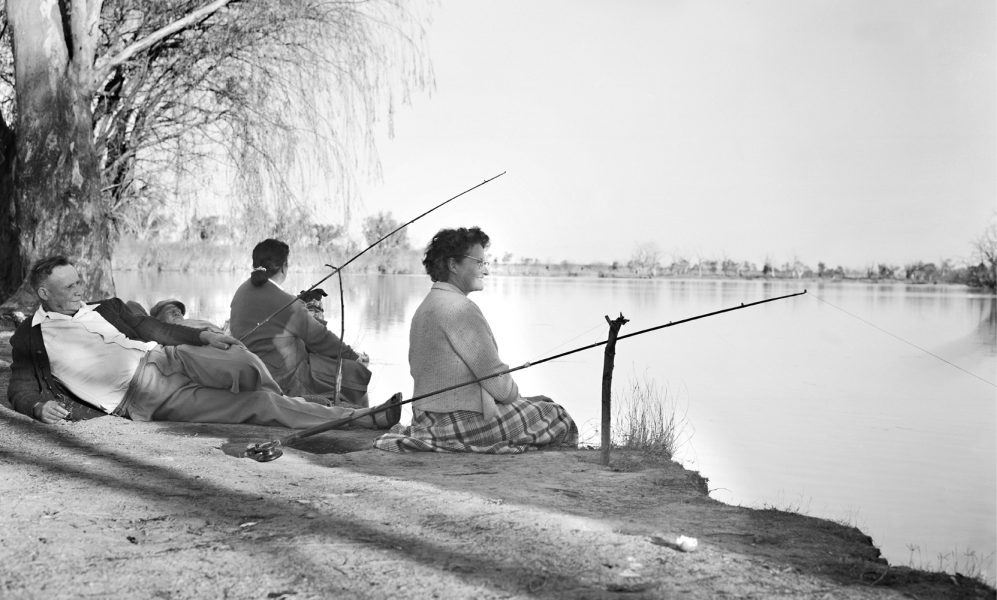
Supposedly hush puppies were fried up and fed to dogs to keep them quiet while fish were fried on the riverbanks where they had been caught as friends and family fellowshipped with each other. Thus, the name, “Hush puppies.” (According to Wikipedia, the name “hush puppy” or “hushpuppy” first appeared in print in 1899)

An alternative theory, a theory that is just as likely to be true, is that escaping slaves used fried cornbread to silence pursuing hounds and to throw them off their scent. Both work for me but the first theory follows better with my pig trail.

At some point hush puppies became a fish camp side dish, and my rabbit hole led me to a seafood platter featuring deep fried flounder or catfish fillets and Calabash shrimp along with mayonnaise slaw and hush puppies.

Fish camps gained popularity before World War Two and owe their beginnings to gatherings on the side of rivers or coastal shores, “creek camps” if you will. Everyone chipping in with fish caught that day, deep fried in seasoned batter, or pan fried after dredging in a seasoned cornbread and flour mix. The main course was served alongside cabbage slaw and hushpuppies. Simple food prepared cheaply, and might I say majestically, with a good dose of fellowship to go with it.
Enterprising souls saw a business opportunity, threw up rough structures, and served up deep fried fish on Friday and Saturday nights. As roads and transportation improved local catfish, carp, and crappy were replaced by flounder, shrimp, and oysters. The ocean’s bounty was transported to the upstate and served on Fridays and Saturdays.

Fish camps once were numerous on both banks of the Catawba River where I grew up. Cute names like “Catfish Cove” or simple ones like the Riverview Inn were prolific. The Riverview Inn featured its own pirate, Captain Windy, complete with a real peg leg but missing the eyepatch and parrot on his shoulder. I really don’t remember it as an Inn and my family was not there for the view. They once served a ton of flounder over one weekend.

In the Carolinas, upstate fish camps were tied to textiles and families. Many were family-run businesses that opened on weekends after the shiftwork of the week was completed. Textile workers flocked to the fish camps and visits to the fish camp became as routine as church on Sunday.

Unfortunately, fish camps are as scarce as hen’s teeth in my part of the world in the foothills of the Blue Ridge. Coastal Carolinas and Georgia have the fish camps, I’m sure Florida does too, but inland fish camps have dwindled into obscurity or become the pricier seafood restaurants.

I’ve been to some of the local ones claiming to be fish camps and if there are good ones, they remain hidden to me…nothing cheap or majestic about their offerings. My taste has changed or I’m still looking for the one perfect fish camp that existed in the late Sixties or early Seventies.

My fondest memory was a wreck of a building at the end of a hard-packed dirt road. A graying whitewash lapboard building covered by a rusty metal roof. Picnic tables with holes in the middle over a trash can to throw shrimp tails or oyster shells. The choices were simple; shrimp, fried or boiled, oysters fried or roasted, and the catch of the day which this day was deep fried flounder fillets. Sides were cabbage slaw, fries, and hush puppies with a hint of onion fried into them.

Squeeze bottles of tartar sauce and spicy cocktail were spaced conveniently around the table along with cheap paper towels to wipe your hands. Sweet tea or iced down PBRs washed it all down. Boiled shrimp and roasted oysters were served on newspaper, the rest in paper “boats.”

I remember a couple of “church” fish fries as a child. My humble Methodist church was a bit more “hellfire and brimstone” and had taken a page from our Baptist brothers. The best way to gather new members was through their stomachs. We just drew the line at requiring a casserole dish to enter Heaven’s Pearly Gates.

From down the road from my home, if the winds were right, late summer would bring the smell of fish frying during the annual camp meeting at the African Methodist Episcopal Zion Church that sat just off the Catawba on one of the creeks that fed it. Later, snatches of them making a joyful noise unto the Lord would be carried by the same breeze. Judging from the smell and the sound, they knew the way to heaven, even if it might have been heaven on earth, deep fried and seasoned by angels from generations past.

Fish camps and their predecessor, “creek camps” bode to a simpler time. Life revolved around work, family, and friends. Fishing was a form of recreation in addition to adding protein to the table. It was also a form of creation as many stories were told on the riverbank about the one that got away.

Combining necessity, recreation, and fellowship can’t be bad. Throw in a “jug band” and a bit of amber liquid and you might have hit on something.  

Don Miller’s Authors Page https://www.amazon.com/stores/Don-Miller/author/B018IT38GM?ref=ap_rdr&store_ref=ap_rdr&isDramIntegrated=true&shoppingPortalEnabled=true

Adventures in Paradise

Martin Denny’s “Quiet Village” is playing in my head.  An early morning conversation with Margaret Dacko cued the music along with a mental side trip to a sandy beach with palm trees and tropical blue-green waters.

I gleefully follow the rabbit trails my mind takes me down.  Wandering is therapeutic, even if it is in your head.  I try to stop short of falling into Alice’s rabbit hole but sometimes….  “If you don’t know where you are going, any road will get you there” or even better, “If you don’t know where you are going you cannot get lost.” 

My rabbit track resembled a jungle waterway filled with alligators, crocodiles, and hippos.  Parrots and other exotics darted in and out of the lush foliage that bordered both sides of the waterway.  Eventually it led to a pristine shoreline complete with coconut trees, emerald blue waters, ivory white sands, and of course native girls in coconut bras waiting on me hand and foot.  There may be a boat drink complete with umbrella in my near future..but doubt the appearance of a native girl.  Is that a sailing ship I see on my horizon?

Margaret Dacko is a former teaching chum and dear friend who shares my curse, being unable to sleep like normal people.  Sometimes, like this morning, we converse during the early, still dark hours via Facebook. 

Our conversation led me to Martin Denny, James A. Michener, Gardner McKay, and the South Pacific or Caribbean Islands of my youthful dreams.  There may be a jungle or two residing there too.

I wander down my rabbit trail to a Monday night in 1959 and an ABC program, Adventures in Paradise,  A program I sometimes was able to watch depending upon atmospheric conditions.  A snowy Gardner McKay starring as Captain Adam Troy of the sailing schooner Tiki.  Sailing around the South Pacific for an hour minus commercials, searching for adventure and romance, always finding a reasonable facsimile around the Tiki’s home port in Tahiti or the Pacific beyond. 

Theme from Adventures in Paradise along with stills from the series. YouTube

Our conversation continued and now I’m playing Harry Belafonte’s “Banana Boat Song” in my head, “Day-O, Day, Day, Ohhh! Daylight come and me want to go home.”  Later my memories trade Harry and Gardner for Perez Prado’s “Cherry Pink and Apple Blossom White,” from the movie Underwater featuring Jane Russell’s breasts in a swimsuit.  I was a young teen when I saw them on NBC Saturday Night at the Movies…I mean it, saw it, the movie, saw the movie. I just remembered Jacqueline Bisset in the movie The Deep. Nice T-Shirt.

Perez Prado and his orchestra. YouTube
Underwater! | Trailers From Hell
A pair of nice ones…Richard Egan and Jane Russell. Movie Underwater. https://trailersfromhell.com/underwater/

As a child and young teen, I was drawn to my grandmother’s National Geographic magazines.  Monthly windows into a world far from the landlocked upper state of South Carolina.  Family vacations to Myrtle Beach or Florida would be as close as I would get to the exotic far off places I read about or dreamed of.  My pirate ship was a small Sunfish sailboat sailed on local lakes…my jungles, the forests of Upstate South Carolina. The Sunfish would be as close to sailing off into the sunset to a tropical island or jungle as I would come.

There would be other books or programs that drew my interest to the exotic, Mitchener, James Clavell or John C. McDonald.  Thor Heyerdahl’s real life exploits aboard the Kon-Tiki.  Marlin Perkins battling an anaconda on the Mutual of Omaha’s Wild Kingdom.   Of course, there was Magnum P.I‘s Hawaiian paradise and the short lived Tales of the Gold Monkey as I moved into adulthood.

There were movies galore in my youth, usually B-movies shown late at night or Sunday afternoons after church. Tarzan or Jungle Jim with Johnny Weissmuller seemed to be a weekly offering. The Saturday morning lineup included reruns of Jon Hall’s Ramar of the Jungle and for some reason I’m seeing Rita Hayworth singing and dancing in Miss Sadie Thompson…hummm, “The Heat is On”. All would be considered socially unacceptable today but were important to my “Beach Boy” attitude.

The Heat is On Rita Hayworth

Even today, much that I read occurs in sunny tropical or at least coastal settings.  I seem to still be drawn to the exotic.

Pat Conroy’s stories set in Charleston, James Lee Burke dark mysteries along the Gulf coast and New Orleans, or Randy Wayne White’s Sanibel Island hero, Doc Ford.  I always thought I wanted to live at a coast…which is why I live as far from the ocean as I can live in South Carolina and still remain in the state of South Carolina. 

I haven’t gone to Tahiti or ventured below the equator to see the Southern Cross.  I still read about soft tropical breezes while roasting my own jerked chicken or coconut shrimp on my Weber listening to Margaritaville on Sirius.  I get to live vicariously through others in my Hawaiian shirt without leaving my recliner or backyard. Still I feel a bit of wanderlust…to the fridge for a Dos Equis or the margarita mix.

Maybe when I finally grow up, I’ll make that trip to Australia.  Maybe move to the Pacific side of South America or a Caribbean island, living my autumn years as an incognito Norte Americano expatriate, all mysterious, an odd little man.  Or maybe I’ll just keep reading, living the life of a want to be beach bum in the foothills of the Blue Ridge.  I think I’ll get a flagpole and run up a pirate flag.  Now I’m hearing Buffett sing “A Pirate Looks at Forty” even though that is a birthday distant in my rear-view mirror.

A Pirate Looks at Forty, Jimmy Buffett YouTube

Thanks for the memories Margaret.    

My little piece of exotica. Martin Denny is again playing in my head.

The featured image is from Adventures in Paradise with Captain Troy at the wheel and an unknown guest star who I should know.

Please take a moment to like Don’s author’s page at https://www.amazon.com/Don-Miller/e/B018IT38GM?fbclid=IwAR3nOBjsp8pBzGU8xJQhoSoZk0SvTPWGEhJEdHkZbe8Y14MMdUFm1IPSyBI

Questions With No Answers


Before social distancing became the in thing, I ran into an old friend I hadn’t seen in thirty years…jeez…more like forty.  I was excited to see her…considering our history excited is not the best descriptor.  Thrilled is a better word.  I was thrilled to see her.

We had a short-term tryst back in the day…just scratching certain itches.  Nothing heavy, a “friends with benefits” kind of thing before “friends with benefits” was a thing…it was the “free love” Seventies after all.  As I think back, I realize there was nothing free about love or even its unreasonable facsimile, lust.

She didn’t recognize me, even when I tried to explain who I was.  Despite the empty feeling in my stomach, I didn’t push it.  She seemed anxious in a bad way.  I think she’s had a stroke or is self-medicating…am I being narcissistic?  Maybe it was my beard, the balding head?  No, I believe there was something wrong.

She seemed frail and infirm.  A woman who once strode through the world confidently was reduced to little shuffles reminiscent of a Chinese woman who had had her feet bound.  The strong alto voice lacked volume and power.  The tall, long-legged, pleasing body seemed to be collapsing in on itself.  Always slender in a good way, she was much too thin.  Maybe it was me looking back on memories through my rose-colored reading glasses.

We remained friends after we both moved on to other places and people…at least I thought we had.  At some point, she seemed to disappear…but, not from memory.  I’ve thought of her often over the years wondering what happened to her.  Wondering if she was happy.  Remembering how foolish I had been.

I wondered if she had moved to a distant part of the world.  Whenever I asked friends, “Have you heard from….”, the answer was always in the negative.

In the mid-80s she decided she was gay and fell under the influence of a “stereotypical” lesbian woman.  You may substitute whatever “stereotype” you wish.  This woman is much more than a stereotype and stereotypes are such oversimplifications.

Still, the time was the Eighties and I was shocked and full of questions.  I’ve often wondered if she crossed over because she was truly lesbian or was it because she had been wounded so many times by people of my gender…or was it I was such a bad lover and friend I drove her to it.  Insecure much?  Ah…yes!

She stumbled and fell over several relationships during those late Seventies and early Eighties.  I wonder if I helped to trip her up as she attempted to recover.  An unwanted splinter under the fingernail of life.  You can tell she is an enigma, she always was.

Are my concerns more about me and my own guilt?  Is it about my own narcissism?  Is it my over-inflated self-importance?  Questions I can’t answer.  Maybe questions I fear to answer.  My greatest question, “Are you happy?”  I hope the answer is yes.

There are questions I can’t even ask.  My friend has dropped off the face of the earth even though she lives exactly where she has always lived.

I think about the crowd we ran with during those thrilling days of yesteryear.  Those days we were lucky to survive.  Those of us still alive have remained in touch.  More so as we have gotten older.  It is as if she has cut all ties with those days and the people who inhabited them with her.   Maybe she wanted to move forward while the rest of us are pulled toward the past.  I know I once did the same thing when my own mistakes became too much of a burden.  Memories too painful to remember…except you do.

Questions, more questions.  Answers, no answers.

***

Don Miller’s author’s page can be found at https://www.amazon.com/Don-Miller/e/B018IT38GM?fbclid=IwAR0813oF-UzSxgl3eyxNYLytu5JhnD70NuizUBdFlbjT2LTyVAXjPEBJZZE

Super Bowl Sunday


I watched the first Super Bowl.  I’ve watched all the Super Bowls.  I guess, unless I go blind, I will watch them all until the “sands in the hourglass” run out.

The first one wasn’t called the Super Bowl.  It was the AFL-NFL World Championship Game back then.  Not only has the name changed, but the game itself doesn’t resemble the first one.  More cameras than there are angles, scantily clad cheerleaders instead of pleated skirts, Bobbi socks and saddle shoes, commercials that were sometimes more interesting than the game itself, half-time extravaganzas instead of marching bands and different rules that the officials continue to blow.  Pretty much the only thing that hasn’t changed is me…laughing, are you?

My love for the game of football hasn’t changed…even though I don’t recognize it as the game I coached and played for three and a half decades.  It seems to be more fun-loving, a less brutal game than the original “three yards and a cloud of dust”version.  Much more fan friendly I guess.  Blame the old fun-loving, more offensive minded, pass-happy AFL, I guess.

As a young child, fall Sundays were reserved for church and a single football game on CBS.  That’s correct…one football game and nine times out of ten it was a Redskin contest.  We did have a thirty-minute highlight show of the previous Colts game.  I’m sure my father prayed at church that no one would decide to visit during the thirty-minute highlight show before the Washington Redskin’s weekly beating at the hands of anyone they might be playing.

Still, I became a fan…of Sonny Jurgenson’s lasers and Billy Kilmer’s wobblers.  It didn’t matter who was under center in the early sixties, victories were far and in between.  At least I had those replays of Johnny U and the Colts…but they weren’t very good either, except in ’59 and ’64.

Every Sunday, late in the game, my father would make the same observation about the Redskins, “I think they have shot their wad.”  For clarification, shooting one’s wad related to old muzzle-loading muskets and not…your dirty mind.

In 1960 a new kid dared to approach the NFL block…an always snowy new kid.  We would attempt to adjust our Sears rotary antenna to distant Ashville hoping the ABC affiliate and  AFL game of the week would come into view.  Click, click, click, “Whoa! That’s too far, go back!” It didn’t matter, early September or late November, the games always looked like it was snowing in black and white on the old RCA.  Later they would move to NBC, a channel we could pick up without snow.

These were the days of the New York Titans, Dallas Texans, Houston Oilers and a few names that would still be recognized today.  No, the Dallas Texans were not the forerunners of the Dallas Cowboys, but the Kansas City Chiefs.  The Cowboys were the first NFL expansion team and while briefly known as the Steers, they opened their first season in 1960 as the Cowboys.

The two leagues would eventually merge but not before the 1967 AFL-NFL World Championship played between the Bart Starr led juggernaut Green Bay Packers and the upstart Kansas City Chiefs with Len Dawson under center.  The score was close at half-time but a runaway by the end of the game.  Green Bay’s smash-mouth brand of football won 35-10 and began fifty-three years of futility as I repeatedly pull for the wrong team.

I’ve quit pulling for anyone…well, maybe I’ll pull against someone…like Brady.  It won’t matter.  If he were a religious figure, he’d walk on water.  Is that blasphemy or heresy?  I can never remember.

I’ll watch to the bloody end, maybe the commercials will be good.  I’ll watch and heft a beer and toast my father.  I’ll even use his favorite phrase when watching a fourth-quarter pass fall harmlessly to the ground…”Well, looks like they’ve shot their wad again.”

The only thing to be decided is who shoots their wad and how many of those beers I heft.  Go Budweiser Commercial!!!!

Further musings and a book or six can be found at https://www.amazon.com/Don-Miller/e/B018IT38GM


WASTE NOT

Excerpt from the book PATHWAYS which will be released through Amazon in late November.

When did we become such a disposable society? I wish people would quit disposing in my front yard. When did planned obsolescence become…planned? I remember ranting to a science class about wasting resources before I even knew what planned obsolescence meant. Does that make me clairvoyant? No, it probably makes me Clarabelle the Clown. Just because we can throw away a plastic bottle should we? Why do we change fashions every season? Hems go down, go up, then go down again while ties get wide then narrow then wide again. How many of you actually wear something until it wears out? Blue jeans maybe. How many of you really drive a car until the wheels metaphorically fall off. I’ve tried often. Linda and I bought an ’86 T-Bird with sixteen miles on it. It was a beauty. Two hundred and sixteen thousand miles later, thinking we had “licked all of the red off the candy” we traded it for a Mustang. A local teenage boy bought it…and the now father of three is still driving it. Presently I am actually attempting to see who can hit a quarter million first – me or my ’97 Cherokee “Bessie Mae.” We just cracked one hundred and ninety thousand on the “Bessie Mae” but I may be slightly ahead. Am I the only one to name his cars?

My grandparent’s generation were the ultimate recyclers and repurposers. My grandmother was also huge on sayings, “Early to bed, early to rise”, “a fool and his money” and one that I heard maybe daily was “Waste not, want not.” She lived it. Old plastic Clorox bottles were carefully cleaned, holes punched in the bottom and a hole cut about a third of the way up from the bottom. Why? It would become a martin house that would join a colony of Clorox bottles suspended over the garden providing homes for birds that became part of Nannie’s insect control. Buttons were cutoff of unrepairable clothing that would be later repurposed into patchwork quilts with matching pillow covers. The buttons themselves were put into an old Quaker Oats container for future repurposing when I didn’t play with them. My first set of drums were old Quaker Oats boxes and a really magical “comeback” toy. Shoes were “half-soled” repeatedly, old overalls that had finally given up the ghost were cut into patches to extend the lives of this generation’s overalls and blue jeans.

Fall would herald another type of recycling. Dried corn and beans were gathered, the best put into burlap cloth sacks and suspended from the high rafters of the crib. There they would wait until the spring to be shelled out and replanted to provide the next year’s bounty. Potatoes were spread and separated from each other on old newspapers in the darkest corner of the crib waiting to be made into chowders, salads and mashed potatoes. Those that survived the winter were cut, dividing the eyes, and replanted in the spring to start the cycle of life all over again.

Late in the fall an odd-looking truck would show up. It was the miller’s truck, not to be confused with the Miller’s truck. This was cutting edge technology for the period. Instead of taking your grain to be ground up, the truck showed up to grind your grain. This would be preceded by a flurry of activity as corn was shelled from the cob, dang that really hurts your fingers. Corn was ground into cornmeal and grits and no I had never heard of polenta. Even the cobs were ground into a fine powder that was mixed with water to be fed to our hogs. None of this could be done until my grandmother had chosen her feed sacks. This was the ultimate repurposing. She would use the emptied feed sacks to make “sack” dresses that she sewed on her foot-operated Singer treadle sewing machine. Rarely, until later in life, did my grandmother wear anything other than homemade dresses, many made from old feed sacks. Later they would be repurposed into cleaning rags or tie ups for the tomatoes. If they were a particular favorite they would be put into her scrap bag to become a part of a quilt. I am lucky to have several.

A LITTLE BIT OF EDUCATION…

This is an excerpt from the book “Pathways” which will be released in mid-November.

I have joked to my classes that I went to the the only elementary school, called a primary school back then, that had a student parking lot. I did, but it was because I went to Indian Land School where kindergarten through twelve was housed in the same building that had just one parking lot. A long low brick building similar to all that were built in the late Forties, it sat on the top of a small hill overlooking Highway 521. The primary school was housed downstairs on one end while the junior high was up the stairs above it and separated from the high school by huge double doors. For my first eight years the only time we ventured into the realm of the upperclassmen was the occasional trip to the library or auditorium and daily, having lined up like Clementine’s little ducklings, when we quietly marched to the cafeteria for lunch. The only sounds allowed were the taps and clicks caused by hard soled shoes on the highly polished hardwood floors.

In order to meet the needs of a modern world, a gymnasium was built adjacent to the high school wing. Other buildings had been added to accommodate such non-core classes as Ag, shop and band, and to house sports facilities in the form of football and baseball locker rooms. These rooms surrounded a cannery that was opened in the summer months and used by all of the families… make that all white families in the area.
There was no kindergarten during those years either. In those days, parents were still responsible for teaching basic ABC’s, numbers, and colors and such – things that kindergarten teachers are now saddled with because parents are way too busy to teach them.

My kindergarten education was year-round and administered not only by my parents but also by my grandmother, Nannie, who was an exacting taskmaster. Even during the summer months between sessions of school my education continued. While other children frolicked, romped, hither and yon seemingly doing nothing educationally, a bookmobile would show up at Pettus’s Store. Every two weeks, like clockwork, my grandmother would take me by the hand and walk me down to Pettus’s Store “to meet the bookmobile,” a vehicle which looked a lot like a converted school bus of a great age. Inside, instead of seats, there were shelves with rows and rows of books on every subject. I would pick out three books that interested me and Nannie would pick out three books that she thought might interest me. Of course the books she picked were of some type of educational value like say Einstein’s Guide to Quantum Mechanics. That gave me a total of six possible books to read over a two week period.

There really wasn’t anything possible about it because I did not seem to have a choice. Sit your self down under yonder shade tree and read or walk yourself out to yonder hot sun and corn row and pick up a hoe. There did not seem to be anything to debate so I became an avid reader and still have not found a hoe that comfortably fits my hand…not that I am actively looking. At any time, while sitting under that shade tree, I might be called upon to read aloud and could expect to be quizzed with a Moon Pie as a treat instead of a carrot strung onto the end of a fishing pole. I did not realize how much I would appreciate that later…much later. During the winter months, activities might be changed due to the weather but still were focused on the three R’s and a healthy dose of Biblical study that went on 24/7 it would seem.

Because all children did not have the benefit of my grandmother and because “Some Children Are Left Behind”, regardless of what a former president might have passed into law in the far distant future, we could have had an elementary school with a student parking lot because the concept known as social promotion was several years down one of those pathways in South Carolina. That’s right – no social promotion! The good side of that equation was that there was no compulsory attendance rule either. Good side? I have been on both sides of the coin. I was a student when there was no social promotion or compulsory attendance and then a teacher under both systems. So which do I prefer? Unh-Unh! That is my secret but there are reasons why South Carolina’s education system ranks so low today and why we had no social promotion or compulsory attendance rule at the time.

Those reasons are connected. We are still trying to shake off and remove the cobwebs from the years when I was a public school student and cotton textiles were still king in the New South. I am not implying that it was the intent of mill owners or their politicians, held firmly in owner’s pockets, purposely to keep the state “stupid.” Well, maybe I am. One did not need a particularly “globally aware” or educated workforce to produce the raw materials and finished products associated with textiles. Remember, an educated workforce might actually ask for a raise or, worse, mention the word—union. You really did not need to know your multiplication tables to do most jobs in a cotton mill although I did, in fact, have to use a slide rule in one. Yeah and I still have yet to use Algebra in the last fifty years. I keep hoping my education was not for naught!

Textiles also provided the ultimate “alternative” school. Where does a “left behind” fourteen-year-old sixth grader go when he decides to drop out of school? In my day, they became solid, tax-paying citizens who labored in the lower recesses of the cotton mills doing those jobs that were highly repetitive, back-breaking and lower paying until they taught themselves something else that would elevate them to another highly repetitive, back-breaking but higher paying “low paying job.” Understand, these low paying jobs still provided a higher level of poverty than the rest of the world enjoyed. We were still taught that education was important and that a high school diploma was the only way to get the “better” jobs in the mill. The problem today is that we do not have that “alternative” school any more and there are only so many shifts at “Mickey Dee’s” or the like.

THE CELLAR

It was an early Sunday morning, as in one or two in the morning. I had just returned to my dorm room from a date with a young woman who was successfully auditioning to become ex-wife number one. Sitting at my desk listening to the radio I was shocked to hear that Billy Stewart, the singer, had died in an automobile accident near the North Carolina coast. It was January 18, 1970; he had died just hours before. Saddened by the news of his tragedy, for the next hour I sat and listened to Billy Stewart’s greatest hits while reminiscing about seeing him live the previous summer. “Summertime,” “Sitting in the Park,” “I Do Love You,” “Secret Love,” – I heard them all and more that morning on WKDK. I had been there to watch him sing all those songs live at The Cellar in Charlotte in 1969.

To this day, I enjoy “hole-in-the-wall” kinds of places, and The Cellar was certainly that. A little dark, it was mostly lit by neon beer signs and had an ambience that was special only to me. A door next to a large oak tree had a simple wooden sign above that welcomed you to “The Cellar.” That tree with roots that had pushed their way above ground level was an obstacle to getting into the club. I think it had become a type of “drunkenness” test administered by the bouncers taking up the cover at the door. I once had a friend get kicked out for being drunk after he had tripped over one of those roots. The problem was we hadn’t made it into The Cellar to be kicked out of The Cellar. Don’t you have to be in before you are thrown out?

The Cellar was aptly named being in the basement of an office building. Once you navigated the tree roots, paid your dollar cover and walked through the door, you would be assaulted with the sound of a live band playing “soul” or “beach” music or the greatest “beach” music jukebox in the world doing the same. A bar, located to the right, ran the length of the foyer for lack of a better descriptor. Double archways separated the bar from the young people “strutting their stuff,” dancing a dance known as the “Carolina Shag,” a descendent and a much slower version of the Jitterbug. The dance itself and the music that went with it was born on the shores of the Carolina Grand Strand and continues to be so popular today that it has been named the state dance of South Carolina. A small bandstand was located against the left-hand wall in front of a hardwood dance floor. The rest of the flooring was unfinished concrete. Near the right-hand wall was a small seating area. In addition to the music that made normal conversation impossible you would be seduced by the smell of stale cigarettes and spilled beer. Oh, how I loved it!

The Cellar had everything a college boy might desire. It was such a ratty place that people our age could do as we pleased and there was no way we could mess it up any more than it was. We certainly did not have to be rich to go there as it had a cheap cover charge, live bands, fifteen-cent drafts, and college girls…if you had a good line to meet them. I did sing the Sam Cooke lyrics from “Another Saturday Night” on occasion, “If I could meet ‘em, I could get ‘em, as yet I haven’t met ‘em, that’s why I’m in the shape I’m in.” I wonder if a simple “Would you like to dance?” would have worked? I was not shutout every night but the night I heard Billy sing live I invited Sally McGinn to join me to ensure I didn’t want for female companionship. It was a good thing. There were so many people jammed in to such a small space, movement, or meeting anyone was nigh on impossible. I remember being packed in so tightly Sally and I could not have been any closer unless it had been our wedding night. No, tightly packed doesn’t quite describe it. When we left, the floor was so sticky with spilled beer, momentarily I was cemented to the concrete. I miss that.

Billy was not the only live act to grace the small stage at The Cellar. Every weekend there were different groups performing. Archie Bell and the Drells “Tightened Up,” The Georgia Prophets gave me a “Fever” and the Catalinas reminded me that “Summertime’s Calling Me,” as is The Cellar…which, like so many places of my youth, no longer exists. There is a restaurant in its place now. Much of my time during the summers of ‘68 and ’69 was spent pursuing coeds at The Cellar. High school friends, Al Stevenson and John Nesbitt, along with myself, became the Three Musketeers those summers pursuing “man’s favorite sport,” but like “car chasing” dogs, rarely did we catch our quarry. We were the Three Stooges instead. We worked during the summer, and I remember many nights getting home just in time to change clothes and head back to work in Charlotte. Working for Crowder Construction Company on Interstate Seventy-Seven, I attempt to avoid bridges that I know I worked on during those summers. I fear they could fall in at any minute.

Trips to The Cellar were not limited to summers. There were many sixty-mile road trips from Newberry to Rock Hill in Sid Crumpton’s VW or Tom Hocker’s little foreign car with the caved-in trunk. We would pick up dates at Winthrop before making the short jaunt into Charlotte. Yes, there were several late nighters that saw us back at Newberry just in time to make our morning classes. Dr. Wilson, a history professor, once remarked, “Miller, if your eyes are hurting you as bad as they are hurting me, you need to bandage them.” I WAS looking through a pink haze.

My last trip to The Cellar would occur in the summer of 1970. I brought Dianne, the woman who would become ex-wife number one, home to meet the family and later took her out for an evening of shagging at The Cellar. It was a standout night that figures prominently in my memories. Dianne was a statuesque redhead who rocked a red-patterned halter suit that she filled out quite nicely and more than adequately. We ran into Al and with his drooling Saint Bernard impersonation I would say he was impressed, too.
I’m not really sure why I never went back. I know I never intended not to. School, life, and marriage along with divorce got into the way. I think in some ways it was a sign of the times, or I just grew up…Nah! Al decided to hitch hike to California. He didn’t make it out of Charlotte and ended up living on a local commune trying to find himself. I understand he was successful. John followed the same track as I, teaching before getting into school administration before he died. Shamefully, to my knowledge I never saw them again.

While the music didn’t die it changed along with the times. It went from easy rhythms about love to harsh Protest music. Shagging to that was impossible and the mood was wrong. In 1977 Saturday Night Fever put a spotlight on dancing suits and Disco. It was something so different I never even tried to get the hang of. As disco fought its death throws, Urban Cowboy was released, making Country, the Texas Two-step and line dancing the craze. Somewhere in the Seventies and Eighties I got lost and our ratty club became a ritzy restaurant and…sadly, like Al and John, a memory of something that once was.