Sittin’ and Whittlin’

“Whittling is not just a hobby it is a life skill” -Unknown

In my youth, late in the evening as the workday had wound down, it was not unusual to see old men sitting in rocking chairs or on benches under the overhang of the Junior’s old mercantile. I was ten or eleven, pumping gas, checking oil, and air pressure for my cousin who owned the store. The pay was minimal, but the life lessons were worth millions.

Some of the men told stories while the group listened…I’m sure their stories were retold and embellished over time. Most participated, waiting their turn, laughter erupting periodically. Some of their discussions revolved around the news of the day. There was plenty to talk about in the late Fifties and early Sixties, little brought laughter. Some days a mason jar with a light amber liquid might have been passed around.

They were ‘workin’ men’, all weather beaten, faces crevassed with age and burned brown from too much time spent in fields. Their eyes had a permanent squint from staring toward the sun. Bib overalls or old-fashioned blue jeans were the fashion statements along with fedoras or baseball caps pushed back exposing their less tanned foreheads. The denim was faded from many washes and was patched on top of patches. Heavy work shirts and brogans completed their attire. They were comfortable in their clothes and with the company they were keeping.

There was one man, Mister Jesse, who sat leaning forward in his rocking chair, elbows resting on his knees. He was more a listener than a talker. A Barlow knife was held in his thickly callused hand. In the other was a thick piece of tree limb. As he listened, he used the knife to peel slivers of wood that made a small pile between his feet.

Mister Jesse was a short squat man, more powerful than fat, although the ravages of time had reduced his muscle mass and gravity had pulled his chest toward his middle. He wore thick glasses and squinted at the stick he was whittlin’ on. I wondered if he worked more by feeling than by sight.

There seemed to be a certain art to his knife strokes. If not art, a method to his madness. The shavings were almost uniform. Thin splinters about an inch long until the bark on the limb was gone, its surface smooth and creamy pale with a hint of green. He would pause periodically and put the knife down and stroke the limb like the arm of a woman, the arm of a special woman.

Once he caught me looking at his knife. The blade polished and curved from use and untold sharpening. When closed, the blade hid inside of a bone handle. It might have been three or four inches long.

Mister Jesse smiled, a gap in his front, lower teeth, “You like my knife, boy?”

I was timid but softly answered, “Yes sir.”
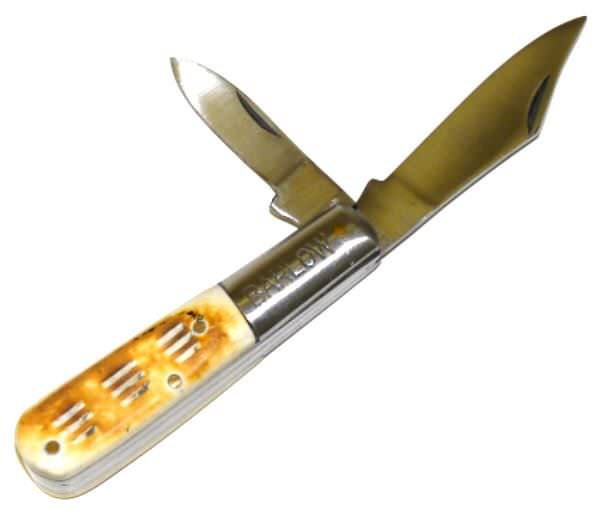
Barlow with a bone handle

“It came from the old country. A genuine Barlow made in Sheffield. My great grandfather carried it across the ocean to Pennsylvania and down through the mountains until they settled here. He passed it down to his son who passed it to his and it was passed down to me. Would like to hold it?”

I nodded, “Yes sir.”

He handed me the knife, handle first, “Careful now, that ain’t no toy. Here take this.” He handed me the limb. The bone handle of the knife was rougher than the stick.

Taking my hand and demonstrating, “Hold it like this and draw the knife away from you. Never cut toward yourself iff’in you can help it.”

I was tentative and stroked the knife away from me, cutting a splinter the size of a sewing needle. The next was wide and too deep. It was harder than it looked.

“That’s right, boy. You’ll get the hang of it. You got a knife?”

“No sir.”

“Well, a boy needs a knife. Junior got some Barlows. They Russell Barlow’s but they still good ones. Save up and get you one.”

I did and I’m sorry to say it was misplaced years ago. It was a working man’s knife. Single bladed with a dark wood handle. A locking clip held it in place when opened and an R with an arrow through it was stamped on the metal that held the blade. A Russell Barlow, still a good one.

The knife that triggered my pig trail wasn’t my knife but my father’s. A small twin bladed knife with a creamy yellow mother of pearl handle. It wasn’t a working man’s knife although my father was a working man. I like to think that it was his “Sunday” knife, more for show than work.

The knife sits in a box on my desk in the study. I don’t carry it because I fear I might lose it. I want to pass it down. I don’t have a son, but my daughter might appreciate it. I don’t think my grandson is old enough to appreciate its history much less be turned loose with a sharp object. In time, I guess.

I need to do a bit of work before I pass it along.

Mr. Jesse passed when I was in college. The art of whittlin’ has passed with him, I think. There is too much going on to just sit and whittle. I’m guessing a lot of thinking passed with it, too. Many of the world’s ills might be solved if we took a moment to sit and think, slivers forming a pile between our feet.

I’m old like them now…well-seasoned. I have squinted into the sun too much and my chest has fallen into my middle. I feel about all I’m useful for is whittling. I need to go buy a good knife. The Barlow Company no longer exists, it was bought out in the mid-2000s, but the name continues as a style of knife. I hear Case makes a good one. Nothing fancy, just a good working man’s knife. So, Mr. Jesse, wherever you are, I reckon I’ll save my pennies and get one. I still have time to become a good whittler.

Don Miller’s author’s page can be found at https://www.amazon.com/Don-Miller/e/B018IT38GM?fbclid=IwAR04JmryGiZ4dKmFNiUXijmwZNfx1a7sd1DFHEVnI7HC8qB1jIT7BisYfqs

His newest release is the non-fiction “Pig Trails and Rabbit Holes”, more musings of a mad Southerner. https://www.amazon.com/gp/product/B09GNZFXFT/ref=dbs_a_def_rwt_bibl_vppi_i1
STUPID MAN TRICKS

Excerpt from the book FLOPPY PARTS which may be purchased at http://goo.gl/XdazVA

RJ was a bit of a thrill seeker. He would have been a perfect fit to play the Tom Cruise character in the movie Top Gun because RJ always “felt the need for speed” whether it was fast women or even faster cars. Since this was before a desire for fast women, RJ would satisfy himself by climbing the highest tree or swinging out the farthest on the school swing before ejecting himself for a crash landing. All of this would serve him well. When I left for Newberry, RJ left for the Navy, specialized in avionics and anti-submarine detection before retiring to a very high paying private sector job in avionics. This would lead to his obtaining a pilot’s license and an airplane. I feel sure the airplane came first.
The trouble began when we watched Roy giving chase to the bad guy who beat Roy over the head with his tommy gun before jumping in his car and racing out of town. Roy, now conscious but still stuck on a second floor balcony, whistled for Trigger and with nary a grunt jumped onto Trigger’s saddled back, saving enough time to chase down the bad guy and shoot out his tires. RJ was mesmerized. “That was great! I’m gonna do it.” I was mesmerized to but for a different reason. Roy did all of this without losing his hat and despite a loaded Thompson sub machine gun on the seat next to the villain. Immediately I pointed out that we had no horses and I knew of no second story balcony except the Nesbitt mansion and it was too far to ride to on an imaginary horse.
Not to be deterred, RJ had a plan– otherwise known as a “stupid man trick” and the reason bicycles should come with warning labels. When we played “Cowboys and Indians” we always pretended our bikes were horses. RJ decided that his bike would be his horse and that I would be his faithful Indian companion who would make sure his steed remained upright and in place. Can you visualize “Kemo Sabe” jumping off of the barn loft and into the saddle of his bike? RJ would then peddle off after imaginary desperados. It did not quite workout that way because for at least once, Kemo Sabe meant “dumbass” white boy. RJ actually missed the first time and landed butt first in the piled up hay we had used to help break his fall. We should have piled up hay on his bike saddle because he didn’t miss the second time. Who knew someone’s eyes could get that big and that your “floppies” were somehow attached to your vocal cords. He landed upright but didn’t remain that way. With his eyes as big as pie plates, his breath exploded from his lungs and he toppled sideways with his hands cupping his…you know. For the next fifteen minutes RJ was struck mute. When he finally found his voice, the first words that came out of his mouth were “If you ever tell anyone about this I will beat your ass.” Well RJ, it’s been over fifty five years and you are welcome to try.
I went to Wally World today and found myself in sporting goods looking for a new rod and reel. I did not find what I wanted but I also did not find any warning labels on their shiny new bikes that I stopped to look. I doubt there is one on my bike either but there should have been one and it should have read “Warning: Jumping into the saddle from excessive heights may render you sterile for life and speechless for fifteen minutes.” I will let you determine what is excessive.

BARNS AND BUTTERMILK

Sitting across the road from my house is an old red barn. Some one hundred and twenty years ago that same barn sat on land that was part of an original two-hundred-and-fifty-acre tract of farmland formally known as The Bramlett Place. By 1987, when we signed over our lives over to it, that original tract of land had shrunk to eighty-five acres which was eighty more acres than we were looking for.

The original tract had been dispersed to who knows where. I know part of it was sold as a tract of land across the road because, at some moment in history, the original barn was separated from the farmhouse by what is known today as Scenic Highway 11 or the Cherokee Foothills Highway. My garden is located directly across the road from the barn and there is not a day that goes by that I don’t commit the deadly sin of envy because I covet the barn. I guess it could be worse; I could be coveting my neighbor’s wife.

I love old barns. I stop and take pictures of old barns and try to visualize how they would have looked in their “hay” day. I have even drawn plans for my own barn that I am going to build one of these days, if that day ever comes before the sands of the hourglass run out. I love what I would call old southern barns that aren’t tobacco barns, although even tobacco barns beat the gambrel or saltbox roof…for looks. For some reason I associate gambrel-roofed barns with the barbarian part of the world located above the Mason-Dixon Line. I’m sure that, for usable space, gambrel roofs allow you to put more hay in the loft but how much hay do you need for one horse and one cow?

I associate barns with my youth. One plow horse and one milk cow were all we had, and our barn didn’t have those nifty advertisements painted on the side either. “Visit Lookout Mountain”, “See Rock City” or “Drink Coca Cola” would have been nice, but you could not have seen it from the road anyway.

My grandparents’ barn was a slab-sided barn. For the uneducated, slabs were the outer bark covered planks that were first trimmed from the log that is being processed. Because a log has a rounded surface, slabs cut from a log had one round side and one flat side. Since they were cut from different sized logs there was no rhyme or reason for their width. This made them only useful as barn siding or for burning in a wood stove or fireplace. We did both.

My grandfather and his brother, Banks, ran a sawmill during the winter months to help make ends meet until my grandfather began working full time at Springs Mills. The sawmill itself consisted of a large rotating circular saw blade that was turned with a pulley belt attached to an incredibly old tractor. I do not know this for sure, but it makes the story in my head warmer to believe that Paw Paw not only built the barn with his own hands but also built it from the lumber that he and his brother milled themselves. True or not, that is the story that I have decided to believe.

As a child that barn seemed huge but, as I sit here as an adult, I realize it could not have been that big. It had only a pair of stalls on one side and a tack room and workshop on the other. It was separated by an entry way large enough to accommodate an old wagon and various plows, planters, and a drag-harrow. Above it all was a loft that was a child’s dream of a playhouse…until I found the twenty-foot snakeskin. Okay, it might have been a little shorter.

Cowboys and Indians, war games and hide-and-seek were all played in and around that barn and in its loft. One game that almost got out of hand was played after seeing some old western movie where the hero jumps from the second-story balcony onto his horse and, without so much as a grunt, rides off after the desperados.

My best bud decided he wanted to imitate Roy Rogers but because we didn’t have a second-story balcony or a horse at the time we decided to use the loft and his bicycle as stand-ins. That didn’t turn out too well and, thankfully, he jumped first while I was holding his bike. Ouch! Not that I was a chicken or anything, but I decided quickly that I didn’t want to imitate him. I wonder if he ever had any children.

One of the first clear memories that I have as a child is of following Nannie, my grandmother, into the barn at dark thirty to milk the cow. Winter or summer, clear or rainy, it did not matter. The cow had to be milked and it was milked every morning before my grandfather returned from his third shift at Springs in his ’49 Oldsmobile Rocket 88.

During the spring and summer, after a breakfast that always included fresh milk, biscuits, grits or oatmeal and eggs, he would trade the Olds for the plow horse and head to the fields before finally going to bed in the early afternoon to rest for his next shift that began at ten that night. My clear memory is of Nannie milking that cow while squatting on her heels in the manner that only country folks can seem to achieve. The memory must have been of an event that took place in winter because my memory is of the steam first rising from the water Nannie used to wash the cow’s udder and then from the milk itself as it hit the cold milk bucket.

Before being refrigerated, the milk would be placed in a clear pitcher and allowed to separate. Cream would rise to the top and be skimmed off and used for baking or to “whiten” the bitter Luzianne coffee with chicory that my grandparents preferred. Of course, there would be raw, unpasteurized milk for the rest of us.

Once a week it would seem, leftover milk would be poured into a churn and turned into sweet, pale-yellow butter and its byproduct, buttermilk, which unlike the butter, was not sweet at all. While I cook with it, buttermilk is not something that I have ever developed a taste for so. I got lost on that path around home.

I remember meals that involved leftover cornbread crumbled in cold glasses of buttermilk. In my mind’s eye I see both of my grandparents wiping their mouths after finishing off a glass of buttermilk and smiling in such a way to make me believe it was the best liquid libation one could have. Eventually the “buttermilk gone bad” would be fed to the hogs.

Periodically, I drink a little buttermilk just to remind myself that I still don’t like it and that I don’t really know how you tell if buttermilk has gone bad. Aside from what was used to make biscuits, it all could have gone to the hogs. Luckily, my youthful memories are as rich as the raw unpasteurized sweet milk in my grandmother’s milk bucket. There are only a few memories that remind me of the soured buttermilk we fed to the hogs.