Spam…balaya, Crawfish Pie, Filé Gumbo….

“100% True Fact: Spam means; Sizzle, Pork and Mmmm. Someone tell me I’m wrong…”― Skylar Blue

SPAM actually stands for spiced ham according to its producer Hormel.

A pig trail ran through shredded Spam and scrambled eggs, twisted to lettuce, tomato, and Spam sammies, switched back to Spam and fried potatoes, to a now dead college chum and his recipe for Spambalaya. Johnny Bolt, you little bald-headed demon, I miss you, I do.
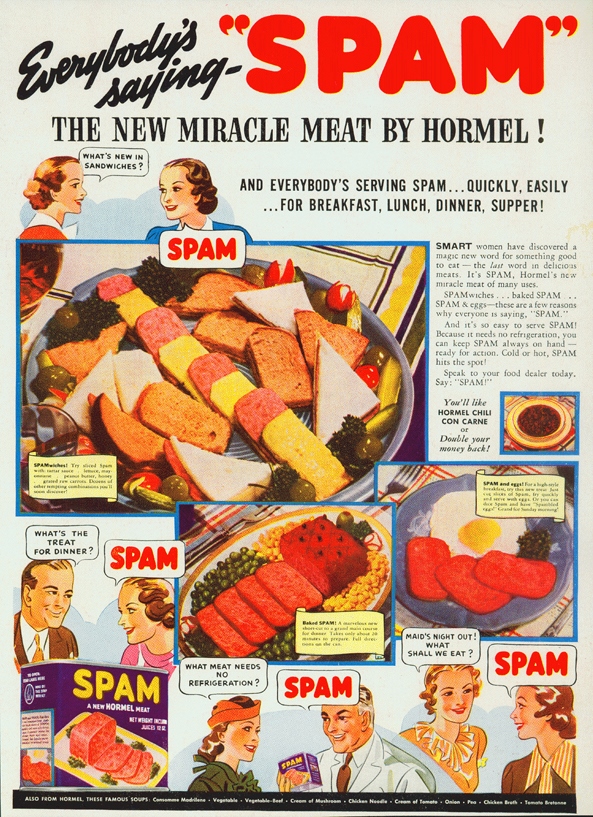
Miracle Meat not Mystery Meat

If you are newer to this earth, Spam is tech lingo for unwanted, unsolicited mass communications. While the term is most associated with email, it can also be used to refer to spam comments on blogs and social media, physical junk mail, robocalls, and more.

The newer description is an assault on a once proud delicacy created by Hormel in 1937 to sell more pork shoulder, the weakest selling part of the pig at the time. For those not in the know, pork butts are not butts but pork shoulder. Back in the day, they were shipped in what were known as butts (barrels), after being butchered in New England or Boston. That’s how they got their name, Boston Butts, but more importantly, they are the star ingredient in pulled pork barbeque…and Spam.

According to Wikipedia, Spam is sold in forty-one countries, trademarked in one hundred, and sold on six continents. It tends to freeze too easily in Antarctica I reckon. In the U.S., Hawaii is the state with the highest per capita consumption of Spam, which has become a major ingredient in Hawaiian cuisine.

Muriel Miura’s Hawaiian Spam Cookbook

Why did it become such a seller? During World War II, the U.S. government sent Spam to the troops because it was easier to deliver than fresh meat. It came precooked in a can, so it didn’t need to be refrigerated or cooked to consume, necessities under battlefield conditions.

By mid-war, Hormel was producing fifteen million cans of Spam for the troops each week. Hormel was buying 1.6 million hogs each year, and 90 percent of the canned goods were going to the military. After the war, soldiers returned home with either a taste or disdain for this odd product, and Spam has adorned grocery store shelves ever since.

We also supplied it to our allies including England and the Soviet Union. Soviet leader Nikita Khrushchev wrote in his autobiography, “Without Spam, we wouldn’t have been able to feed our army.” Before she became the English Prime Minister, Margaret Thatcher, a teen at the time called it, “a war-time delicacy.” “Spam the food that won the war!!!”

Spamville somewhere in the Pacific during WW 2

My father was a World War II vet, and he brought home a taste for the salty processed canned pork made primarily from pork shoulder and ham…with a bunch of nastier ingredients like fat, sodium, and preservatives. People were not deterred by its high fat and sodium content. Austin, Texas even celebrates it with their annual “Spamarama.”

During my childhood, we ate it a lot along with bologna, deviled ham, and Vienna sausages. We considered Spam to be a higher quality meat. Bologna, deviled ham, and Viennas were lunch selections, what we call dinner here in the South. Spam was reserved for a simple supper, the evening meal.

“Don’t knock it till you’ve fried it” was once a catch phrase for Spam. I honestly haven’t seen a Spam commercial since…well…since the last time I ate it which has run into decades ago. I don’t know why.

It is not a healthy meat choice, but I would say I wasn’t eating it well before I turned my lifestyle around after a 2006 heart attack. I’m not inclined to run out and grab a tin, but if I do, I might try Johnny Bolt’s recipe.

Johnny passed over a decade ago. Our lives first tangled in college the fall of 1968. He was a cocky little fellow, mostly bald by age eighteen. By the time his hair fell out, he had quit growing upward, topping off at about five-five.

When it came to playing the saxophone, he had an ego the size of a sperm whale. I was the only member of the saxophone section of our jazz ensemble that wasn’t a music major and played like it. Johnny was at the other end of the spectrum, and I guess I was a bit jealous. What is it they say? “It ain’t braggin’ if you can do it?” Johnny could do it.

We both became teachers; he was band director, and I became a science and history teaching football and baseball coach. It was inevitable we would run across each other when our schools faced off, but in the early Nineties, we found ourselves teaching at the same school.

It was at Riverside High School that the powers that were decided we should publish a “Cookbook” as a fund raiser. Johnny’s submission was “Spambalya so good it will make you want to slap your momma.” Before you ask, I did “Chicken Cooked in the Ground,” one of the only things I learned in the Boy Scouts.

As it turns out Johnny’s recipe for Spambalaya came directly from a Spam cookbook from the Fifties. Teachers are adept at stealing good lesson plans, why not a recipe? I did add some spices to “kick” it up a bit.

“Spambalya so Good it Will Make You Want to Slap Your Momma!”

Ingredients

1 (12 ounce) can spam luncheon meat, cubed (It called for lite, but I’d use regular. Why bother.)

1 tablespoon of vegetable oil

1 cup chopped onion.

2⁄3 cup chopped green bell pepper.

1⁄2 cup chopped celery.

A tablespoon of chopped garlic

1 (14 1/2 ounce) can diced tomatoes (use liquid from tomatoes)

1 (10 3/4 ounce) low sodium chicken broth (I use regular)

1⁄2 teaspoon dried thyme

1 1⁄2 – 2 teaspoons hot sauce (recipe read 6 to 8 drops)

1 bay leaf

1 cup long grain rice

1 tablespoon chopped parsley.

If you wish to add shrimp or chicken, please do.

Cajun spice mix, if you desire, and I would.

Directions

In a large non-stick skillet over medium heat, sauté spam until browned.

Add vegetable oil, onion, green pepper, celery, and garlic. Cook until all vegetables are tender.

Except for rice and parsley, add remaining ingredients.

Bring to a boil and add rice.

Cover, reduce heat and simmer for 20 minutes or until rice is done.

Remove bay leaf, and sprinkle with parsley.

Best served with an ice-cold pilsner beer. Put on some Zydeco and laissez les bons temps rouler.

***

I could not find a live version of Jambalaya On the Bayou. This will have to do.

Don Miller writes in various genres and on various subjects. His author’s page is found at https://www.amazon.com/stores/Don-Miller/author/B018IT38GM?ref=ap_rdr&store_ref=ap_rdr&isDramIntegrated=true&shoppingPortalEnabled=true

REMEMBERING PEARL HARBOR Revisited

I was nearly a decade away from even being a glimmer in my parent’s eyes when the Japanese attack on Pearl Harbor occurred on December 7, 1941, so I have no true remembrances of the “Day Which Will Live in Infamy”. My remembrances come from listening to my father and his buddies talking, history books and movies.

My father, a single, twenty-six-year-old at the time, did what many patriotic young men did and with several friends headed to the Marine recruitment center to join up…only to find out he was 4F due to a birth defect he didn’t even know he had. Determined, he attempted to enlist in the Navy and Army but was turned down. Two years later, the now-married twenty-eight-year-old, would receive a letter that might have begun “Greetings, your friends and neighbors….” Drafting a married, twenty-eight-year-old missing an entire row of ribs and vertebrae they attached to should tell you how dire the situation was in late 1943.

I remember sitting as a family in front of our black and white television on a Sunday evening, December 3, 1961. Walter Cronkite was the narrator of the CBS documentary program, The Twentieth Century. On this particular night, the Sunday prior to the fifteenth anniversary of the Pearl Harbor attack, we sat as a family watching and listening.

The episode was “The Man Who Spied on Pearl Harbor” and Cronkite’s distinctive voice narrated the black and white action scenes, some made as the attack occurred, most staged for propaganda use during the war itself, as we remembered Pearl Harbor…and as I remember that night in 1961.

Over the years my thirst for knowledge about Pearl Harbor and my father’s war has caused me to read, watch or listen to almost every available documentary, book, movie or interview about Pearl Harbor specifically and World War Two generally. Thankfully I had access to the History Channel when it actually aired programs about history rather than programing about Alaskan truck drivers or pawn shops. I continue to remember Pearl Harbor, the men who lived it, died during the attack, the ships that were sunk, some later resurrected…and my father who was thousands of miles away at the time.

I have never outgrown my interest in World War Two movies seen repeatedly over again, especially those taking place in the Pacific Theater, the theater my father said he didn’t fight in. “What did you do in the war, Daddy?” “Son, I was so far away from the fighting the nurses went in before we did.” His admission did not deter my interest in …or my pride.

My favorite movies were movies involving Pearl Harbor on the periphery, not quite the center stage like “Tora, Tora, Tora.” Instead, it was  Fred Zimmerman’s “From Here to Eternity”, John Ford’s “They Were Expendable” and my absolute favorite, Otto Preminger’s “In Harm’s Way.”

A line from “in Harm’s Way” has always stuck in my head.  It was uttered by Henry Fonda  portraying Admiral Chester Nimitz, “On the most exalted throne in the world, we are seated on nothing but our own arse.” Good words to remember.

The featured image I used is a colorized picture of the iconic USS Arizona burning after the attack.  I met a survivor of the attack in the late Seventies.  A career Navy man he had “joined” up after during the War to End All Wars as an eighteen-year-old and served for thirty years.  He served in dozens of Pacific stations from China to San Diego.  One of those ports was on board the USS Arizona. 

 Among his many duties was manning an anti-aircraft gun.  He never got the opportunity.  Providence intervened that day.  Off duty, he met a friend ashore and watched helplessly as 1,177 of his shipmates and ship were sent to glory.  Despite the life, he was able to live…to create, he never quite forgave himself for surviving.

As I’ve gotten older and a bit of a peacenik, I find myself watching less the movies about the valor and courage of our fighting men and more about the periphery, the politics, our own cruelties…which are simply the cruelties of war itself.

I hope we continue to “Remember Pearl Harbor” and the generation characterized by Tom Brokaw as the “Greatest Generation”. We need to remember the sacrifices they made in our last righteous war before the concepts of good versus evil became so blurred during the Cold War and in the Middle East.

For more of Don Miller’s unique views of life, humor and Southern stories of a bygone time, try http://goo.gl/lomuQf

“Daddy, what did you do in the war?”

There is a World War Two photo of my Dad in his uniform and another of my Mother dating from the same era. Both were black and white “portraits” that had been “colorized.” There is a somewhat faded snapshot taken at Easter some twenty years later and not long before my Mother’s death to ALS. She is seated in a wheelchair with the rest of us crowded around in order for the old Kodak to get us all into its viewfinder.

Tom Brokaw’s book The Greatest Generation was written about my parents. Not my parents specifically but the millions of young men and women who went off to fight and win the Second World War, the last war that had a righteous goal of saving the world from monsters – Hitler and his Nazis or the Japanese Imperialist and Tojo. Some served as soldiers like my Dad or worked in munition factories like my Mother. Hers might have been a more important job than my Dad’s as she, along with millions of young women, filled the industrial workforce that defeated the Axis Powers. After they came home, those who came home, began to try to create better lives for themselves and their families than they, themselves, had had. I would say my parents were successful.
My father Ernest rarely spoke of his involvement in the war. He fought, or according to him, didn’t fight, in the Pacific Theater under the command of MacArthur. In 1941, just days after the bombing of Pearl Harbor, he and several of his buddies attempted to join the Marine Corp. After receiving his physical, I am sure, that “hell hath no fury” as my father when finding out he was 4F – physically unfit for duty due to a birth defect that left him one set of ribs too short. Undeterred, he attempted to join the Navy and then the Army but the 4F continued to follow him. I can only imagine his surprise upon receiving a draft notice in 1943. I guess this should graphically enlighten us on how well the war had gone up until that point. He served in the Philippines and was a part of the forces that occupied the Japanese Home Islands after the surrender at Tokyo Bay. Placed in the tank corps, his physical defect would cause him so much pain he would later be transferred to a group that maintained the landing craft that would be used to invade the Philippines and other Japanese held islands.

“Daddy, what did you do in the war?” I think this was a question that most of us from our generation asked. Like most vets that I have been around, neither he nor any of his friends seemed to want to answer that question or talk about the bloody action that they might have seen. They were full of funny stories but seldom ventured down the dark path of battle. “How many Japs did you shoot, Dad?” Let me say up front that this was his term for our now Japanese allies. In fact, there were worse descriptions used to describe the enemy that they fought in the Pacific. He would smile at my question and inform me that of the many waves of soldiers that “hit the beaches,” his wave went in right after the nurses when the island was secured. He did say that they were close enough to occasionally hear gunfire but it was the exception, not the norm. He once told a story of a “dud” bomb going off in a fire and commented that had he been in the Japanese Army he would have assumed it had been assembled by the Japanese equivalent of my mother. I found out later that the lone casualty was one of my father’s best friends.

Like most of the returning servicemen, my father brought home souvenirs from the war, along with his dress uniform with sergeant strips that included a “rocker” below the three strips and a big T in the middle. Tucked away in my mother’s cedar “wedding chest”, Japanese Kimonos made from rich colorful silk, small porcelain curios and Japanese script that had been used in place of money were just a few of the souvenirs that he returned with. My favorite souvenir was a Japanese rifle and bayonet. It had been “fixed” so that the bolt could not be retracted and, therefore, it could not fire. I spent hours trying to remove that bolt but that was okay. I got to use it to play at war when playing war was still okay to play. I would put on Dad’s old field jacket and boots, both several sizes too big, and with one of my mother’s metal mixing bowls turned over on top of my head, I was ready to defend the good ole United States against all of our enemies, at least the imagined ones.

I remember staying up late on a Saturday night, after the Gillette Fight of the Week had ended. It was a special treat to watch the NBC Saturday Night Movie of the Week with the family. The movie Sahara starring Humphrey Bogart was being shown. The story was about a tank crew separated from their unit as it retreated after the rout of Allied forces at the seaport of Tobruk. The story is not important, while my thoughts about it and my father are. I always thought that my father resembled Bogart in a somewhat less gaunt way, especially with a “coffin nail” hanging from his lower lip. Like Bogart he was not a big man and I am sure it was the dark hair and the strong and silent personality that he had. Maybe it was their sense of duty, although my father’s was not portrayed on the Silver Screen but in the way that he lived his life. I can remember thinking, “Gee, I wish Dad was more like Bogart and had gone out and killed all of those Krauts or Nips!” You know, someone heroic instead of a landing craft mechanic. Really? I guess youth is wasted upon the young or maybe with age comes some sort of wisdom.