“Whenever you are confronted with an opponent. Conquer him with love.”
― Mahatma Gandhi
On Christmas Eve, 1914, The Great War was still in its preliminary stages. Three more Christmas Eves and most of another year would pass before the guns of “The War to End All Wars” would fall silent in November of 1918.
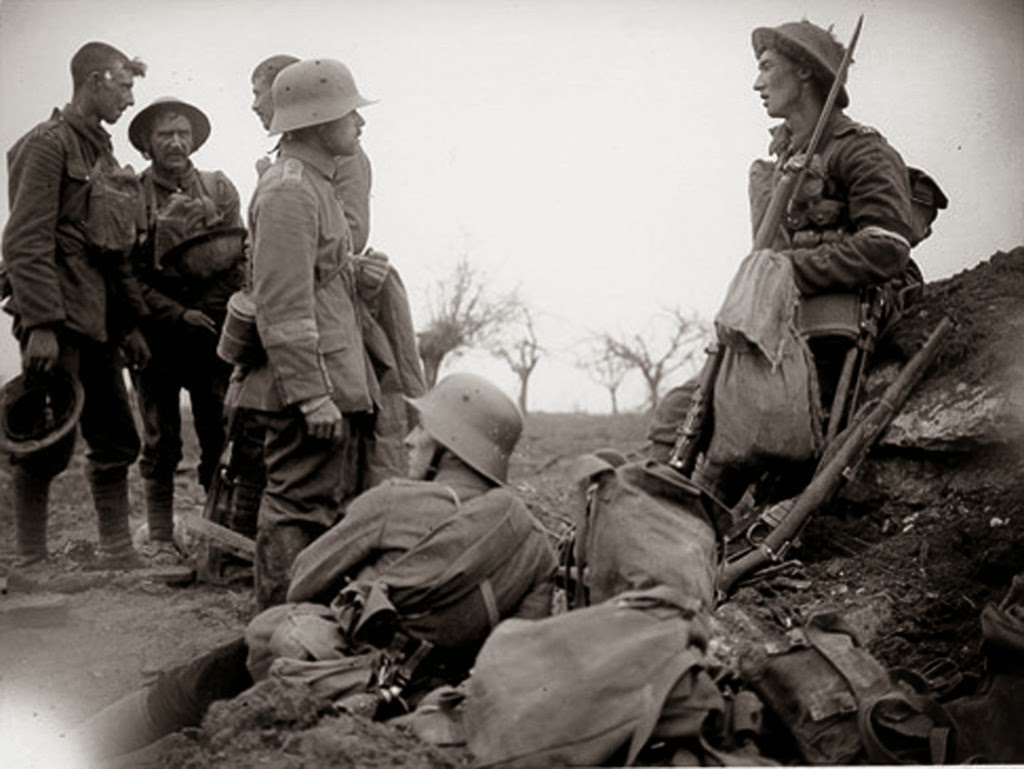
Late in the evening on a dark and gloomy Christmas Eve 1914…in the dank, muddy trenches on the Western Front of the First World War, an odd occurrence happened, briefly peace broke out. It came to be called the Christmas Truce. It remains one of the most storied and strangest moments of the Great War—or of any war in history.
British troops had spent six months fighting the Germans. In a part of Belgium called Bois de Ploegsteert, the British who crouched in a trench that stretched just three feet deep by three feet wide heard German troops singing Christmas Carols.
In the darkness, some of the British soldiers began to sing back and before you say, “Dash away all”, German and British soldiers were meeting in the middle of no man’s land among the barbed wire and shell holes, not to kill each other, but for a moment, to share a bit of peace and good will toward men, even their enemies.
According to journals written on both sides, there were handshakes and words of kindness. The soldiers traded songs, tobacco, and wine, joining in a spontaneous holiday party in the chilly night. According to accounts, small trees were adorned with candles.
Other accounts tell that there were impromptu cease fires all along the front involving British, French, Belgian, and German troops. On the Eastern Front, Austrian, German, and Russian troops participated but on a smaller scale.
For six months the warring factions had experienced great hardships and tribulation. For a brief time, they put the death, mud, homesickness, and poor food behind them.
In a diary, British rifleman, J. Reading, wrote, “Later on in the day they came towards us, and our chaps went out to meet them…I shook hands with some of them, and they gave us cigarettes and cigars. We did not fire (a shot) that day, and everything was so quiet it seemed like a dream.”
Another British soldier, named John Ferguson, recalled it this way: “Here we were laughing and chatting to men whom only a few hours before we were trying to kill!”
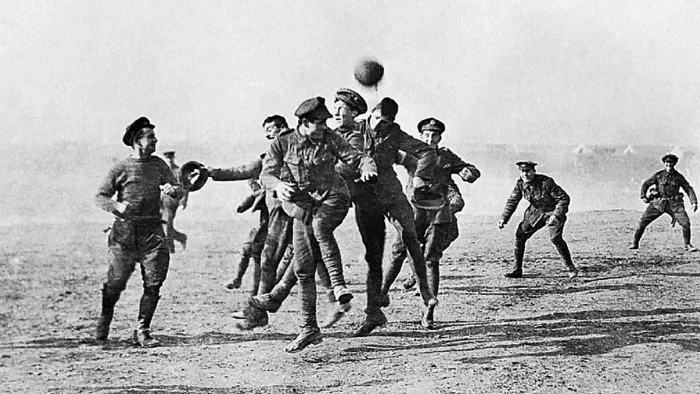
The strangest of the strange, a soccer ball appeared, and a soccer match involving hundreds began. German Lieutenant Kurt Zehmisch of the 134 Saxons Infantry, a schoolteacher who spoke both English and German, also described a pick-up soccer game in his diary. “Eventually the English brought a soccer ball from their trenches, and pretty soon a lively game ensued,” he wrote. “How marvelously wonderful, yet how strange it was. The English officers felt the same way about it. Thus Christmas, the celebration of Love, managed to bring mortal enemies together as friends for a time.”
Not everyone was happy. Both German and British High Command were horrified when the news of the truce found its way into the newspapers. Any further celebrations were banned, and the Christmas Truce of 1914 would not be repeated. Instead, armies would go about doing what they do best, killing themselves in horrific numbers. Some fifteen million would shed their life blood before the guns fell silent on November 11, 1918.
Unless you are involved or have family and friends involved, I think for our own sanity we see wars being fought with game pieces instead of flesh and bone human beings. The Christmas Truce of 1914 should remind us, war is not fought with “forces” but with humans. Christmas should remind us that we are all members of humanity, and that peace should reign. There is nothing humane about war.
To all who read this, and those that don’t. Merry Christmas and Happy Holidays. Pray that those in places of power give peace a chance. Pray that we love and attempt to understand our fellow man. Tidings of peace and good will toward all men and women.
Thanks to the History Channel for providing most of my information and my images.
“Teachers got it good they [teachers] get a great pension they never pay in the social security they get free lunches they only work 9 months a year and have weekends off.” – Facebook PhD
Note to self, don’t read the comments, it will take time out of your life you can’t get back and cause irritations you simply don’t need. Mr. Facebook PhD, “Have you ever used commas or periods?” Names have been changed to protect the mentally deficient.
I feel the need to clarify…no, I feel the need to rant since Mr. Facebook PhD refused to engage. Remember, don’t read the comments!!!!
Teachers do have pensions. In South Carolina where I taught until retirement, we contribute seven percent of our salaries to have a pension. Seven percent. Even after I retired and “double dipped”, a misnomer, I paid seven percent into my pension which didn’t increase my retirement one penny.
We also contribute to our own healthcare after retirement to the tune of $100.00 per month on average. It is, with Medicare, great healthcare unless you are becoming deaf, going blind, or losing your teeth.
Nationwide, most teachers pay into social security although there are some teachers that don’t, about 1.2 million. Their states chose to roll the dice that their state offered pensions would pay better. A few rolled ‘seven come eleven’ and others have thrown ‘snake eyes’.
Free lunches? “There ain’t no such thing as a free lunch” and most teachers have little time to gulp it down anyway. I’m sure there are school districts that provide teachers with free lunches but for over forty years I bought mine or carried a paper bag with a sandwich, yogurt, and a pack of Nabs. Oh, for those days of rectangular pizza slices with a side of corn and a cup of peaches.
I normally ate on the move making sure little Johnny or Jenny Sue didn’t do something stupid. My favorite duty station was restroom monitor…eating my turkey sandwich while breathing in ‘ode de urine’ making sure little Johnny wasn’t lighting up a blunt or flushing someone’s head in the urinal.
The final nail that caught my attention, the fallacy of having three months off in the summers and free weekends. “There ain’t no such thing as a free summer or weekend.” There are courses to be taken, instructional workshops to attend, standards to be reviewed, and yearly plans to be made during the summer…and now you must review your syllabus making sure nothing you teach or none of your reading material suggests CRT, Marxism, or why little Johnny has two dads or two mothers.
Weekends? Papers to be graded, grades to be recorded, and lesson plans that must be turned in first thing on Monday morning.
But what about your planning period? Parents to contact or professional learning communities or data meetings to attend…a quick trip to the restroom? Planning? Rarely does planning happen. Did I mention that most weekday evenings suck too?
As a side note, because many are confused, teachers are paid for the one hundred eighty days they teach and whatever planning days are added in. In our state, South Carolina, it is one hundred and ninety days. Federal holidays? Nope. Summer? Nope. Our one hundred and ninety days are divided into twelve months so that we don’t starve in the summer. Still many must take summer jobs just to supplement their families’ income if they can work it around workshops, we aren’t paid for…or paid little, to attend.
So, while we are paid over the summer, we are not paid FOR the summer. Further note, many school districts are moving to year-round school. Did the pay go up…nope, nope, nope, they are still on site for one hundred and ninety days.
Much is being written and there are myriads of opinions about teacher shortages. Good, experienced teachers dropping out, few new teachers entering the profession. Anyone who slept through my US History class has offered an opinion.
Many teachers have pointed to the increase in lack of respect from politicians, administrators, parents, and students. While lack of respect has certainly increased, it is not new. Teachers have never been recognized as ‘real’ professionals…we aren’t even recognized as real state employees unless it benefits the state.
When I first faced a class of smiling faces some fifty years ago, I was an anomaly of sorts, a male in a profession populated by females. At the junior high school there were only four males on staff. A principal, an assistant principal, a physical educator, and yours truly.
Male teachers were recruited to coach, not to provide mentorship in the classroom unless it was a blue-chip athlete. Coaches with history degrees were a dime a dozen which is why I added a physical science certification to put beans on the table…ridiculously small plates of beans. Yes, I was originally recruited to coach but am proud of my teaching career. I didn’t teach to coach, I coached to teach.
Why might you ask? Teaching was viewed as women’s work, a nice side job to keep the ‘little lady’ out of trouble and supplement the household income provided by the male who ‘did the real work.’ This was an improvement over the days when ‘schoolmarms’ had to quit if they got married. The view that teaching was a side job is one of the reasons teachers haven’t been paid as professionals until recently, if at all. Presently, women make up seventy-five percent of the nation’s teachers.
Another problem in what was once ‘textile country’, you don’t need to have much education to run a machine and uneducated workers don’t expect to get paid as much. “Keep ’em stupid, keep them poor” might have been a mantra.
That belief is a holdover from the textile days which ended in the Eighties and why we have a challenging time finding qualified technicians and engineers to fill our needs. We must recruit from other states and countries to maintain our 24th-place ranking in economic outlook.
Teachers tend to be looked down upon because of the “Those who can do, those who can’t teach” mentality which has been around much longer than the past decade. A family member once asked me in all seriousness when I was going to get a real job. Another asked me when I would graduate from teaching at a junior high school.
Public Education is in decline and parents, politicians and those who believe education should be used to fatten certain people’s billfolds (private schools) are throwing the dirt in its grave. With three hundred thousand teaching vacancies, many states are lowering their teaching standards to allow anyone who can breathe the opportunity to teach. Many parents believe this is fine as long as their schools provide free childcare and a couple of free meals during the day. One more slap in the face of dedicated teachers.
Public education hasn’t helped itself. Bloated administration costs, emphasis on testing instead of problem solving, passing everyone to elevate graduation rates, and a decrease in reading and math skills upon graduation have not endeared public education to certain groups, including me. We continue to lag in math and reading. There are more Facebook PhDs on the horizon, but these won’t be able to add and subtract either.
Add to this toxic brew, the politically motivated accusations of indoctrination, grooming, teaching CTR, teaching Marxism, etcetera, ad nauseum, I understand why good teachers are getting out and teacher education programs are sucking air. I had two choices of callings when I graduated from college. In this environment I would pick the other one.
I would like to emphasize three points that exemplify the problems found in South Carolina. This is an incomplete list.
We have formed a task force in South Carolina at Governor Foghorn Leghorn’s insistence to study teacher recruitment and retainment. There are no presently teaching teachers on the task force. These members are political appointees and the two who have taught haven’t in several decades.
A new state superintendent will be elected this November and one candidate running does not yet have the qualifications to run and no teaching experience. She has never stood in front of a classroom. I pray she will not meet the qualifications in November because in our state, she will be elected because so many people vote straight party ballots.
If education is fully funded in South Carolina this year, it will be the first time in over a decade.
If you want to know what is wrong with education try something different and it is not a task force. Ask a teacher and involve frontline teachers in problem solving…something we’ve really never done and probably won’t. Until then we will exclaim with pride, “Thank goodness for Mississippi.”
To sum up, a quote from former teaching peer, Brent Boiling, “Teachers at *** used to be like gourmet chefs…. creative and free to do their jobs as professionals. Now they’re McTeachers.”
“To eat figs off the tree in the very early morning, when they have been barely touched by the sun, is one of the exquisite pleasures of the Mediterranean.” ― Elizabeth David, An Omelette and a Glass of Wine
I must add, “and one of the exquisite pleasures of the Southern summer.”
Last week I picked my first home grown tomato. I dined on the first tomato sandwich of the season. Both sweet and tart…in the past week I have dined on at least one tomato sandwich daily and have included them in other dishes. One can never get enough of a good thing.
This week I picked my first fig and ate it in the early morning as suggested by Elizabeth David. The fruit was untouched by the morning sun. Covered in dew it was still cool from the nighttime temperatures. It WAS a decadently exquisite pleasure. I picked more than I could eat at one time but for some reason the picked figs I eat later don’t seem to be as decadent as the ones I eat fresh from the tree.
The Brown Turkey Fig I intend to enjoy…now.
My trees, I have two, came from cuttings my grandmother started for me over thirty years ago. She laid a small limb down on the ground and put a rock on it. When roots formed, she snipped it loose from the tree and I brought it home to transplant. Her tree came from a cutting her mother gave her and I am still trying to get a cutting to give my daughter.
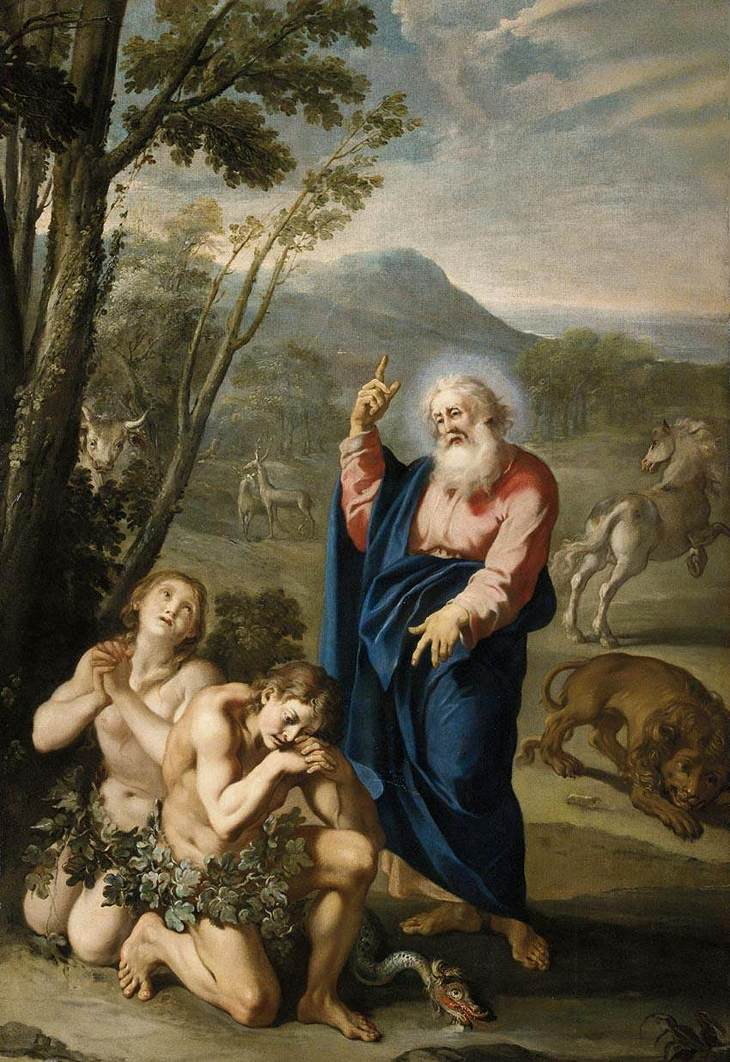
I’ve described the fig as decadent, an odd word to describe the fig considering its religious overtones. Adam and Eve covered their nudity with fig leaves after sampling the forbidden fruit of the Tree of Knowledge of Good and Evil. In western culture the forbidden fruit has been portrayed as the apple.
Considering that the fig was cultivated well before the apple, it is quite possible the apple has received a bad rap. The fig might have been the forbidden fruit Lucifer No Shoulders successfully tempted Eve with…if so, decadent might be a perfect word. The fig or the fig tree is mentioned some two hundred times in the Bible, the apple less than ten.
Okay, for the biologists in the group. A fig is technically not a fruit. It is an inverted flower…whatever that is. If it looks like fruit…tastes like fruit…
In the Quran, the fig is considered THE sacred fruit. Buddha rested under the Bodhi Tree, a fig tree whose DNA still exists after three thousand years. It was under this tree the Buddha gained enlightenment. Both the Hindus and Jains consider the fig a holy fruit. The Greeks so loved the fig they enacted laws forbidding the export of them.
A painting of the Buddha under the Ficus Religiosa. The “tree of awakening”.
As Christianity began to view nudity differently than say…the Greeks, religious paintings and statues featuring nudity were redone, some even destroyed in the attempt. Many fig leaves were added after the fact to cover he and she parts.
I’m not sure David needed a covering for his man part.
My figs are Brown Turkey figs. I don’t know why they are called Turkey figs but guess it might have to do with country of origin. Figs are associated with Greece and Asia Minor was awash with Greeks for a thousand years before the Turks of the Ottoman Empire descended upon them.
I’m sure the Greeks brought their fig tree cuttings with them, fig trees that came from Egypt or North Africa to Crete to Greece and then on to Turkey. These became known as Brown Turkey figs. Turkey is one of the top four fig producers worldwide.
I could be wrong but I’m glad someone brought them to Spain and from Spain to Mexico. From Mexico it was only a turkey’s hop, skip, and jump to California. Spanish Franciscan missionaries brought the fig to southern California in 1520, leading to the variety known as the Mission fig. California produces ninety-seven percent of commercial figs sold in the United States. If you like Fig Newtons, thank the Franciscans.
Ain’t cultural diffusion wonderful!
Brown Turkeys normally have two crops. The first, the crop I’m feasting on now, features large brown/yellow fruit on the outside, light red, almost pink insides. Oh, those insides, sweet and sugary, but not so sweet they set your teeth on edge. One site I was reading described the taste as “decadently sweet, providing flavors of hazelnuts and confectionaries.” I just ate one and didn’t get the taste of hazelnuts. I just describe it as good, especially covered in dew in the pre-dawn light.
The second crop provides more numerous fruits but smaller in size. Fruit that is perfect to wrap in bacon and roast in balsamic vinegar. I mean, figs and bacon are perfect together. I still go out in the pre-dawn and eat a few raw before I harvest.
My figs are a labor of love and of luck. Luck primarily. Our climate is in the foothills of the Blue Ridge and is not conducive for figs. Several times over the past thirty-five years my tree has been killed down to the roots by a late freeze or the first crop decimated by a killing frost.
Despite my worries the tree would not recover, it always has. In some ways it reminds me of my grandmother who somehow recovered for ninety-eight years. I would never describe her as decadently sweet, but she was an exquisite pleasure, and my predawn fig always reminds me of her.
Expulsion of Adam and Eve ~ Aureliano Milani , 1675–1749
“It’s not unpatriotic to denounce an injustice committed on our behalf, perhaps it’s the most patriotic thing we can do.”
― E.A. Bucchianeri, Brushstrokes of a Gadfly
Happy birthday America! Two hundred forty-six years young. The grand experiment…the shining light on the hill…an example for the free world. I think we need a transfusion or take off our rose-colored glasses.
I’m just not feeling it. Oh, I went to the annual Bennett July Fourth eve cookout and gorged myself on ribs, pulled pork, and Carol Ann’s potato salad. But I’m not feeling the patriotism. Even after talking with a young man (57) who had spent the past eighteen years in China, I couldn’t feel it. It was just a backyard cookout to me, and I didn’t stick around for the fireworks. I’ll probably watch the fireworks on TV but then I will think about the fireworks on January 6, 2021,
I’m not feeling July 4, 2022. I am feeling a bit overstuffed from last night. That’s not a good thing either.
The Fourth of July is supposed to be a celebrated, a day to commemorate independence, a day of freedom…”let freedom ring.” It took seven years of war to gain that independence and when the gunpowder cleared there were many still not free. Should I dwell on that?
I try to take comfort in the history of our nation. We’ve rarely been totally united as a nation. Our history is rife with examples of discord, and few examples when we all marched together, in step for a cause. Somehow, we’ve muddled along despite the discord. Well, there was that four-year period during our Civil War. The best I can say is we have a voice that is allowed to express our discord.
The thought really is only responsible for a small portion of my malaise and indifference. I’ve been in my malaise since 2016 and it is darkening. It isn’t my malaise; it is my country’s malaise, my country’s failure to come together on anything. Rare is there common ground. It is us versus them and them are the traitors.
Malaise: an indefinite feeling of debility or lack of health often indicative of or accompanying the onset of an illness. A vague sense of mental or moral ill-being. That is according to Merriam-Webster and sums up how I feel about my country. I fear we are on our death bed.
A post came across one of my social media platforms that gave me pause, “I don’t think America deserves a birthday celebration this year.” That’s what I’m feeling. I’m also feeling that there might not be many more birthdays to celebrate…at least in our country’s present form. America the Beautiful may have an incurable illness and facing life support.
I read a quote made by Ralph Waldo Emerson, “When a whole nation is roaring patriotism at the top of its voice, I am fain to explore the cleanness of its hands and the purity of its heart.” Fain is a somewhat archaic word that means pleased or willing.
I hear and see posts from people who, by their own voice, call themselves “patriots” and point fingers at people with opposing opinions calling them traitors. This accusation is not even implied, it is boldly printed or yelled. It is on their standards as they march on city streets, wrapping themselves in Old Glory, their faces covered lest someone might see who the “patriots” are. I never thought I would be accused of being a traitor for doing what I thought was right…even if that thought was wrong.
These people are wedges. If you ever spent time splitting wood, you know the function of a wedge…to split. I believe people are being indoctrinated, nay…groomed to be wedges. Whomever is responsible is doing a bang-up job. I’ve never seen us so splintered…not since 1968 and I think 1968 falls short of the mark when compared to present day, July 4, 2022.
On a personal note, I used the words indoctrinated and groomed purposely. I see it all the time when reading about the educational shenanigans in my home state. Mostly they are directed toward my former peers, teachers.
Along with Critical Race Theory and the word “woke,” these are dog whistles or buzz words to further turn people against each other. They are used to wedge apart teachers and parents and liberals and conservatives.
To what end? To destroy public education in favor of for-profit private schools? That is what I think. Just “follow the money.” Propaganda ads reigned supreme as “big money” from out of state fueled one of the sides and our deep red state ate it up. The same is true when the government gets involved. I am so happy I’m a retired teacher. I guess I could retire as an American.
Last quote and I’ll quit beating a dead mule.
“… patriotism lies in supporting the values the country is supposed to cherish: equality, life, liberty, the pursuit of happiness. When our government compromises, undermines, or attacks those values, it is being unpatriotic.” Howard Zinn, WW II vet, historian, playwright.
I believe January 6, did just that. January 6th compromised, undermined, and attacked our democracy. As I have watched the congressional committee my depression has grown. I consider myself to be a sane man most of the time. I don’t know how anyone could watch the videos from the January 6 Insurrection and not believe it was exactly that…an attempted insurrection.
It was an attack on our democracy and I believe on some level, planned. I don’t know how you can question what occurred. I don’t know how you can question what the congressional committee has unearthed.
Yet people do. They question the election, the motivations, come up with more and more bizarre theories. My malaise grows when I think that many applauded as they watched it unfold on their televisions.
Happy Birthday these dis-United States of America. I’m not sure you were ever as great as I thought you were but I’m damn sure you are not as great as you could be.
Some will say, “If you are so unhappy, maybe you should move to another country.” Well, my retort is unprintable.
I would be remiss if I did not mention that over half our population lost the right to control their own bodies this past week. I fear more losses will occur.
“Born in the South. Raised in a Glass” – Cheerwine Slogan
The little general store on the winding mountain road caught my eye and without consulting my co-pilot, Quigley Apples, or my navigator, Linda Gail, I slid the Jeep to a stop in front of the ancient gasoline pumps, Gulf with the old clear tops and decorated in blue and orange. There was copious barking, and not from Quigley. My wife did not like being jerked about.
Photo by Kathy Clark
“Signs, signs, everywhere there’s signs”. The store front sported many antique signs, some with bullet holes, but unlike the song, they didn’t block any scenery, they made the scenery. The store reminded me of the image I use for my blog, a colorized version of a depression era general mercantile in North Carolina…except for the Texico pump.
Original photo by Dorothea Lange, colorized by unknown
Once I quieted the snarling from my bride, we made our way into the breeze created by the big overhead fans and the aroma of smashed hamburgers cooking on a gridle with onions. What a glorious smell. Quigley agreed if his nose in the air was an indication. Linda Gail? I’m not sure but her nose wasn’t in the air. She has no affinity for the smell of grilled onions.
What pulled me up short was the ancient Coca Cola ice cooler which, due to its age, had been turned into an ice box. Soft drinks covered in ice, a weep hole drilled into the side to allow the water to drain into a large, graniteware dishpan as the ice melted. With visions of an eight-ounce coke filled to the rim with a package of Lance peanuts, I reached in and got a surprise.
I didn’t pull out a “Dope”, instead my fingers closed around a Cheerwine. Golly, Gee, Whiz, I haven’t seen one of these in a month of Sundays. Well, I don’t get out much and I tend not to choose soft drinks unless it is in a Cuba Libre or Jack and Coke. What a lovely surprise.
Cheerwine has been around since 1917 but for some reason it is scarce as hen’s teeth in my part of the world, or I haven’t been paying attention. Supposedly it is the oldest continuous family-owned soft drink company in the United States, the Carolina Beverage Corporation of Salisbury, NC. The family of Lewis Peeler, its founder, runs it and has for the last one hundred and five years.
From their website, “Cheerwine has a mildly sweet flavor with strong cherry notes, most notably black cherry; is burgundy-colored; and has an unusually high degree of carbonation compared to other soft drinks. The product was named for its color and taste”. According to Wikipedia, the company website also states that “it made sense to name a burgundy-red, bubbly, cherry concoction—Cheerwine.” The far superior, “Retro Cheerwine”, variant is sold in glass bottles and is sweetened with cane sugar instead of high fructose corn syrup. Despite its name, Cheerwine is not really a wine and contains no alcohol. I had scored a glass bottle.
From Zac’s Dinner Menu, Burlington, NC. Note the burgundy color that contains the “strong cherry notes”
As I sipped, I remembered the fountain version sold at the old pharmacy on main street in Monroe, NC that I mixed with another Southern libation Sun Drop. Served with a maraschino cherry, I found it to be better than the traditional cherry, lemon, Coca Cola. There is a drink called “The Whining Pirate” made with Cheerwine and Captain Morgan Rum. I’m getting a bad vibe thinking about praying to the porcelain altar after a few too many Whining Pirates.
The Cheerwine takes me to further memories of the eight-ounce Cokes, Pepsis, and Nehi grape and orange sodas at Pettus Store’s cooler…and the bubble gum machine where a one cent speckled ball got you an eight-ounce nickel Coke for free. With an added nickel I could add a pack of peanuts. Heaven for six cents if I was lucky.
Just for clarification, I used the word “Dope” because the early version of Coca Cola supposedly contained cocaine and the “old folks” called it a “Dope.” Further, if you are in the South and ask for a coke, be prepared to answer a follow-up question, “What kind of coke?” If you actually want a Coca Cola, you should ask for a Coca Cola. The descriptor coke is one of the all-encompassing titles that could include any form of soft drink in the South from Mountain Dews, Sundrops, to Royal Crown Colas. For goodness’ sake, don’t ask for a “soda pop” or it’s shortened version “pop”. You might get run out of town in a northerly direction.
“The Wild West didn’t have much in the way of forensics; when you saw the bullet hole you’d say, ‘That’s prob’ly what kilt ‘im’.” ― P.K. Vandcast
My recent trip to Texas got me chasing a pig trail looking for a “Western” rabbit hole.
I am from a generation that learned Wild West history on the “Silver Screen”, both the large one and the smaller one. Many of the producers of Wild West movies and TV programing learned theirs from “dime novels”, the forerunner of comic books, written about Wild West heroes and outlaws alike, and Buffalo Bill’s Wild West Show which opened to European audiences in 1887. Much that was learned was not actual history.
I admit I also learned Wild West history through authors like Max Brand and Zane Grey. Later I would add Louis Lamour and Elmore Leonard to my list of western authors read. Since…James Lee Burke’s Holland family series has made the list.
Unfortunately, most of that history, while founded on ‘glimpses’ of the real West, is based upon romanticized lies…romanticized because the truth can be quite boring.
William F. Cody, Buffalo Bill, had firsthand knowledge of the West, he was a rider for the Pony Express, an American soldier, bison hunter, and army scout. He even won a Medal of Honor in 1872. It was revoked in 1917 due to a change in military regulations. The medal was won for gallantry, but Army Scouts were “civilian” scouts. It, along with four others, was restored in the 1980s.
Poster from PBS’s American Experience
More to my point, Cody was a showman and knew what was needed to sell tickets. He sold a lot of tickets. His show would run for thirty years, mostly to sold out crowds, even though Cody had to have help mounting his horse during his later years. The show would tour Europe eight times.
The show featured gun fights, bank robberies, cattle drives, battles with Native Americans and a Wild West version of “Ben Hur’s” chariot race, with chuck wagons. Like any good Wild West show, the good guys always won…usually shooting down a “dark hat” with a six gun.
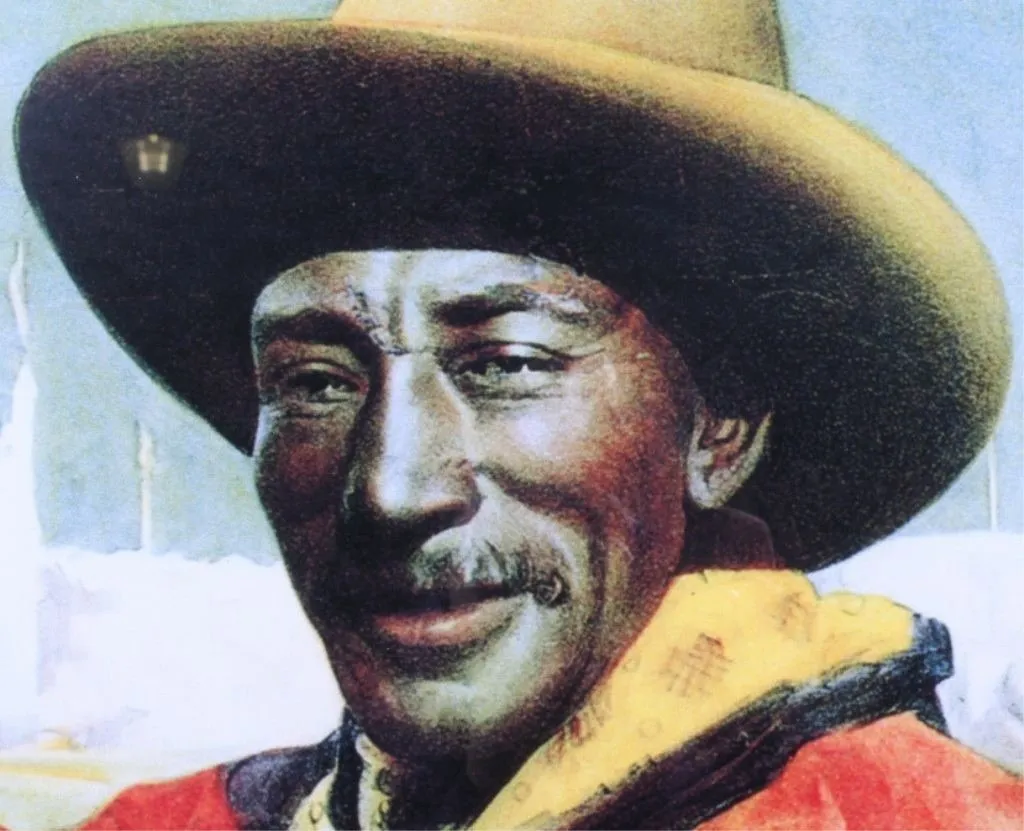
As many as one thousand actors participated in the three or four hour show and included the likes of Ned Buntline, Annie Oakley, Calamity Jane, Wild Bill Hickok, and Black rodeo star, Bill Pickett. Unlike the early movies, real Plains Indians and other Native Americans were employed, along with many women and Mexican cowboys. Sitting Bull, Geronimo, Chief Joseph, and Red Cloud, all toured with the show. Cody was in some ways an equal opportunity employer.
Rodeo star Bill Pickett-Trend Magazine
His show, along with the print media of the time would go on to influence the motion picture industry during its infancy and to a certain extent still does. The romantic Old West is still portrayed today and is just as inaccurate. Lies build upon lies. This is true of the smaller screen, TV, too.
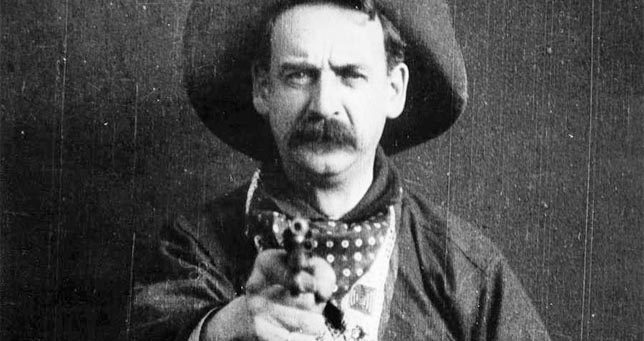
The first motion picture ever made although that is disputed, was “The Great Train Robbery, a1903 American silent Western film made by Edwin S. Porter for the Edison Manufacturing Company. During the radio days, pre-TV, Saturday Matinees featured westerns. In 1949 the first western debuted on TV, The Hopalong Cassidy Show. By 1959 there were thirty western TV shows and another fourteen aired the following year.
Frame from the Great Train Robbery
Most of those shows featured the steely eyed hero rather than working cowboys, Rawhide and a few others excepted. “Good Guys with a Gun”, square jawed, squinting eyes and a bedrock sense of what is right and wrong…and a way to enforce the right…the six gun. Matt Dillon facing the gunslinger at High Noon. Every Friday night, on TV, the bad guy drew first, and Matt still sent him to his just desserts.
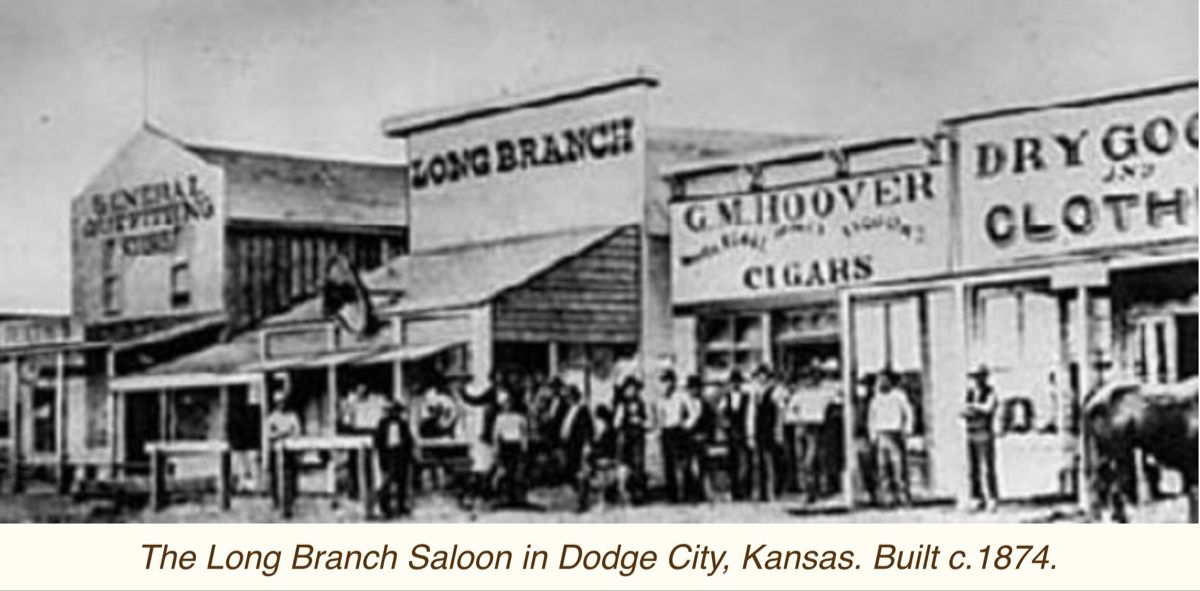
Actual gunfights in the Old West were exceedingly rare, few and far between despite what we would like to believe. Fewer gunfights took place in the middle of the street at high noon. In the cow town of Dodge City, there was only one. There were shootings at the famous Long Branch Saloon but there were no “rules”. Men didn’t face off in the street at twenty paces and the quickest draw didn’t always win.
The famous Gunfight at the OK Corral didn’t take place at the OK Corral, but in a vacant lot behind it. According to all accounts, it lasted about thirty seconds, a gunfight between the bad guys and the not quite so bad guys. Good and bad were not always clearcut in the Old West.
Gunfights were violent affairs where not one, but several gunshots were usually fired. Six shooters were wildly inaccurate. Often onlookers were hit. And unlike in the movies, easy shots were often missed. Often the two shooters just continued firing until they had completely emptied their pistols and called it a day. If no one was hit, drinks might follow with a lot of backslapping. “Belly up to the bar, boys.”
Gun slingers weren’t even called gun slingers. The more authentic terms for the period would have been “gunman”, “pistoleer”, “shootist,” or just “bad man.” The term gunslinger wasn’t used until the 1920 movie, Drag Harlan. The term was adopted by Western writers and movie makers after the fact.
Most experts on the Old West also agree, it was not the “fastest gun” who won. Most gunfights went to the more accurate shot with the coolest head. Those same historians also agree, if you were shot dead it was probably with a rifle or a shotgun…and likely from behind. Like today, long guns, repeaters like the Henry or Winchester, were preferred because of range, accuracy, and rate of fire.
Still, many associate the American West with the “good guy” with a gun, the lone knight in black instead of shining armor ala Paladin in “Have Gun, Will Travel”. A Colt Single-Action tied down against his thigh instead of a sword. Overall, they are both myths, even though with most myths…there are kernels of truth.
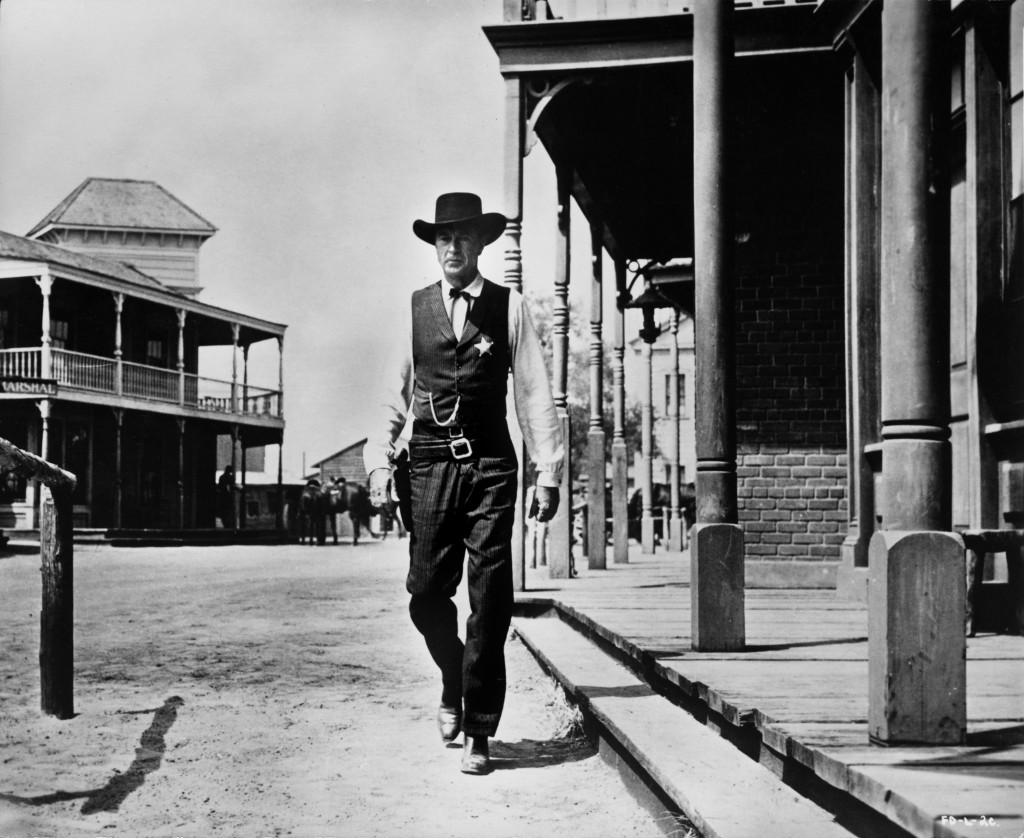
Don’t get me wrong, I love Westerns. “High Noon” with Gary Cooper’s Will Kane I consider to be the greatest Western ever put on film…maybe the greatest film period. Man versus man, man versus elements, man versus himself. A moral dilemma, stay and fight or take his new bride and run. Kane is loyal, brave, and prideful…even when abandoned by his own town.
Will Kane (Gary Cooper) in High Noon ABC News
Will knows that it would be easier if he and his wife merely ran away from killer Frank Miller and his three henchmen, but Kane is emphatic, “They’re making me run,” he says. “I’ve never run from anybody before.” His bride saves the day and Tex Ritter provides a song now playing in my head, “Oh, don’t forsake me oh my darlin’….”
Scenes from High Noon and Oh Don’t Forsake Me Oh My Darlin’ at the end
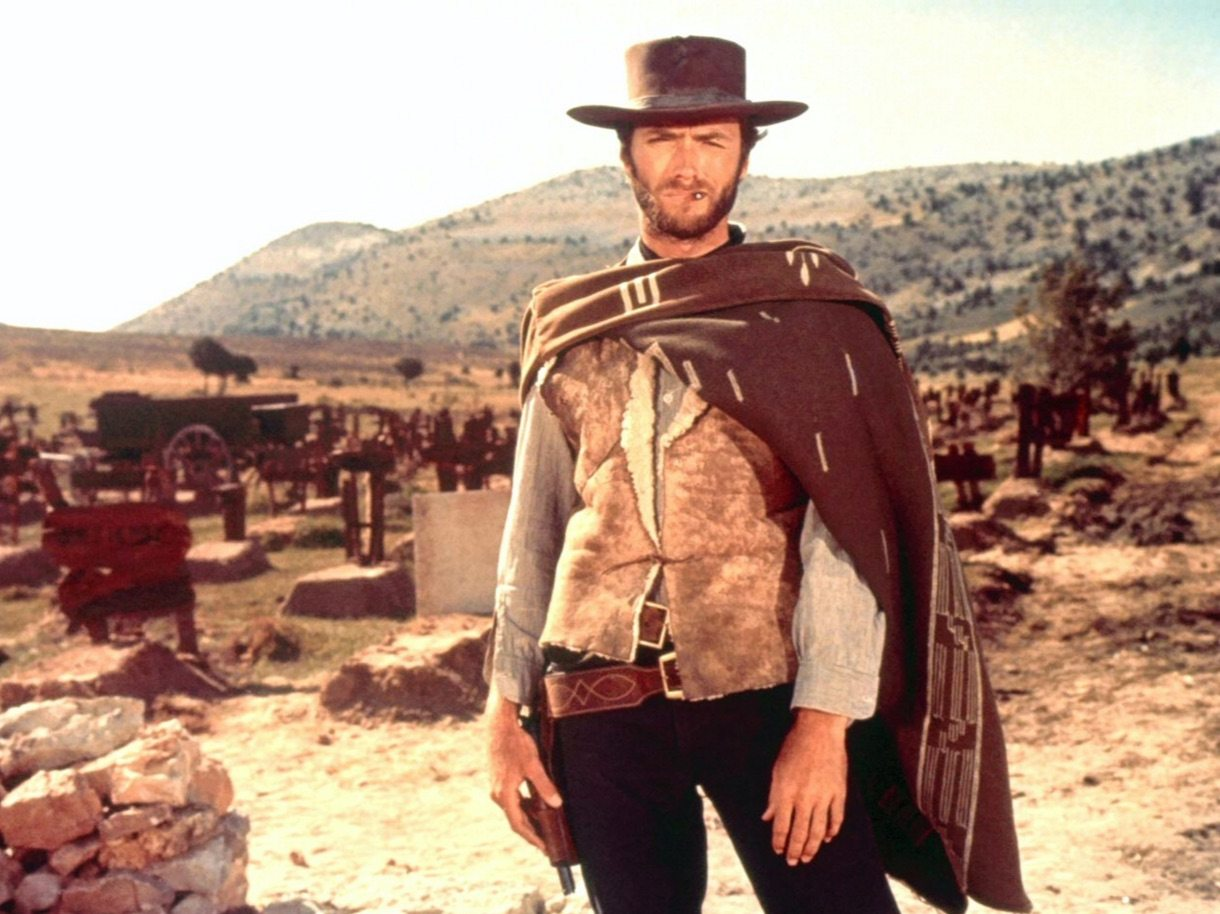
Westerns shouldn’t be remembered just for their inaccuracies. Hollywood has reflected American culture at its best and its worse, against the backdrop of the politics and social issues of whatever time they are produced. I grew up during the Cold War and cowboys were a bit darker than Roy Rogers or Gene Autrey singing as they rode into the sunset. John Wayne in The Searchers and Alan Ladd in Shane are early examples. Clint Eastwood as the antihero “man with no name” in Sergio Leone’s spaghetti westerns. Westerns were uniquely American even when they moved to Italy.
Westerns have provided a vehicle to discuss thorny issues in American history too. Dancing with Wolves, Brokeback Mountain, Django Unchained, The Harder They Fall all made political or social statements.
According to director Quentin Tarantino, “One of the things that’s interesting about westerns in particular is there’s no other genre that reflects the decade that they were made and the morals and the feelings of Americans during that decade [more] than westerns. Westerns are always a magnifying glass as far as that’s concerned.”
I wish our culture weren’t tied so tightly to guns and the fictitious “good guy with a gun”. I have to believe the Westerns my generation grew up with contributed to the mindset. You’re not manly enough if you aren’t willing to settle it man to man with your fists or a gun.
Gun culture is so uniquely American that it is estimated that Clint Eastwood killed almost four hundred victims to the cheers of his adoring fans. According to MovieBodyCounts.com that is good for fifth place on their top twenty-five behind Arnold Schwarzenegger. Don’t despair, Clint was tops in western movies, but John Wayne didn’t make the list. John was more selective about who he killed. Having an internet site devoted to body counts should tell us much about the culture we have created.
Clint Eastwood in a “Fistful of Dollars”
In the American West created by the likes of Max Brand, Zane Grey, or Buffalo Bill, the “good guy with the gun” always wins, kisses the girl…or his horse, and rides off into the sunset. I wish this were true in real life. In real life the good guy is usually out gunned and ends up dead.
“Little roadside restaurant we artfully complain, Rudy tells the waitress that his chicken died in vain” – Opening Lyrics of Jimmy Buffett’s Coast of Carolina
Earlier in the week I made note of the passing of the last, orange roofed, Howard Johnson’s restaurant. Once it boasted hundreds of restaurants along with motels. First the motels were sold off to Marriott, who later sold them themselves. The restaurants were closed until there was only one left standing in St. George, New York. I was surprised to learn that it still existed. I also noted that as a child I referred to it as Howard and Johnson’s. Stupid kid thoughts.
Yes, “Another baby-boomer icon has bitten the dust. The last remaining Howard Johnson’s restaurant, the orange-roofed baby-boomer favorite known for fried clams and twenty-eight flavors of ice cream including both peanut and pecan brittle, shut its doors, bringing down the curtain on a chain that once boasted 1,000 locations across the nation, the Times Union reported. The outlet, in Lake George, New York, closed this spring after almost 70 years.”
I am a baby-boomer, but I am not a gourmet of wine or food…I don’t speak French either. I do know what I like, and Howard Johnson’s was never what I liked…ice cream not included. I can’t remember any ice cream I didn’t like.
I ‘m certainly am not making a definitive epicurean review but when I hear the lyric, “Rudy tells the waitress that his chicken died in vain,” several restaurants come to mind, HoJo being one of them along with the cafeteria style S & S my father and brother and I frequented when we visited my mother in the State Hospital in Columbia.
My mother was part of a study of ALS, known as Lou Gerig’s Disease, at the state mental hospital, less than affectionally known as the crazy house. Our Sunday visit lunch choice was the S & S. I do not have fond memories of the S & S, but it is more about the death of my mother than their food offerings. Well, there was their green Jell-O salad.
Cafeteria style right down to the plastic plates and glasses. Good, cheap food…well cheap at least. With their different food choices and ambiance, I shouldn’t equate HoJo’s and S & S to each other, except their “facture de tarif” should have been accompanied by a gastric SOS. Facture de tarif is bill of fare, but I had to look it up.
Howard Johnson’s died due to the fast-food industry and the lifestyles we are forced to live. Most of us don’t have the means or the time to sit down for even a cafeteria style meal. There are other restaurants that died too, thanks to the fast-food hamburgers and fried chicken…along with some of their fans as ground beef patties fried in fat clogged their arteries.
The first hamburger chain in the States was White Castle, which opened in 1921. It was opened by Billy Ingram and Walter Anderson who started with the first White Castle restaurant in Wichita in 1916. They had a small menu which had cheap, square shaped hamburgers and they sold them in large numbers. The first franchises appeared in 1921 (A&W Root Beer franchised their syrup) and the first restaurant franchise appeared in the 1930s by Howard Johnson.
Johnson didn’t know he was contributing to the eventual demise of his restaurant and honestly it didn’t begin to snowball until the Fifties when the American love for cars became associated with suburbs, drive-ins and in my part of the world, the Hardee’s fifteen cent hamburger that made its appearance during the Fifties and Colonel Sanders’ KFC sold its first franchise in1952.
As bad as I thought Howard Johnson’s food was, it didn’t die because of its chicken dying in vain. It was American lifestyle changes. Well, the chicken might have contributed.
I do feel remorse that another symbol of my youth is gone even though the orange roof had been previously forgotten by me. I also regret all fast food doesn’t taste like Burger King hamburgers smell. But then Burger King hamburgers don’t taste like they smell.
May all your fast-food hamburger patties be larger than the pickle slice topping it and may you not die of a heart attack from eating them.
A little live Buffett for your listening enjoyment. No, not Cheeseburger in Paradise.
“The definition of insanity is doing the same thing over and over and expecting different results.” – attributed to Albert Einstein
As a retired teacher I have suffered over the deaths at Uvalde…and Columbine…and Sandy Hook…and…so many more. Late in my career I participated in “active shooter” drills and helped to produce strategies to counter an attack. We locked our doors even though the only thing between us and an active shooter was a five-eighth piece of sheet rock.
Since the brutal deaths of nineteen students and two teachers in a Texas school, barely a week after the shooting of six, one killed, in a California church, and ten killed in a New York grocery store many have opinions on what needs to be done to ensure the safety of our children and ourselves.
Most of the reactions follow a familiar path, “thoughts and prayers”, media outcries for change, pro-gun rights folks debate anti-gun rights folks including deflection, time passes with nothing happening except more guns are bought until the furor dies, and we are again shocked with the next mass shooting. The debate begins again and honestly…we don’t seem to be as shocked as we once were.
I’ve seen suggestions from arming teachers, my least favorite out of myriads of least favorites, to we must “harden the targets.” That sounds like something from a war zone or a “sh!th@le” country. All ignore the underlying issue. A culture that embraces violence over diplomacy and access to weapons to execute that violence.
Another suggests “evil exists, and laws will not change that.” The next time a highway patrolman pulls me for speeding I think I’ll try that one out. No, I’m not equating speeding to murder, but the comment has me wondering why we have laws at all. Are laws just for honest people?
Let me be fair. It is not just about school, church, or supermarket shootings. It is the drive by in LA, or gang violence in Chicago or Baltimore, or the drunken good ole boy who decides to William Tell a PBR can off his friend’s head and misses a bit low with his hunting rifle.
It’s about four students wounded while walking to their prom. It is about gunfire due to road rage and looking cross eyed at the wrong person. It’s about good old boys strapping AR-15s to their back when they get a coffee at the local coffee shop. It is about a lack of empathy and ignoring the sanctity of life in favor of an amendment.
In 2020, gun violence became the leading cause of youth death’s surpassing automobile accidents. Most were suicides. According to the Pew Research Center, in 2020, 54% of all gun-related deaths in the U.S. were suicides (24,292), while 43% were murders (19,384). The numbers came from the CDC and were backed by other sources. According to CNN, personal safety tops the list of reasons why American gun owners say they own a firearm, yet 63% of US gun-related deaths are self-inflicted.
It is a fact that it took a finger to pull the trigger, the gun didn’t do it on its own, and these Pew and CDC statistics do not reflect accidental gun deaths or where guns were a contributing factor but not the cause of death. It is also true that we live in a gun rich environment. Five percent of the world’s population owns 44-46% of the world’s civilian firearms depending on the study you might be reading. According to a recent CNN study, we own more guns than we have people, one hundred-twenty guns per one hundred people.
According to a Scientific American study in 2015, assaults with a firearm were 6.8 times more common in states that had the most guns, compared to the least. More than a dozen studies have revealed that if you had a gun at home, you were twice as likely to be killed as someone who didn’t.
Research from the Harvard School of Public Health tells us that states with higher gun ownership levels have higher rates of homicide. Data even tells us that where gun shops or gun dealers open for business, killings go up. There are always exceptions to the rule, but some politicians would have you ignore the overall data and quote the exceptions rather than the rule.
In an article by Fortune Magazine published by Yahoo, Gun rights groups spent $15.8 million on lobbying last year, compared to just $2.9 million in lobbying from gun control groups. Beyond lobbying, gun groups have contributed $50.5 million to federal candidates and party committees between 1989 and 2022, with the vast majority going to Republicans. They spent especially heavily in the 2020 election, with $16.6 million in outside spending.
Oh, but the Second Amendment…. I’m not going to debate it except to say that one side always ignores two words, “well regulated.”
Will there be a change after Buffalo and Uvalde? If history repeats, why would I expect there would be change. I don’t believe I am an overly cynical person but why would I expect change? Guns are as much a part of our culture as mom, apple pie, and Chevrolet. Other than exchanging duck and cover drills for active shooter drills little has changed.
Our history is rife with violence, mostly involving a gun. Our country was born from violence and expanded using violence. Do we have a greater propensity for violence than other countries? I don’t know but other countries have done a better job of curbing theirs.
We have violent games, violent movies glorifying the gun and the heroic figure welding it. I’m just as guilty. Several of my novels include violence…gun violence but the good guy with the gun always saved the day…unlike real life.
When I read my comic books, Zane Grey, or Louis Lamoure, I knew it was fiction. James Arness or John Wayne wasn’t really gunning them down in the streets. After I became a history student, I found out their fiction was…based on fiction. There were few gunfights in the streets and the Gunfight at the OK Corral lasted about thirty seconds. My novels are no different.
Other cultures have violent games, movies, and literature, but they don’t have real-life violence like we do here. Maybe we should work to keep guns out of the hands of the violent. Maybe we should look at the underlying issues that lead to violence and attempt to correct them.
It is mental illness. I believe someone who goes out and kills nineteen children is mentally ill…but that doesn’t give him a free pass. Other countries with much lower murder rates have mental illnesses too. Could it have something to do with our health system? Maybe we should work to keep guns out of the hands of the mentally ill.
It is parenting. Probably but why? Single parent homes? Parents having to work multiple jobs leaving their children to their own devices. Cycles of poverty? We don’t seem to care much once a child is born.
Criminals will always find a way…yes probably. Why are we not cutting off access at the source? Gunmakers and smugglers? Everything is done after the murder instead of trying to prevent it. Could it be gunmakers and politicians are making too much money off the sale of legal and illegal firearms?
Maryland was one of the outliers in the Pew study. Strict gun laws but a higher number of gun deaths. Sixty-five percent of the guns used in violence in Maryland that could be traced came from other states with laxer gun laws. I don’t know the numbers but the same can be said about Chicago, I’m sure. Just something to ponder.
Cain killed Abel with a rock. Yep, if the Bible is to be believed. I would rather confront a killer walking around with a bag of rocks than a bag of thirty round magazines and a rifle or pistol to put them in.
Along the same lines, “We’ve taken God out of … fill in the blank.” There are many countries who aren’t considered “Christian Countries” who have much lower gun homicide rates. Research Shinto Japan and while you are at it research their gun laws. Japan has a very violent history at times. Somehow, they decided to overcome it as did other less Christian countries.
It does seem we have lost our appreciation for the sanctity of life…all life. Our hatred for others leads us to violence. Disagreement has become life threatening. Some Christians will say it is because we have become Godless, I will say that some Christians have driven me from organized religion because they are Jesus-less. If you can’t appreciate the Earth and the people who live on it, I want no part of you.
I don’t expect any of this will change anyone’s mind about guns…or violence…or mental illness and I don’t believe any effective change will occur. Gun violence is too engrained in our culture, and we pass it on to our children. I fear it is who we are.
***
For clarification, Albert Einstein had many thoughtful quotes, “The definition of insanity is doing the same thing over and over and expecting different results” was not one of them. The quote, or a similar quote, first appeared in an Al-Anon article in 1981. There is no evidence Einstein ever said it.
“Spring (May) is nature’s way of saying, ‘Let’s party!'” ― Robin Williams
I was informed of a lengthy list of Spring activities happening this weekend. The weekend that includes Sunday’s May 1st… May Day. Thank you “Your Friend Four”, the local news station and their morning anchor for filling me in.
There was not one mention of a May Day celebration or a May Pole. Where has May Day gone? A victim of the Christian Sunday or Christian persecution due to its pagan roots?
If I Google May Day I get celebrations of workers, branded Anarchist, Communist or Socialist by my right leaning friends. If I Google May Pole, I find images of scantily clad ladies hanging from a stripper pole. I wish I were that limber.
There is much to do around the foothills of the Blue Ridge this weekend, but the closest you get to the “spirit” of May Day is the “euphoria Spring Fest presented by Lexus.” When I clicked on their link, the Spring Fest was more about food than the celebration of Spring. It is also a chance to dance around a new Lexus rather than a May Pole, I guess.
I did find one May Day celebration. May Day Faerie Festival at Marshy Point. All Right!!! Now we’re cookin’ with gas…in Maryland you say? Oops.
There was a time. Girls in ethereal, white dresses and flowers woven in their hair, mocking wood nymphs or Spring witches while dancing around a “May Pole”. A bonfire might have been involved. May Day had a decidedly pagan feel to it with good reason. In a time long ago, I celebrated even though as a child I knew not what we were celebrating.
Charles Amable Lenoir – A Nymph In The Forest
The child in me remembers a May Day celebration held in my school’s gymnasium. I was forced to participate by my fifth-grade teacher or our music teacher. I forget which. I suspect they were in cahoots.
Little boys in their school clothes, too long blue jeans rolled up over sneakers, were matched with female classmates dressed in colorful little girl dresses. We were forced to dance, skipping through an arbor covered in fake vines and around the gym floor. The only upside was I was matched with the fifth-grade love of my life that was never to be. How could it have been? Every time I tried to speak to her, I stuttered. I remember choking back a sick feeling, fearing I might throw up as we touched hands.
Later, I went to a fine Southern institution of higher learning associated with the Lutheran Church. May Day and Lutheranism had Germanic roots so it is inevitable we would celebrate May Day. The area my college was founded in was named the “Dutch Fork”. Dutch was a mispronunciation of German in their own language, “Deutsch”.
German immigrants settled in the area between the Saluda and Broad Rivers of South Carolina in the mid-1700s when incentives were offered to European Protestants to go forth and multiply while growing crops in the fertile river bottoms. Unlike the Pennsylvania Dutch, German culture beyond family names and Lutheran Churches has not survived…including, I guess, May Day.
A delivery of a Mayday basket of flowers to First Lady Grace Cooledge in 1927 – Library of Congress
We had a fine celebration at the college. A concert provided by the college band and jazz ensemble along with the choir. Baskets of spring flowers, treats, a Germanic blond coed named as the May Queen…purely a popularity contest…and she was quite popular. There might have been fruit punch laced with alcohol by one of our less than upstanding young men.
We Southerners do love a good celebration complete with a beauty contest and spiked fruit punch. These were the early Seventies, and it seems now like it might have been medieval times. Of course, we had the mandatory May Pole dance with coeds winding streamers around a tall pole anchored in the center of quad…until our Dean of Women got involved. She deemed our liberal arts education as too liberal as it related to certain fertility rites.
Part of a traditional German May Day Celebration-Erster Mai
There are competing theories about the origins of the May Day celebration. The symbolism of the maypole has been debated by folklorists with no definitive answer arriving. Some scholars classify maypoles as symbols of the world axis, others believe maypoles were erected as trees covered with garland and a sign that the happy season of warmth and comfort had returned. These were celebrated by towns people with substantial amounts of food and drink…and bonfires.
Erecting the May Pole – Double entendre? pinterest.com
The fact that these celebrations were found primarily in areas of Germanic Europe has led to the speculation that the maypoles were in some way a relic of a Germanic pagan tradition. I ascribe to this speculation.
A more recent speculation involves the belief that the May Pole represented a phallic symbol and young ladies dancing around it, a symbol of…well, I’ll let you use your imagination. I raise my red Solo cup filled with spiked punch and toast to a fertile Spring.
Our Dean of Women used her imagination when she learned of this, and it did not bode well for the May Pole dance specifically and the May Day celebration in general. She didn’t much like the annual “panty raid” either.
She was the prudish female who proved the stereotype. An older, unmarried woman, small in stature but who had a look and tongue that could cut you off at your knees. I was never comfortable in her presence at all and hoped I would never run afoul of the acid dripping from her tongue. Her influence was legendary and at her insistence May Day celebrations ended.
Supposedly…and, like the origins of May Day, this is up for debate…her comment to our college President included the statement, “If we are going to have young ladies dance around a pole, young men should dance around a hole in the ground.” Legend or rumor? I do not know.
There is something about a good pagan festival… if the animal sacrificed is a pig, slow cooked over hardwood coals. Good clean fun until it isn’t when the barbarians run off with the women folk. Food, drink, a bonfire. My last bonfire with a group of barbarians was several years ago. We were celebrating life and it was early May. It may well have been pagan.
Instead of young nymphs, older folks used clear, unaged alcohol and herbal remedies to relive those earlier days of our youth. Instead of dancing around a May Pole we moved slowly to Jimi Hendrix or Janis Joplin with a little Jerry Butler to mellow things out. The only real difference between then and now was we all left the bonfire about the time we once got going full tilt in those thrilling days of yesteryear.
“In the oddity or maybe the miracle of life, the roots of something new frequently lie in the decaying husks of something old.” ― Craig D. Lounsbrough
As I finished my walk with my best friend the conversation turned toward religion, as it often does. It continued while we drank our morning coffee at a local cafe. For some reason he thinks I’m more versed in this area than I really am. Less versed but our conversation got me thinking. Always an uncertain condition for me.
One of my thoughts was how the conservative, Evangelical Southern Baptist and the liberal, raised Methodist, and Dudeist continue to find common ground. Tis a shame some of our other brothers and sisters in faith can’t find the common ground. All it takes is a little work on both our parts. For clarification I am the liberal, he the conservative.
Later my thinking took me down a pig trail and the mental gymnastics I attempt to avoid. Coming to grips with my own beliefs…or lack thereof. A day of thinking turned into my own form of comedic relief. I realize it may only be funny to me.
April is a month in which the three major monotheistic religions and pagans celebrate important somethings and I found myself doing a bit of research. I am no longer as less versed as I was three mornings ago, but a little bit of knowledge can be dangerous.
Today, as I share this, is the Christian Easter, the most important celebration on the Christian calendar that proclaims Christ’s victory over death and the forgiveness of our sins as we are washed in the blood of Christ. As a child, being washed in the blood of Christ was a bit scary as were many of the stories told to me from the Bible. I still find myself more literal than I should be.
Besides celebrating the resurrection of Christ, we have expanded our celebration to include Easter hams, hot cross buns, new clothes, chocolate bunnies, dyed eggs, and rainbow-colored chicks along with Passion Plays, Easter Masses and Communions. There seems to be a tie in with the Christian Easter and ancient pagan spring festivals celebrating fertility and rebirth. (More on that later)
In accordance with Christ’s teachings, this connection to pagan festivals is perfectly fine with me. Resurrection is a form of rebirth and there are fertile fields of pseudo believers, nonbelievers, and those who have slid back waiting to be harvested. I know, for I am one.
Connected to Easter, Biblically and by the calendar, is the Jewish celebration of Passover, the exodus of the Israelites from slavery in Egypt, which occurs on the 15th day of the Hebrew month of Nisan, the first month of Aviv, or spring. To translate that into English for non-Jews, Passover is celebrated from April 15 through April 23. In Western Christianity, Easter Sunday must always follow the first full moon after the spring equinox which means Easter is celebrated near Passover. In the Eastern Orthodox Christianity, it is a bit more complicated because it involves a different calendar but sometimes, they even coincide.
During the time of The Passover, according to the Book of Exodus, God commands Moses to tell the Israelites to mark their homes with lamb’s or goat’s blood so that the Angel of Death will pass over them. This was the tenth plague placed upon Egypt for keeping the Israelites in bondage. The plague – the deaths of all first-born males except for those protected by the blood.
After the death of all firstborns, the Pharaoh orders the Israelites to leave, taking whatever, they want, and asks Moses to bless him in the name of the Lord. The Passover sacrifice of a lamb or goat recalls the time when the LORD “passed over the houses of the Israelites in Egypt”.
After ten plagues I understand why the Pharaoh might have been happy for the Israelites to leave but he backtracked some seven days later sending his chariots after them and setting up another miracle, The Parting of the Red Sea.
April is also the month of Ramadan for those who practice the religion of Islam. The Islamic holiday of Ramadan began on April 2 and lasts through the month of April. It’s centered around fasting, self-reflection, and prayer, and serves as one of the Five Pillars of Islam central to the religion.
During this month, Muslims can eat before sunrise – a meal called suhoor – and after sunset. The evening meal is called iftar. The month ends with a celebratory feasting holiday, Eid al-Fitr.
Unlike Easter and Passover, the origin of Ramadan is not surrounded by “blood”…that will come later. According to Muslim traditions, in a cave on a mountain, Muhammad was visited by the Angel Gabriel and was told he was a “Messenger” or “Prophet of God”. This was confirmed to Muhammad by a Christian relative Muhammad discussed it with.
Shortly after, Muhammad began to receive further revelations from Gabriel, as well as from the realizations of his own heart. According to hadith, the stories about Muhammad’s life, all holy scriptures were sent down during Ramadan, making these thirty days the holiest in the Muslim religion.
Along with the monotheistic religions I must shout out to my pagan friends too. I know I have one. They are involved in this intersection too and seem to be a fun group. Their calendar was based off the lunar cycles and equinoxes and solstices were important, none more so than the Spring Equinox. I know their lives were hard, but they certainly knew how to throw a celebration. Their Spring festival to the Goddess Oestara or Eostre or Biblically “Ishtar” being just one.
Their Spring celebration is the origin of the Easter Bunny and the Easter Egg except for the pagans it was the ‘moon hare’ that laid the ‘Cosmic Egg’ from which emerged all life. It is a short leap to chocolate bunnies and dyed eggs. The ‘hare of Eostre’ became the ‘Easter Bunny’ and the ‘Cosmic Egg’ became the Easter egg. It is thought that the word Easter morphed from Eostre.
A statue of The Cosmic Egg
Further, in pagan time special cakes were baked as sacrificial offerings to the moon goddess and were marked with an equal-armed cross to divide the cake into four quarters. These represented the four lunar quarters. The cake was then broken up into pieces and buried at the nearest crossroads as an offering. Again, we have a short leap to the ‘hot cross buns’…with a slab of Easter ham resting between two halves. That too is of pagan origins.
Biblically, Ishtar, both the mother and wife of Nimrod, a grandson of Noah, became pregnant and bore a son named Tammuz claiming he was the product of a sunray, which caused her to conceive. But Tammuz grew to be a hunter and was later killed by a wild pig. Ishtar, who claimed Nimrod had not died but became the god, Baal. She designated a forty-day period (the source of Lent?) to mark the anniversary of Tammuz’s death.
During this time, no meat was to be eaten. Every year, on the first Sunday after the first full moon after the spring equinox, a celebration was made. Ishtar also proclaimed that because a pig killed Tammuz, that a pig must be eaten on that Sunday, preferably in a hot cross bun. I added the bun part.
Enough research and intersection. I hope however you celebrate Easter it is a wonderful experience. I am going to have a ham biscuit.
***
A cousin of mine, Sara Howie Hammond, pointed out to me I was remiss in not including the Baha’i Faith, the newest of the world’s revelations, which is celebrating Ridvan which is a twelve-day celebration beginning on April 21. Bahá’u’lláh, the latest manifestation of God, came to unite the people of the world, to eliminate prejudice, and to bring an era of peace and justice to the world. The celebration starts at sundown on the 13 of Jalál, which corresponds to the 20 or 21 of April, depending on the March equinox date. The Ridván Festival is known as the “Most Great Festival” and the “King of Festivals” and it is the holiest festival in the Baha’i faith.
Thanks to Laura Dye for suggesting the site: Folklore, Customs, Legends and Mythology. It was helpful and the basis of my research on pagan celebrations. I might have even copied a bit.
Google supplied the Bunny Rabbit image although it looks just like the semi-tame bunny who lives in my back yard.












 Ravings of a Mad Southerner