Flipping Rocks, Looking for Snakes

“Turn over enough rocks you are bound to find a snake.”- Don Miller
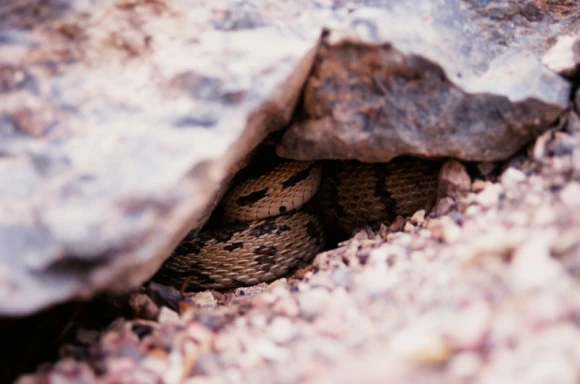
My first real memory as a child is of a late spring/early summer Sunday family gathering. I distinctly remember little boy dress shorts, a dress shirt featuring a little boy bow tie, and colorful socks disappearing into my little boy shoes. It had to be Sunday and I couldn’t have been more than four or five.

Doing my best to be seen and not heard, I sat on a large rock in my grandparents’ front yard watching the adults being seen and heard. My biggest desire was to avoid being chastised for doing something wrong on the Lord’s Day and keeping my Sunday Best clean. I failed. I kept my clothes clean but did get chastised and it has corrupted my views on rocks since.

I saw my grandmother headed my way. There was a purpose in her step, and I briefly wondered what wrong I had committed and forgotten about. It turned out I was doing it, simply sitting on a rock.

Nannie exclaimed, “Boy, don’t sit on that rock. You don’t know, there might be a snake laying under it.”

I remember jumping up as if I had been shocked and becoming really shocked when the rock was moved, to find old Charlie No Shoulders was in fact lurking beneath me. Shocked and forever warped when it comes to rocks hiding snakes.

I can’t tell you how many rocks I have moved, first flipping them to make sure a snake wasn’t hiding beneath it, before carrying it to its new location. I don’t know how many times I heard my grandmother’s voice explaining, “You know there might be a snake laying under it.” I do know, since that day, I have yet to find another snake laying under a rock. Yet I still look.

This memory reminds me of today’s society and all the perceived ills that go with it. How much of our divisiveness as a nation, as a world, is due to social media, news sites, politicians, influencers, provocateurs, and opinionators flipping over rocks looking for snakes. If you flip enough rocks you are bound to find a snake or in today’s world, search hard and long enough, you are going to find something to support your particular cognitive dissonance.

If you find your snake, does this make your dissonance true? No.

I’ve never understood how the “exception proves the rule” but I do understand “the proof of the pudding is in the eating,” If I take bite after bite of pudding and it taste like banana pudding, even to the point of bananas and vanilla wafers being present, I should rightly believe it is banana pudding. The opposite should also be true because the lack of proof is in the eating.

It is the same with flipping rocks. You may assume there are snakes under every rock, but one snake doesn’t make it true that there are snakes under every rock.

What is my point? I see fingers pointing at educators maligning their “wokeism”, using descriptors like brainwashing. indoctrination, groomers, and accusations of teaching Critical Race Theory or its close kin, racist Marxism…that was tongue in cheek. Is there any truth to this finger pointing? Of course. Under some rocks there are teachers doing just that. Is that proof that the vast majority are? No. Most rocks have no teachers teaching anything other than what they are supposed to. The proof is not if certain aspects of CRT find their way into your curriculum. because some will.

I am a retired teacher who primarily, among other courses, taught history. I even used CRT when I taught science. That would be a cathode ray tube. Not funny?

I hope I used certain aspects of Critical Race Theory when I taught history. Blasphemous you say. Woke liberal! (Probably, at least left leaning and I can spell empathetic, and I am alert to injustice and discrimination in society). Groomer? (No, I need a beard and hair trim right now.) Indoctrinator (If it is about historical truth, yes. Yes, I am…if indoctrinator is a word.) Brainwashing (I wouldn’t know where to begin).

Historical truth? Do we teach it, or do we gloss over those uncomfortable areas? I believe that if I were teaching the period from Reconstruction through the Civil Rights era truthfully, I would find it impossible not to teach something that was in line with CRT or the recent Florida ban on teaching Advanced Placement African American Studies. I’d like to point out AP European History and AP Japanese Culture and History are still allowed in Florida. Am I looking for bigots under every rock? No, just in the Florida Governor’s mansion.

Does teaching that millions of African Americans left the South to travel North only to find ‘de jure’ segregation mean I’m teaching CRT? No, but I wonder if I would still find myself under the scrutiny of the Anti-Woke police if I taught redlining, a discriminatory practice in which services (financial and otherwise) are withheld from potential customers who reside in neighborhoods classified as “hazardous”. Could I be hauled off to where left leaning teachers are held prisoner if I dare teach that in 1923 a white mob razed a thriving black community in Rosewood, Florida.  What if I dared to use the words “White Flight” when discussing cities in the late Sixties and Seventies?

I hear many of my right leaning friends say, “Just teach the facts.” I agree but what happens when you move past “who, what, and when” to “how and why?” How do I answer questions like “How or Why did Rosewood occur?” “Why was redlining used to segregate communities?” Answering questions like this will certainly require a teacher to toe a thin line.

I think a certain right leaning political group has created buzz words to send their minions on a crusade to look under rocks for snakes that don’t exist. Certainly, a few do, but that there is a nationwide cabal of educators attempting to indoctrinate your kids is propaganda from the right… unless it is to do their homework or treat their classmates with respect. Is making students aware of certain warts in history really indoctrinating or brainwashing them? I suggest if you have concerns, take the time to look at your state’s teaching standards or drop by your child’s class. I know it is much easier just to pass on the propaganda.

So, Nannie. Once again you taught me a lesson that has stayed with me through the years. I’m just not sure what kind of lesson. I won’t know until I find a rock with a snake under it.

***

It should be noted that history has shown that authoritarians target education in general and teachers in particular. It is a goal of authoritarian leaders to silence the intellectuals. Hitler’s concentration camps, Stalin’s gulags, and Pol Pot’s Reeducation camps were full of teachers, intellectuals, artists, novelists, musicians, and the other educated deemed to be menaces to their policies. There are reasons why schools are taken over by authoritarian governments. This is how future citizens should learn to think for themselves after all. Education that focuses on research and finding truth is scary for authoritarians. Or, as a former president once stated, “I love the uneducated.”

***

Don Miller writes in multiple genres. His latest novel is a fictional historical novel that focuses on The Great Depression and the labor unrest it triggered in the South in 1934. The novel is “Thunder Along the Copperhead” and may be purchased in paperback or downloaded at https://www.amazon.com/dp/B0BJYQ3SSV

The Art of Lookin’ Busy


A big for his age youth sporting a lint covered flattop staggered through his first day at the Springs Mills White Plant.  Staggered because in the first hour the man tasked with teaching the youth the art of ‘takin’ up quills’ attempted to crush the youth’s skull with one of the metal quill cans.  It was the youth’s fault, not the young man’s.  The youth was bloodied and staggered, and it was the beginning of a series of the first day on the job accidents, but that is a story for another time.  Clumsy much?

(In textile parlance, a quill is or was the wooden part of a bobbin the thread is wound on.   The bobbin would seat into a shuttle running perpendicularly to the warp threads. When the thread in the shuttle ended or broke, the bobbin was kicked out into a metal ‘can’ and replaced automatically from a magical gizmo called a battery.  I’m a bit short on the science of it all and you aren’t here for a lesson.  A battery with bobbins is shown below.  The wooden portion of the bobbin is the quill.)

I was the big for my age, crew-cut sporting youngster.  Tall for my age, and I got no taller, I was immature by anyone’s standards at any age.  Big for my age and dumb might have been a requisite for the job I was doing.  A spare hand, I did the jobs regularly employed folks were glad they didn’t have to do or filled in where needed.

I understood hard work having grown up on a farm and having been hired out as farm labor since I had turned eleven or twelve.  Farm labor is hard, but cotton mill labor is a horse of a different color as the old farmers might say.

I had worked at Springs for a week and was worn to the bone…battered and bruised, to the point of tears at various times. The narrow alleyways between the looms left my shoulders marked with scrapes and abrasions.  My body was a skin covered sack of pain.  It was a Saturday and all I could think of was the day off on Sunday…except it would be followed by a Monday when it all would begin again.

When I ran into a much older cousin in the water house I received a life lesson I didn’t know I needed. The water house in mill parlance is a combination bathroom, smoking area, and an escape from the noise and heat of the mill.  An oasis of relatively cool, quiet, and stinky aromas.

As I started to walk out, Charles, a much older cousin who had grown up just below my home, stopped me and put his arm across my sweaty, lint covered, bruised shoulders.

“I been watchin’ you boy,” tapping me on a sore arm with his pointer finger.  Charles was what was called a warp hand who worked out to the tie-in room.  It seemed to me warp hands had a good bit of time for watchin’…or playing practical jokes.  Charles, and his buddy Tommy, were masters at playing practical jokes, “Go down to the parts room and get me a loom stretcher, will you?”   It was the first of many practical jokes endured by the young group of spare hands.  I wasn’t singled out any more than anyone else.

The man in the part’s room cocked his head giving me the side-eye, “Loom stretcher, huh?  Charles sent you down, didn’t he?”  Got me.   

Northrop Loom - Wikipedia

Loom with visible battery and warp.  The warp is the big spool of thread.  A quill can is seen below the battery.  Image https://www.timetoast.com/timelines/industrial-revolution-1750-1900-f8002b6a-a164-4f2c-bea9-a0d54908556d

Back to Charles in the water house.

“You work hard but you got to learn to work smart.”  What Charles really meant was “learn to not work if you don’t have to.”

Beings Charles was an elder I decided I was supposed to listen intently…plus he had a scholarly look going…in a Howdy Doody kind of way.  I really felt I needed to learn how to work smarter.

“This ain’t no horse race and you ain’t learned the art of lookin’ busy when you ain’t.  You got to slowwwww things down.  Shifts are eight hours and you doin’ more than your buck sixty-five an hour.  Whatchu’ do after you finish your quill job?”

“I have to strip quills.”  Nothing provocative, I had to remove the leftover thread from the bobbins so the quills could be reused by the spinning room.

“An what do you do when you get through strippin’ quills?”

I pondered a moment wondering if this was a test, “I don’t know, I’ve never gotten through.”

He popped me on the shoulder as if I had had a major philosophical breakthrough.

“There you go.  You ain’t nevah gonna get through.  You could work a month of Sundays an’ you’ll nevah, evah get through.  The only time you’ll be through is when you die.”

So profound, I pondered too long on his words and Charles began again.

“Pretend you do get through.  Whatchu’ think gonna happen then?”

“They’ll find something else for me to do?”

Shooting me with his pointer finger and thumb, he exclaimed, “Bingo!  You nevah get through or if you do, ole Coley Spinks is gonna come along and give you something else to do.  You got to learn the art of lookin’ busy while doing nothin’, boy.”

Just then, as if to add an exclamation point, Coley Spinks, the second hand walked in.  Folding his Popeye sized forearms sporting the Marine Corp ‘globe and anchor’ tattoo across his ample chest, Coley gave us a head jerk which translated to, “You’ve spent too much time in here, get out and earn you wage.”

Charles scooted out the door with me behind, but Coley planted a flat palm against my chest, jolting me to a stop, “I don’t know what line of bull Charles was spouting but don’t listen to a damn thing he says.”  The age-old disagreement between management and the workers?

“Yes sir, Mr. Spinks.” 

But I did listen to Charlie and endured his harmless practical jokes even if I never quite mastered the art of looking busy or falling for practical jokes.  I practiced a great deal and ran into many fellow workers who had truly turned it into an art form.

I am more of a “git er done, git er over with” kind of guy and I guess it served me well.  Mr. Spinks came to me on my last Saturday before the school year began and proposed, “We’d like you to work Saturdays during the school year if you are a mind to.”  Eight hours of hell for $13.20 before taxes.  “Yeah, okay.  Thanks.” 

I’d work there for three more summers and Saturdays during the school year.  Later, I would work part-time in a cotton mill during my college days.  I never did get done. whether it was stripping quill or some other grunt job, and I ain’t dead yet.  Instead, I moved on to another vocation I never finished until retirement.

It was the mills themselves that died at the end of the last century…something I find saddening.  I would never want to return but I do appreciate the lessons I learned.

***

For more of Don Miller’s shenanigans, visit his author’s page at https://www.amazon.com/Don-Miller/e/B018IT38GM?fbclid=IwAR3EyTJntrwvN_Yq4p_rpDH3Ynurn688xmdNvzJhe_fH7NSBku3Zen-6yb0

The image is of belt driven looms take from one of the Lowell Mills.  https://www.newschoolers.com/news/read/The-List-Newschoolers-Member

Etiquette Lost


“Yes, ma’am, No, ma’am, Thank you, ma’am, Please!”  The little ditty echos inside of my head like basketballs rebounding off of walls.  We’re tryin’ to help our daughter and son in law teach our grandbabies to consistently say “Yes, ma’am, Yes, sir….”  My bride, Grandmommy Linda, is big on this little saying which is why it is repeating over and over again like a never-ending loop.

In the world we presently live in, the learning process is somewhat tougher than it used to be.

Etiquette is not a Southern exclusive but there was a time when Southerners of any class, race, or religious affiliation displayed good manners.  It was a priority.  Our good manners were a badge of pride.  Remember “Southern Hospitality?”  We seem to be less hospitable these days, displaying poor manners.

I don’t mean knowing which spoon or fork to use, outside in folks, but the polite, “good” manners which seem to be eroding as I write this.  Some folks would ask, “Who died and made you Lord of the Manners?”  It’s my blog and I’ll rant if I want to.

When I coached, I periodically admonished my charges to “Remember where you come from (your parents), who you are representing (your parents, your school, me), and what you stand for. (Truth, Justice, and the American Way?)”  In other words, “Don’t disappoint your mommas and daddies.”  Disappointing momma was a big deal.  Good behavior was an expectation and most of the time it was realized.  That included baseball caps taken off inside the building and worn with the bill pointing forward.  I am old school.

It seems we have misplaced our manners and please don’t think I’m denigrating today’s generation; I’m not.  They are not the guilty ones.  Erosion takes place over time and today’s generation reflects what they are being taught and those who taught them…or didn’t.  Some of us are failing our charges, failing the next generation, and this has been going on for multiple generations.

Please don’t point a finger, blow out your chest, and pontificate, “Not me!”  We can all do better and there is no one cause.  That being said….

I happened upon an article in Southern Living, “20 Unspoken Rules of Etiquette That Every Southerner Follows.”  Should have said, “used to follow” but to their defense, it was an old article.

Using today’s world view some of these seemed Draconian.  If you read the article one might think most Southern manners revolve around eating and they do.  I learned most of mine while eating fried chicken, biscuits and gravy, and washing it down with sweet tea so sugary it set my teeth on edge.

I’ll come back to the article in a bit, but I just had a thought.  The undermining of Southern manners may have coincided with the rise of fast-food eateries specializing in fried chicken.  KFC, Chick-fil-a, Popeyes, Spinx…wait…Spinx?

Spinx is a glorified gas station founded in South Carolina offering gas, oil and about anything else you might need to outfit a wilderness trek through the Australian Outback.  Offerings also include slow service but pretty good Southern fried chicken.  You know the kind, crisp and greasy at the same time.

The problem is not Spinx but what I call “stand up food”.  The food rests on waxed paper and you stand around eating out of cute little pasteboard “boats” in red and white checkerboard.  Greasy fingers wiped on dirty jeans; baseball caps still perched backward on heads kind of food.  There’s the problem.  There isn’t a table to learn your manners around and the people you are eating with have no better manners than you do.

Once upon a time, Grandmamma went out and chopped the chicken’s head off, gutted it, dipped it in boiling water and plucked it clean.  All before she got around to cutting it up, dipping each individual piece in the batter of her choice and frying it to a golden brown.  You damn well were going to sit at a table, “minding your manners”, while you ate it.

If you didn’t mind your manners, you might find yourself going to bed without your supper instead of waiting for the adults to be served so you could get your chicken wing.  I was twenty-five before I evah got a pully bone.  Manners have eroded with the death of the sit-down, family meal.

Matching the world we live in, we have become grab and go consumers.  I am just as guilty of grabbing a piece of pepperoni pizza after gassing up my truck…having never left the gas station.

Let’s look at the article, shall we?  I won’t hit all the points because I am assuming you can read as well if not better than I can write.  These are just some “manners” that were hammered into my head…or beaten into my backside.

“Never eat with your mouth open or talk with your mouth full”  Son, you are sprayin’ food everywhere!  At least cover your mouth.  Alternative reminder, “Children should be seen and nevah, evah heard.”

“Get your elbows off the table!  If you are that tired you can go on to bed.”  As I stood in line at the local Chick-fil-a, I saw a bunch of folks who needed a nap.

“Never wear a hat to the table…or inside a building.”  This one…!  For some reason this is the pinnacle of rudeness for no other reason than my father, who worked in a greasy, lint filled cotton mill weave room, always removed his hat when he entered the cafeteria.  It was the polite thing to do and if I didn’t remove mine it might be nailed to my head ala Vlad the Impaler.

Addendum, “Always take your hat off in the presence of a lady…and all women are ladies until proven otherwise.”  If the sun was particularly bright and hot, one might get away with a simple tug on the bill or brim and a nod.  Sunstroke and sunburn trumps manners.

“Never sing or whistle at the table or talk about unpleasantries.”  This one was tough if asked, “Did you behave at school today?”  Sometimes the answer might prove to be unpleasant in regard to the response.  I didn’t understand the singin’ or whistlin’ but never did I….

Addendum for the next eight months, “Nevah, evah talk politics at the supper table.”  Definite unpleasantries.

It seems like there are many Southern manners related to gender, doors, and entries…”Ladies and girls first”, “Always open the door for a woman, a girl or your elders”, “Adult ladies first in the food line”, “Always stand when a woman enters the room (and when she sits, stands or leaves the room} and pull out the chair and help her seat herself.”  Not that she needs help, it is just the gentlemanly thing to do.  I think assisted seatings dates from the days of corsets and layer upon layer of petticoats and crinolines.

I ran afoul of the “opening the door” thing back in the late Sixties when I opened the library door for a cute, little coed.  There was an ulterior motive.  This was during the “burn your bra” period of history.  She burned me a new one and it wasn’t a bra.  Turns out she needed no help from a man.  I knew such but old habits are hard to break.  I still open the door for my wife, and she seems to appreciate it.

“Never go to a gathering empty-handed.”  The South is the casserole and banana puddin’ capital of the world for this very reason.  It doesn’t matter if it is a house warmin’ or a funeral, bring something other than yourself.

Politeness, civility, and graciousness seem to be the casualties of today’s war on political correctness.  Bullying, apathy, and indifference have replaced our good manners.  I don’t know we will ever get them back.  In lieu of manners, just be kind.

Please feel free to add any you are enamored with, in the comments section.  I’d love to hear from you.  Y’all hurry back now.

***

The article may be accessed at https://www.southernliving.com/culture/unspoken-etiquette-rules

Don Miller’s author’s page may be accessed at https://www.amazon.com/Don-Miller/e/B018IT38GM

Deep Impact


If you hope to be successful in life there are people who impact you.  I don’t know how successful I was but I certainly had people who guided me, mentored me, people I wanted to emulate.  Marilyn Koon Hendrix had the impact of a pile driver as far as my life is concerned.

I don’t know what I expected.  I didn’t know how a principal was supposed to act, but “Koon” certainly wasn’t what I expected.  She was a friend, a mother figure…maybe a god figure.  She was the standard I measured all other principals by.

She was certainly the queen of her realm.  Everyone knew who was in charge but not in a heavy-handed way.  No one would accuse her of being a micromanager.  She wanted to lead, taking you along because you wanted to go, not dragging you along because you had to go.

Mrs. Hendrix allowed you to teach or coach in your own way.  She was comfortable allowing you to learn by making mistakes, backing you the first time and expecting you to gain wisdom and not repeat the mistake.  I made plenty of mistakes those first few years and she made sure I learned from them.  My wisdom?  I made sure I didn’t make the same mistake again.

Koon was a big woman or maybe I should say, she had a big presence.  She cast a huge shadow, bigger than life.  To me, she was an Amazon in every way. A deep raspy voice and a hardy laugh she liked to use.  Koon worked hard and she played hard, she expected the same for those who worked under her.  She had an “if it ain’t fun, I ain’t wantin’ to do it” attitude and her attitude translated to all around her.  I tried to adopt her attitude throughout my career, always trying to find fun in what I was doing.

I was young and impressionable trying to soak up as much knowledge and wisdom as I possibly could.  I was a twenty-three or four-year-old child who couldn’t bear the idea of disappointing his parents or Ms. Koon…although I’m sure I did.

The youthful me was “country come to town” when I entered her office for my interview.  It was a casual affair…a sit down on the couch, she in her rocking chair.  A let’s get to know you kind of interview.  I found out we grew up in the same county, she the “huge” metropolis of Lancaster, me in a wide place in the road near a cow patty, eighteen miles north.

I’ve often looked back on that moment.  I’ve often wondered what she saw in an immature hayseed from Indian Land, but she offered me a job teaching Physical Science and coaching and my life’s course had been set.

As the interview ended, I remember she leaned in as if to tell me a secret, instead asking a question, “Do you think you can work for a woman?”  An odd question in today’s era but this was the early Seventies and she was the first female principal in Greenville County.  I wanted the job badly and would have worked for an Orangutan.  No, I never said such and working for a woman was no problem.  Working for Koon was a joy of a lifetime.

If you are successful there are usually one or two people who impact you.  I was lucky…I had many impactful role models just at Mauldin, many who never realized their effect on my life.  Many who are now gone but not forgotten.

I was fortunate, I got to tell Marilyn how much she meant to me a year or so ago.  One person I didn’t get to tell was Jay Lunceford who passed too quickly to tell.  I find it particularly ironic to have learned of Marilyn’s passing on the anniversary of Jay’s.

Saddening but then the memories come flooding in.  I’m not sure how we survived to have memories.  God takes care of the young and stupid.  Oh, the stories I could tell but won’t…some of the people involved are still alive.

Koon will be missed but she’ll never really die either.  I have too much love.  Too many people owe her much…much love.  Too many people have the warm glow you associate with the warm morning sun and with Koon.

I have hopes she and Jay have met up somewhere in the cosmos, telling tales, laughing with each other, reminding us of what it was to be a Mauldin Maverick back in the day. “Do you remember when….”  You bet I do.

Koon, I’ll miss you, but I’ll still be laughing with you, telling tales of those days…the good old days.

***

Clarification:  Jay Lunceford was the head football coach and athletic director at Mauldin High School…and the father figure to Marilyn’s mother figure.  He too had a significant impact on my life.  Unfortunately, he passed way too soon in the late Seventies due to a brain tumor.  I believe he was thirty-two.

Don Miller writes on various subjects and his author’s page may be found at https://www.amazon.com/Don-Miller/e/B018IT38GM

The image is from an old yearbook.  Marilyn Koon Hendrix when she was still Marilyn Koon.  I pray she’s not looking down pointing a finger at me.

Roots….

As we grow, if we are fortunate, we put our roots deep into the deep, rich soil of life.  We anchor ourselves in the lessons we have learned.  No matter how far away the branches of our limbs reach, we are still anchored, still attached…to home.

As I’ve gotten older, old, I find myself slowly meandering back toward my roots, the memories, the lessons, the people of a place that no longer exists.  Not true, it exists quite clearly in my mind.

I was triggered by a rerun of an episode of The Waltons.  John Boy reads an editorial he had written that spoke to family roots and the destruction of an old home in the name of progress.  Before the quote was completed and fully formed in my mind, I was wondering why progress seems to create so much destruction.

Once more, my broken kaleidoscope of a mind sent me down a pathway toward home, a home that only exists in my mind.  A home that was destroyed in the name of progress.  A dusty dirt road, a white clapboard house with hip roofs sitting on a hill, a wide front porch, gently rolling fields of hay and stands of pine trees, people and places gone but not forgotten.

The often-quoted African proverb, “It takes a village to raise a child” comes to my mind.  It was true in the 1950s and 1960s as I grew up and may still be true in some isolated areas.  Unfortunately, the villages have been swallowed up by a monster named Urban Sprawl and the changes in the world we live in have destroyed extended and nuclear families and the pearls of wisdom they might have imparted.

Growing up on my particular wide place in the road, I was surrounded by family on all sides…it seemed I was related to everyone.  Aunts, uncles, and cousins from one side of the family on a hill beside us, aunts, uncles, and cousins from the other side of the family on the hill opposite.  My grandparent’s home sat on a hill above us…looking down to protect and teach lessons for a lifetime.

Further on up or down the road, more family.  On a five or six-mile stretch of highway between my grandparent’s home and my great grandparent’s home it seemed every other house was occupied by a family member, some distantly related, others more closely.  Cousins, aunts and uncles, family friends, all intent upon raising all the village children.

As I moved into my dating years a discussion of who might have been on my family tree was a must it seemed.  Even then I sometimes went out with distant female cousins.  The pool of eligible consorts was very, very small.

The area east of a western meander by the Catawba was sprinkled with small villages.  Most took the name of the church that was close by…or maybe the opposite, the church took the village’s name.  Belair, Pleasant Hill or Pleasant Valley, Osceola, Steel Hill.  In addition to the church, usually, there would be a small general store to serve the smattering of homes around it. These communities tended to overlap and were a part of a bigger area named Indian Land.

There were names like Yarbrough Town or Camp Cox and six or seven miles to the southeast, a true village, Van Wyche.  Northeast there was the town of Fort Mill and right across the river, a true city, Rock Hill.  Additional family members had settled there, raising us too.

When I was young, I didn’t appreciate the “village raising the child.”  It seemed any news of trouble I might have gotten into traveled at light speed, alerting my parents or grandparents before I got home.  Punishment would be quick and decisive…more often than not, it was well deserved. “Whatever you get at school, you’ll get double at home.”

I’m sure time has softened the focus of those days…maybe my memories are of a time I wished to be rather than was.  The front porch probably wasn’t quite as big as I remember but the roots of my family tree have dug deeper into the fertile ground I remember.

The villages are gone, and family dynamics have changed.  Monsters and socioeconomics have changed them.  Few parents can make ends meet on a single salary; others find themselves working multiple jobs.  Latch key children and helicopter parents are a rule, no longer the exception.  Child care is expensive and does little for family dynamics.

Grandparents are working longer and can’t provide or are unwilling to provide the safety net my grandparents provided.  We are unable to go back to those “thrilling days of yesteryear” but must somehow realize children don’t raise themselves.

I’ve got to do a better job of imparting my own lessons.  Actions over words, practice what you preach.  I have grandchildren who are growing up too fast.  I feel I have been somewhat absent, an absence they can’t afford…I can’t afford.  I’m not a village but I have lessons to be taught, stories to be told.  I hope there is still time to teach and to tell…time to impart wisdom and lessons.  Past time to help them put roots into fertile ground.

“Work for a cause, not for applause.  Remember to live your life to express, not to impress, don’t strive to make your presence noticed, just make your absence felt.”     —Gail Lictenstein

***

Don Miller, a retired teacher, and coach writes on various subjects.  His author’s page may be found at https://www.amazon.com/Don-Miller/e/B018IT38GM

The interesting image is a drawing by Jillian Deluca and may be purchased at https://www.saatchiart.com/print/Drawing-Deep-Roots/985383/3619990/view